
How to Become an NEMT Driver
Contents:
- What Is an NEMT Driver?
- NEMT Driver Requirements at a Glance
- Valid Driver’s License and Clean Record
- Experience as a Driver or Worker in a Healthcare Setting
- Top-notch Customer Service Skills
- Formal Training and Additional Qualifications
- Improve Drivers’ Trips With Non-emergency Medical Transportation Software
What Is an NEMT Driver?
An NEMT driver is a licensed, background-checked professional who transports non-emergency patients to and from medical appointments, dialysis, rehabilitation, and other healthcare services in an ADA-compliant vehicle.
Passengers typically include Medicaid beneficiaries, Medicare Advantage enrollees, and members of managed care organizations who cannot drive themselves or use standard public transit. NEMT drivers are not emergency medical technicians and do not deliver clinical care. Their job is safe boarding and deboarding, correct wheelchair or stretcher securement, and reliable on-time transportation.
Non-emergency medical transportation is a covered Medicaid benefit under 42 CFR 440.170(a). The same regulation requires that "transport personnel are licensed, qualified, competent, and courteous" (42 CFR 440.170(a)(4)(i)(B)), which is the reason NEMT drivers face background, training, and vehicle standards that go well beyond what rideshare or taxi drivers meet.
NEMT Driver Requirements at a Glance
|
Requirement |
Detail |
|
Driver's license |
Valid state license. CDL (Commercial driver's license) only if vehicle gross vehicle weight rating (GVWR) is 26,001 lbs or more, or seats 16+ passengers (49 CFR Part 383). |
|
Motor vehicle record |
Clean MVR (motor vehicle record), pulled annually. |
|
Age |
At least 21 for most broker networks. Some states permit 18 for intrastate work. |
|
Background checks and drug screening |
Criminal check, sex offender registry, pre-employment drug screen. |
|
Physical exam |
DOT medical certificate (Department of Transportation) (49 CFR 391.41) for CDL vehicles; provider-administered physical otherwise. |
|
Training and certification |
CPR and First Aid, defensive driving, passenger assistance. |
|
Regulatory awareness |
HIPAA familiarity for handling protected health information encountered in transit, and ADA compliance duties under 49 CFR Part 37 covering wheelchair boarding, four-point securement, and non-discrimination. |
Valid Driver’s License and Clean Record
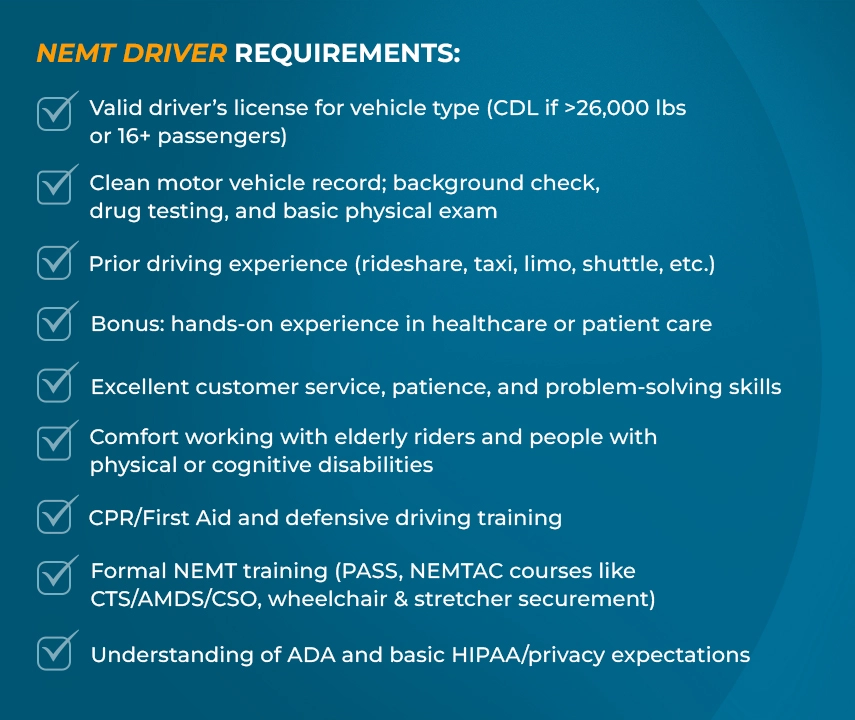
It goes without saying that as a driver, you’ll need a valid driver’s license that matches the type and weight of the vehicle you will be operating. A CDL (commercial driver’s license) is required if the vehicle exceeds 26,000 pounds or is carrying 16 or more passengers. On top of that, you’re in a great position if you have a clean motor vehicle record. One or two speeding tickets might not completely hinder your ability to get the job, but if you’re up against another driver with a sparkling clean record, you can probably guess who will get the job. Anything beyond a couple minor offenses will almost certainly deem you unfit for the position. Most providers and Medicaid brokers will also request a basic physical exam, run a criminal background check, and conduct regular drug testing.
Experience as a Driver or Worker in a Healthcare Setting
 Experience may not be necessary, but as we all know, it always helps. If you’ve worked as a driver for a company before, even if it was a ridesharing or limo company, you still have experience in the industry. However, NEMT is very different and requires a more critical level of attention and care. If you have experience working in the healthcare industry, specifically at a hands-on level with patients, you’ll stand out when it comes time to submit your application.
Top-notch Customer Service Skills
As an NEMT driver, your customer service skills can be nothing less than excellent. Drivers should be patient, understanding, and willing to find a solution to every problem. Many passengers are elderly and/or have physical or cognitive disabilities that require extra attention, so drivers need to be prepared to handle any situations that come their way.
Formal Training and Additional Qualifications
The NEMT industry aims to standardize itself and elevate the quality of service to deliver value over volume to the healthcare system. Therefore, beyond a clean license and strong people skills, an NEMT driver candidate should also look into formal training to improve the chances of employment.
Today, many medical transportation providers treat CPR/First Aid certification and defensive driving training as standard, especially for those trips that involve higher-acuity passengers. Heartsaver® First Aid CPR AED Training developed by the American Heart Association (AHA) teaches how to provide first aid, perform CPR, and use an automated external defibrillator. The aim of defensive driving training is to increase driving safety, reduce collisions, and reinforce risk awareness among NEMT professionals.
Formal medical transportation training may involve multiple programs. Among them is Passenger Assistance, Safety and Sensitivity (PASS) developed by the CTAA (Community Transportation Association of America), and various NEMTAC courses. The latter includes a Certified Transport Specialist (CTS), Advanced Mobility Device Securement™ (AMDS), and Certified Stretcher Operator™ (CSO). These training programs teach NEMT drivers how to assist passengers, deliver the safest and most sensitive transportation services, secure wheelchairs and stretchers in transit, and use other ADA mobility equipment.
Finally, in addition to the abovementioned qualifications, if a driver is familiar with HIPAA standards, then he or she becomes an even more attractive candidate for employers.
Improve Drivers’ Trips With Non-emergency Medical Transportation Software
NEMT drivers face challenges every day, from finding the best routes to dealing with trip cancelations and no shows. Non-emergency medical transportation routing software is the solution to these problems and so many more. Get in touch to book your free RouteGenie demo today, and see the difference software makes!
FAQ About NEMT Drivers
What is an NEMT driver?
An NEMT driver is a licensed, background-checked professional who transports non-emergency patients to medical appointments in an ADA-compliant vehicle. Passengers typically include Medicaid beneficiaries, Medicare Advantage enrollees, and managed care members who can't drive themselves. The role is regulated under 42 CFR 440.170(a).
What is the difference between an NEMT driver and an EMT?
An EMT is a state-certified emergency clinician who responds to 911 calls and delivers on-scene medical care. An NEMT driver transports stable, non-emergency patients between homes and healthcare facilities and does not administer clinical treatment. Duties center on safe boarding and WC18-compliant wheelchair securement.
Do NEMT drivers need a CDL?
Most NEMT drivers don't need a CDL. It's only required if the vehicle has a gross vehicle weight rating of 26,001 pounds or more, or is designed to transport 16 or more passengers including the driver (49 CFR Part 383). Standard sedans, minivans, and most wheelchair-accessible vans fall below both thresholds.
What qualifications do you need to become an NEMT driver?
The baseline is a valid state driver's license, a clean motor vehicle record, a passed background check and drug screen, current CPR and First Aid, and passenger assistance training. Federal Medicaid rule at 42 CFR 440.170(a)(4)(i)(B) requires transport personnel to be licensed, qualified, competent, and courteous but doesn't name a specific certification. In practice, national brokers including ModivCare, MTM, and SafeRide require NEMTAC's Certified Transport Specialist (CTS) or CTAA's PASS. Wheelchair drivers also need NEMTAC's Mobility Device Securement (MDS, formerly AMDS), and stretcher drivers need Certified Stretcher Operator (CSO).