
How to Find the Best NEMT Vehicles for Your Business
Contents:
- How to Select the Right NEMT Vehicle
- What Vehicles Should You Consider?
- Set Your Business Apart With NEMT Software
How to Select the Right NEMT Vehicle
If you’re just starting out, it’s good to have one or two reliable NEMT vehicles until you grow a little. While you can choose from a variety of styles and sizes, including minivans, full-size vans, and buses, it’s probably realistic to start out small. This way, if you get a handful of regular customers, a minivan or full-size van should do the trick until you find a bigger customer base. Some important things to keep in mind are additional assets you may need within the vehicle. For starters, a wheelchair. You’ll have a wheelchair-accessible vehicle, so having a few extra wheelchairs on hand is a good idea. Additionally, equipment like walkers, gurneys, and oxygen tanks are other devices you should consider having on hand. While the vehicle is your main priority, it won’t be useful if it’s not equipped with the appropriate tools for your passengers.
What Vehicles Should You Consider?
The most important thing to keep in mind as you begin your vehicle search is accessibility. For the most part, your patients will be those living in nursing homes, assisted living facilities, and other environments that make them vulnerable. Making sure the vehicles you choose can accommodate a variety of people, including those who need wheelchairs and walkers, and people who require oxygen tanks or gurneys. Below, we outlined the types of vehicles that will best serve your needs, along with some popular makes and models of each kind.
Wheelchair Accessible Vans
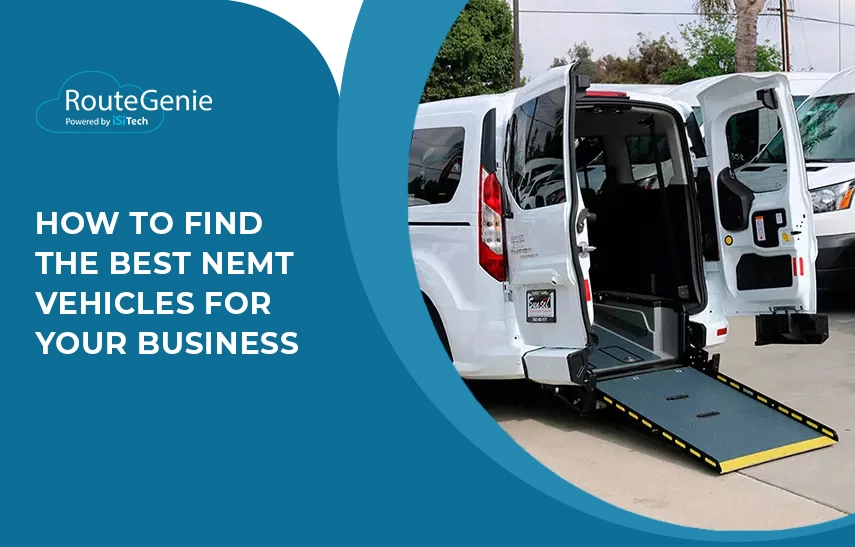
Your vans should be wheelchair accessible for your passengers. Depending on the size you want, there are a couple different popular options:
Ford Transit: This vehicle is a full-sized, wheelchair and gurney van, available in a variety of floor plans. The Ford Transit seats up to 8 passengers, including 1 or 2 wheelchairs.
RAM ProMaster: This vehicle has a lift capacity of 800 pounds and is available in two different lengths and roof heights. Seating can be shifted around when needed for a few different floor plan options.
Rear access wheelchair ramps
Dodge Grand Caravan Legend II: With this vehicle, you can seat 2 wheelchairs and up to 7 passengers. The van allows the operator to control what height the van lowers to. You can also remove seats to make more room for wheelchairs when necessary.
Ford Transit Connect: This vehicle seats 5 passengers and 1 wheelchair.
Stretcher Van
Ford Transit 150: This ADA-compliant vehicle is equipped with hardware that secures a gurney in the vehicle for a safe trip.
Set Your Business Apart With NEMT Software
Once you have your vehicles, it’s time to book some trips. As you get more customers and develop a process, you’ll probably find that scheduling, routing, dispatching, and billing is a lot of work when done manually. That’s why we recommend looking into an NEMT software as soon as possible. Software like RouteGenie automates the entire process for a simpler, money-saving operation. If you’re interested in seeing how RouteGenie can help your business, reach out to our team today!
Most Asked Questions About Medical Transportation Vehicles
How much does a NEMT vehicle cost?
NEMT vehicle cost depends on trip type. Ambulatory service can use almost any car and is typically the cheapest. A used wheelchair-accessible van can start around $12,000 for a roughly 7-year-old model, while stretcher-capable vehicles can run $50,000+. Add ADA and mobility conversions, which often add $10,000 to $35,000+ and can reach $60,000+ for lowered floors or advanced lifts.
What is the best vehicle for non-emergency medical transport?
For most NEMT operators, the Toyota Sienna is one of the best all-around choices because it handles the majority of trip types, is reliable, affordable to run, and has a long track record in fleet use.
How much can a non-medical transportation company make with one vehicle?
A single non-medical transportation vehicle can gross roughly $5,000 to $15,000+ per month, depending on your rates and how many trips you run. After fuel, insurance, maintenance, and any driver pay, many operators net about $1,000 to $5,000+ per month with a hired driver, or $3,000 to $10,000+ per month if the owner drives and utilization is strong.
What types of vehicles are typically used for NEMT services? short faq answer
Most NEMT providers typically use minivans for ambulatory and assisted trips, wheelchair-accessible vans with ramps or lifts for wheelchair riders, and stretcher-capable vans for non-emergency stretcher transport.