
Do NEMT Vehicles Need DOT Inspections?
Do NEMT vehicles need DOT inspections? Are medical transportation businesses subject to DOT regulations? The short answer is: it depends. At the federal level, most NEMTs are exempt from these inspections. However, the reality of the Department of Transportation regulations is more complex. States have their own DOT-like inspection mandates that apply regardless of what the federal government requires. Moreover, broker contracts add a third layer on top of both. In this article, we will cover all of these details to resolve the ambiguity of DOT and FMCSA regulations in NEMT once and for all.
Contents:
- Who/What Are DOT And FMCSA?
- What Triggers Federal CMV Status
- Where Most NEMT Vehicles Land
- State-Specific DOT Requirements That Matter For NEMT
- Bonus Data: If Your NEMT Vehicles Do Qualify As CMVs
- Broker Contracts And ADA Requirements Can Be As Strict As DOT
- NEMT Software Is Essential To Stay Compliant
Who/What Are DOT And FMCSA?
The U.S. Department of Transportation (DOT) is the federal agency overseeing all transportation safety. The Federal Motor Carrier Safety Administration (FMCSA) is the DOT division that specifically regulates commercial motor vehicles. These agencies set the rules for inspections, driver qualifications, hours of service, and operating authority across the entire nation. When medical transportation providers talk about "DOT inspections" or "DOT numbers," they're typically referring to FMCSA's programs. State DOTs (like NYSDOT or PennDOT) operate separately under their own authority.
What Triggers Federal CMV Status
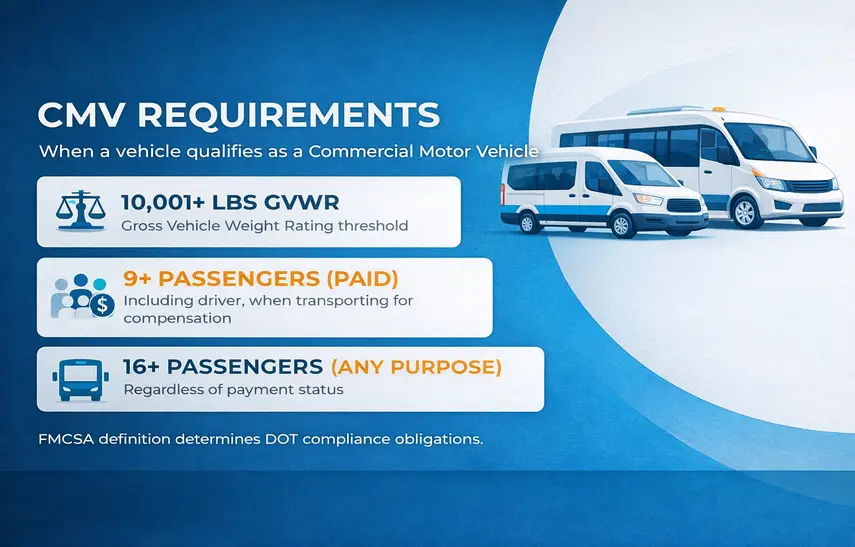
To become subject to DOT inspections, an NEMT van must qualify as a Commercial Motor Vehicle. Under 49 CFR § 390.5 of the Code of Federal Regulations, this status needs three conditions:
- a gross vehicle weight rating of 10,001 lbs or more
- designed to carry 9 or more occupants (including the driver) for compensation
- or designed to carry 16 or more occupants regardless of whether they're paying
If any one of these thresholds is reached, the DOT regulations come into effect. A large van designed to carry 8 passengers plus a driver hits the 9-occupant threshold, even if the vehicle weighs well under 10,001 lbs.
Where Most NEMT Vehicles Land
The good news is, if you run the numbers against the abovementioned federal thresholds, most NEMT fleets come out exempt:
- Sedan (~4,000 lbs GVWR, 1–4 passengers): exempt
- Converted wheelchair minivan (~7,000–8,500 lbs, up to 7 passengers): typically exempt
- Stretcher van (~8,000–9,500 lbs, 1–2 patients plus crew): typically exempt; passenger count stays well below 9
The standard NEMT operation doesn't meet any federal CMV definition. So for such vehicles, federal mandates do not apply, meaning that no annual USDOT inspections are required, providers do not have to complete hours-of-service logs, and the drivers avoid the federal drug testing mandate.
So is that it? There are no DOT regulations in NEMT? No, the reality is more complex, and we still have a lot of ground to cover. The devil is in the states. States impose additional or parallel requirements for intrastate operations. Moreover, later in this article, we will also go over DOT standards for the larger CMVs that cannot avoid federal DOT mandates.
State-Specific DOT Requirements That Matter For NEMT
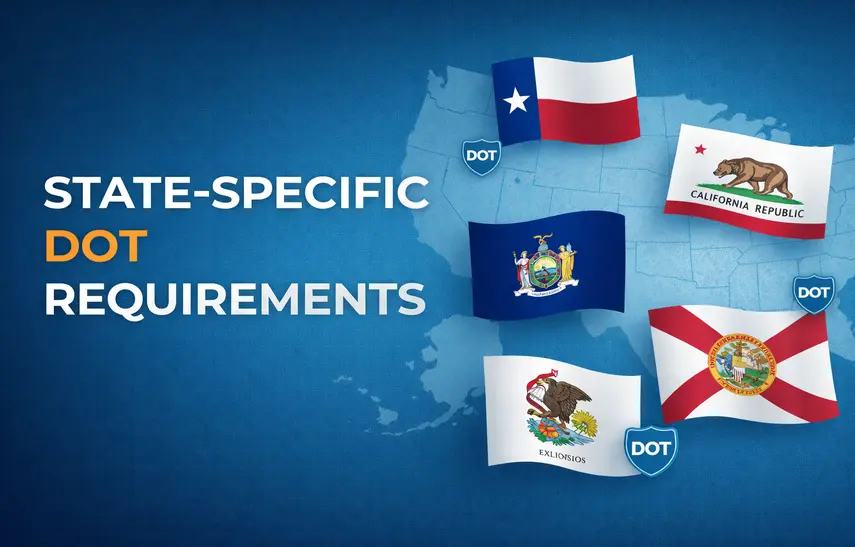
Federal exemptions are clear, but they set the regulatory floor, not the ceiling. Most NEMT vehicles fall below federal CMV thresholds entirely, so state-specific DOT rules layer on top of the Washington standard. Some states qualify NEMT vans as ambulettes and have built full parallel licensing systems that apply to every NEMT vehicle regardless of size or weight. Others choose to enforce vehicle and driver standards through Medicaid program rules. A few layer both.
Before you start a medical transportation business, contact your state DOT and Medicaid agency directly. Here we will give you a glimpse of the states that combine large NEMT markets with the strictest state-level requirements in the country:
New York (NYSDOT)
The most layered NEMT framework in the country. Providers need NYSDOT operating authority plus semi-annual vehicle inspections covering 400+ safety factors. Drivers fall under Article 19-A: biennial physicals, annual record reviews, and FMCSA-standard drug testing. NYC adds TLC licensing on top.
California (CA Public Utilities Commission)
A CPUC TCP permit is required for every for-hire NEMT provider regardless of vehicle size. Drug and alcohol testing applies to all drivers statewide, including those driving vehicles below federal testing thresholds. Insurance minimum is $1.5M CSL (Combined Single Limit). Short-haul exemption runs at 100 air miles, not the federal 150.
Texas (TxDMV)
All for-hire NEMT vehicles need TxDMV livery plates and annual DPS safety inspections. Drivers must complete a state-approved certification program with written and practical tests, plus FBI/DPS fingerprinting. Medicaid providers go through a separate HHSC enrollment with ongoing recertification.
Florida (Florida Department of Highway Safety and Motor Vehicles)
A Certificate of Public Convenience and Necessity is required, processed at the local government level. Requirements vary by county. Minimum liability is $300,000. CPR certification is required statewide. Florida is the second-largest Medicaid NEMT market in the country by volume, and FHP actively enforces commercial vehicle standards on major corridors.
Pennsylvania (PA Public Utility Commission)
Providers need approval from both the PA Public Utility Commission and the Department of Human Services. For-hire passenger vans are subject to semi-annual PennDOT inspections. An insurance lapse triggers a $500 penalty and mandatory plate surrender.
Minnesota (MnDOT)
MnDOT certifies all NEMT providers under its Special Transportation Service program, requires a USDOT number regardless of vehicle size, and conducts annual and random inspections.
Virginia (DMAS)
DMAS publishes detailed driver and vehicle standards requiring current state safety inspection on all vehicles, mandatory PASS certification for every driver category, and Virginia State Police background checks before any driver transports a member.
Other states
Ohio: oversight is split across four agencies; annual ASE-certified inspections and daily wheelchair vehicle pre-trips are required.
Michigan: MDOT conducts annual commercial passenger vehicle inspections plus CVSA Level V for vehicles over 10,001 lbs.
Illinois: Medicaid enrollment through DHFS with background checks, drug testing, and ICC operating authority.
Oregon: Portland adds city-level vehicle and driver certification on top of state rules.
Bonus Data: If Your NEMT Vehicles Do Qualify As CMVs
If your medical transportation fleet (or a part of it) crosses into CMV territory, then federal requirements kick in fully:
- Annual vehicle inspections
- Driver qualification
- HOS (Hours of service) limits: maximum 10 hours driving, maximum 15 hours on-duty, with required off-duty periods and weekly hour limits
- ELD (Electronic Logging Device) requirement for operations, but there is an exemption for drivers who operate within 150 air miles of their home base and return there within 14 consecutive hours
- USDOT number displayed on both sides of the vehicle in letters legible from 50 feet
Broker Contracts And ADA Requirements Can Be As Strict As DOT
If you operate within a state with lighter oversight from the federal and local authorities, you still face inspection and compliance requirements through broker agreements. ModivCare, MTM, and other major brokers contractually impose drug testing, background checks, vehicle inspections, and insurance minimums that mirror federal CMV standards. These apply regardless of vehicle size, state rules, or whether the provider runs a single van.
Moreover, for providers who work with Medicaid or Medicare passengers, ADA standards become one more goalpost to reach. NEMT statistics confirm that the majority of NEMT rides are taken by these people; therefore, ADA compliance is nearly non-negotiable.
NEMT Software Is Essential To Stay Compliant
Compliance in NEMT can be elusive and spans across multiple regulatory layers: DOT requirements, state inspections, broker credentialing, and ADA standards. Missing a renewal date, letting an inspection lapse, or losing track of a driver's certification can cost you a broker contract or trigger a Medicaid audit.
RouteGenie helps providers stay ahead of it. Fleet maintenance tracking, driver document management, trip documentation, and billing tools are all built into one platform, so your records are audit-ready without the manual scramble. Book a RouteGenie demo to see how it works for your operation.
About the author


Serhii Taborovskyi is the founder and author of the Automotive Territory YouTube Channel, with 300,000 subscribers and counting. He is an avid automotive enthusiast and a fan of any and all motorized vehicles. Serhii is a visiting author at RouteGenie, sharing his expertise for the benefit of the NEMT community.