
How Much Do NEMT Companies Make?
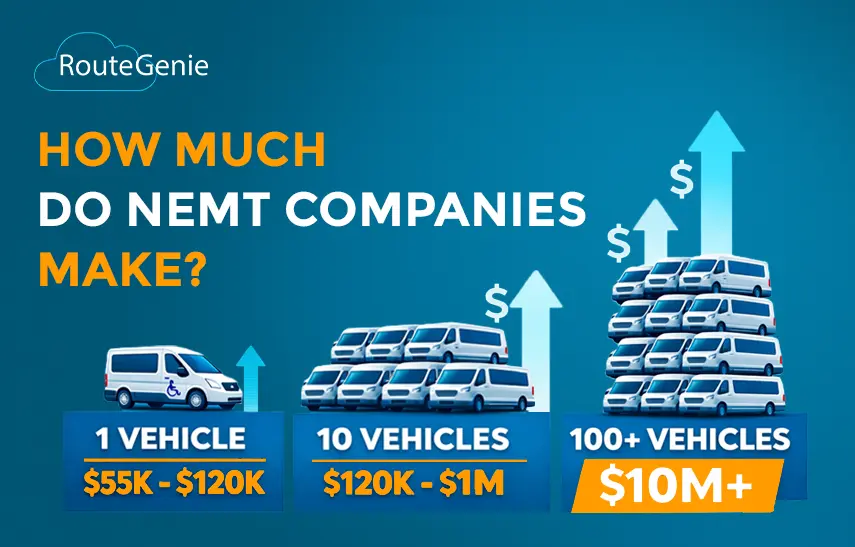
NEMT operators' pay differs widely. It can fall somewhere between $20 and $300 per trip, depending on state, type of service, trip volume, fleet size and composition, area of operation, and broker agreement. On paper, that can look like solid money. But in practice, the annual take-home amount can vary significantly.
This post breaks down how medical transportation providers actually generate revenue, what realistic income looks like at different fleet sizes, and which costs do the most damage to margins.
Contents:
- How NEMT Providers Generate Revenue
- How Much NEMT Companies Make By Company Size
- Which NEMT Trips Are Most And Least Profitable
- Efficiency Is Key to Running a Profitable NEMT Operation
How NEMT Providers Generate Revenue
Except for a small share of private-pay trips or direct facility contracts, most NEMT providers do not set their own prices. In most cases, rates are determined by state Medicaid programs and broker contracts, so understanding how those payments are structured is the starting point for any honest look at the numbers.
The basic payment structure
Providers are paid per trip, per loaded mile, or a hybrid of both. A typical Medicaid rate structure works like this: a base fee when the driver picks someone up, plus a per-mile rate for the distance traveled with a passenger in the vehicle. Deadhead miles, meaning the unloaded miles without a passenger driven to reach a pickup or return after a drop-off, generally can't be billed as a separate line item under most state programs, and the same goes for no-show trips when the passenger doesn’t show up.
What reimbursement actually looks like by service type
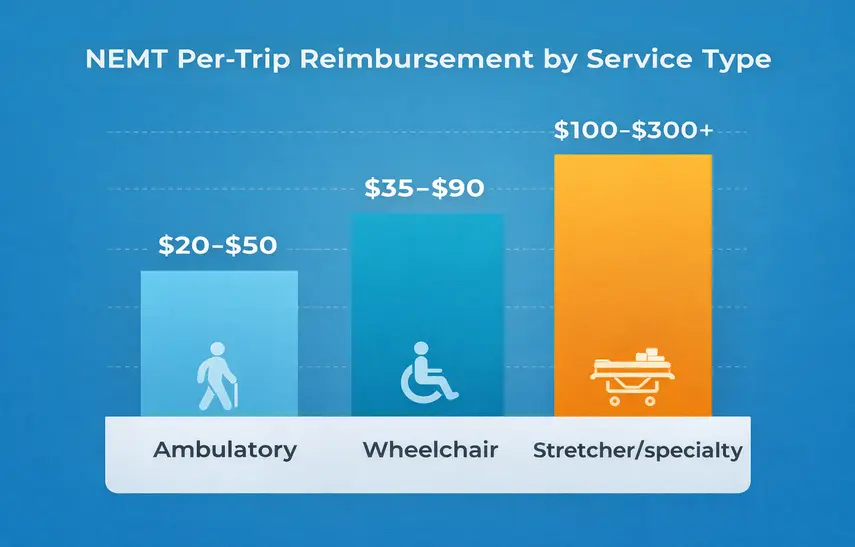
Rates vary significantly depending on trip type and state of operation. The Western part of the nation typically has higher rates than the Eastern part.
Several factors can increase the final trip price. Mileage reimbursement is commonly added on top of the base rate:
- Trips beyond standard zones add $2 to $10 per mile, depending on passenger mobility and vehicle type
- Some contracts allow extra charges for extended wait time, typically $15 to $30 per half hour
- Specialized medical equipment or an onboard attendant increases the price
- Off-hours and weekend trips run about 25% more than standard rates; holiday rates can be 45% higher
On average, per-trip reimbursement for a short to moderate leg typically falls within these ranges:
|
Service type |
Typical per-trip range |
Notes |
|
Ambulatory |
$20–$50 |
Patient walks to vehicle; taxi-cab-like vehicle requirement, lowest base rate |
|
Wheelchair |
$35–$90 |
Limited mobility passengers who require wheelchair-compatible vehicles. Equipment, additional driver training, and load time factored in; some states start mileage pay only after a minimum distance |
|
Stretcher/specialty |
$100–$300+ |
Highest acuity passengers. Larger vans with additional medical equipment. Higher base and mileage rates, but also higher vehicle, staffing, and insurance costs |
Who pays NEMT providers
State Medicaid programs set base rates for fee-for-service billing, but many providers work under broker or MCO contracts where rates are negotiated and not publicly posted. Beyond Medicaid, providers also bill Medicare Advantage transportation programs, hospitals and dialysis clinics under direct facility agreements, assisted living and rehab facilities with standing transportation orders, and private-pay patients. Mixing payer sources is how most operators protect themselves when Medicaid rates don't keep up with operating costs.
How Much NEMT Companies Make By Company Size
Revenue and profit vary widely based on fleet size and composition, local reimbursement rates, contract mix, and how efficiently the fleet runs. The economics of a single vehicle completing 6–10 trips per day across roughly 250 operating days per year generate approximately $55,000–$120,000 in annual revenue, depending on vehicle type and utilization.
The figures below are planning ranges, not guarantees. Actual provider financials are rarely published.
|
Operator type |
Fleet size |
Estimated annual revenue |
Typical net margin |
Estimated owner income / net profit |
|
Single-vehicle owner-operator |
1 van |
$55k–$120k |
n/a (owner is driver) |
$35k–$60k total owner earnings |
|
Small fleet |
2–10 vehicles |
$120k–$1M |
8–15% |
$20/60k–$150k |
|
Regional operator |
10–100 vehicles |
$600k–$15M+ |
8–15% |
$100k–$1.5M+ |
|
Statewide operator |
100+ vehicles |
$10M+ |
5–10% |
$500k–3M+ |
Single-vehicle owner-operator
A solo owner-operator running a single wheelchair van and driving themselves can expect $55,000 in gross annual revenue, but if that owner drives a stretcher van in a high-reimbursement area, then the revenue can be as high as $125,000. After fuel, insurance, vehicle depreciation, and compliance costs, economic net profit is typically modest, often $0–$15,000. But total owner cash earnings, meaning the driver wage they pay themselves plus any surplus, generally land in the $35,000–$55,000 range. That's closer to a market driver wage than a true business profit figure, and it varies widely based on trip volume and contract rates.
Small NEMT fleet (2–10 vehicles)
At this size, the owner often continues driving while also managing paid drivers. Revenue across the fleet runs $120,000 to $1 million annually. Operators running 8-15% net margins, which is typical for a well-managed small fleet, clear roughly $60,000 to $200,000 in owner profit. The low end of that range reflects a 2-vehicle operation, still building its contract base, and would require the owner to collect a driver’s salary. A 5-vehicle fleet at decent utilization starts generating income that justifies the management overhead.
Regional NEMT operator (10–100 vehicles)
Annual revenue at this scale typically runs $600,000 to $15 million. Net margins of 8–15% are common for fleets that have established contract diversification and efficient routing. That puts owner profit somewhere between $70,000 and $2.5 million. Compliance systems, billing staff, and fleet maintenance become real fixed costs here, but so do the economies of scale that make per-vehicle overhead cheaper than it is for small operators.
Statewide NEMT operator (100+ vehicles)
Large NEMT fleets operating across multiple counties or states can generate $10 million or more in annual revenue. They generally hold multiple contract types: state Medicaid broker subcontracts, hospital discharge agreements, dialysis standing orders, and sometimes paratransit program contracts. Net margins at this scale commonly run 5–10%, translating to $500,000 to $3 million or more in annual profit.
Which NEMT Trips Are Most And Least Profitable
To reach these revenue levels and sustain high profit margins, providers have to balance their priorities. Not all trips pay equally, and knowing the difference matters for bidding and scheduling decisions.
Least profitable
Short one-way ambulatory Medicaid trips at the low end of the reimbursement scale are often the hardest to make work. Add a rural pickup location, a no-show, or a last-minute broker dispatch with minimal advance scheduling, and those trips can cost more to run than they pay.
Most profitable
Stretcher NEMT for the highest acuity passengers is regarded as the main income-generating type of service. In fact, some providers have reported that a disproportionate 50 percent of revenue comes from 20 percent of stretcher vehicles in the fleet. However, this service requires a highly trained team, much more sophisticated equipment, and stricter compliance requirements.
Dialysis runs are among the most reliable earners for standard NEMT vans. They're recurring, the schedule is predictable (usually three days a week per patient), and with tight routing a driver can complete multiple round trips without long idle gaps. Hospital discharge contracts and facility standing orders with assisted living or rehab centers have similar characteristics: consistent demand and lower no-show rates.
Long-distance medical trips can also generate a strong margin when mileage reimbursement stacks up, provided the provider can limit the empty return leg.
Efficiency Is Key to Running a Profitable NEMT Operation
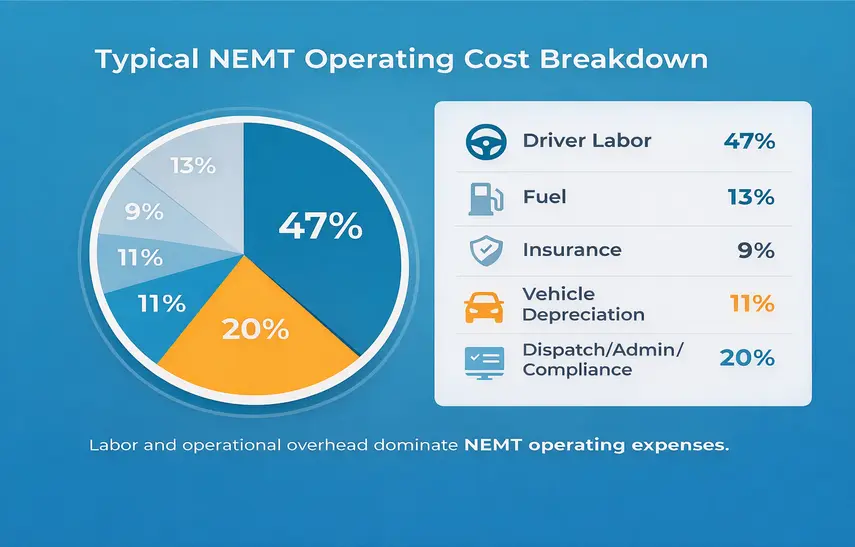
To maximize NEMT profits, fleet operators must keep in mind that ambulatory trips have to be mixed with higher acuity (and more profitable) wheelchair and stretcher rides. Additionally, providers must stick to high-efficiency protocols and consider a value-based model in medical transportation. Controlling operating expenses is a major part of that process:
Major operating expenses for NEMT providers
• Driver labor: Largest cost. Drivers earn roughly $24–$34/hr ($45k–$80k fully loaded). Labor across drivers, dispatch, and billing typically equals 40–55% of operating costs.
• Vehicles: Wheelchair vans such as a BraunAbility Sienna (~$93k) must be replaced every 5–7 years, creating ongoing depreciation and financing costs.
• Insurance: Typically $7k–$15k per vehicle annually, exceeding $20k for stretcher units. Insurance inflation is a common reason providers leave the market.
• Fuel: About $6k–$15k per vehicle per year. Deadhead miles are not reimbursed, so empty miles directly reduce margins.
• Dispatch, administrative, and compliance overhead: Office-staff, software, credentialing, billing, and regulatory compliance add roughly 8–18% of revenue.
Medical transportation software makes a difference
Interestingly, in this breakdown, the software expenses should be treated as an investment that can actually yield savings across the rest of the spending buckets. For instance, NEMT software RouteGenie has the capability to streamline vehicle maintenance, save fuel by eliminating deadhead miles, ensure precise routing and communication, and improve road safety by avoiding high-traffic areas.
Unfortunately, Medicaid rates don't automatically adjust when wages or fuel prices rise, and providers end up absorbing those increases until the next rate negotiation. NEMT can be profitable, but just like any other business, it can be challenging. Explore RouteGenie so it can help you keep profit margins high and achieve the full potential of your medical transportation enterprise.
About the author


As RouteGenie's Marketing Director, Yurii gained deep knowledge in the NEMT industry. He is an expert in marketing, leveraging all channels to build RouteGenie's brand and ensure NEMT providers have access to powerful NEMT software that can boost their growth. Yurii shares his knowledge by writing content on marketing and healthcare topics, including medical transportation, home care, and medical billing.