
Member Experience Starts at the Curb: The Role of Transportation in Health Plan Retention
For health plan members, transportation is not a minor add-on. It is the first and last touchpoint with the healthcare system wrapped around every appointment. When the ride fails and jeopardizes patients’ health outcomes, they rarely blame a broker or a local transportation provider. They blame their health plan. That is why transportation belongs in any serious conversation about member experience and retention.
Contents:
- Why the Ride Matters for Health Plan Retention
- Transportation Failures: What's Breaking at the Curb
- The Business Case: Why Poor Transportation Experience Costs More Than You Think
- What Good Looks Like and How Medical Transportation Software Helps to Get There
- Conclusion: Retention Starts Outside the Clinic Door
Why the Ride Matters for Health Plan Retention
Access failures are a leading reason Medicare Advantage members disenroll or switch plans, especially among high-need populations who have frequent appointments and little tolerance for missed care. Moreover, according to a study by DaVita Clinical Research, a single missed hemodialysis treatment is associated with a 1.4-fold greater risk of hospitalization and a 2.2-fold greater risk of death in the subsequent 30 days. That's not just a transportation problem—it's a retention and added costs crisis.
By eliminating transportation barriers, health plans drive up customer satisfaction and see a significant return on investment. For instance, an evaluation of the Florida medical transportation program found that every dollar invested in NEMT saved an estimated $11.08 in avoidable hospitalization costs, largely by ensuring members adhere to critical treatment schedules and preventing costly emergency interventions. The availability of dependable transport directly addresses patient grievances and negatively influences member retention, making NEMT essential for maintaining positive Star Ratings.
Transportation Failures: What's Breaking at the Curb
Most transportation failures fall into recognizable patterns and, unfortunately, influence the most vulnerable. This is especially true for high-risk populations with frequent visits, such as those in dialysis, oncology, or behavioral health programs. Here are the most common failures of the medical transportation experience:
- Poor scheduling experience
- Long or uncertain wait times
- Absence of NEMT vehicle tracking
- Drivers arriving significantly late or not at all
- Vehicles that do not follow the ADA requirements and cannot safely handle wheelchairs, walkers, stretchers, etc.
- Lack of door-to-door assistance where it is needed
- Difficulty reaching a live person when something goes wrong
Our mind often remembers more vividly how an experience started and how it ended. Transportation touches these most sensitive moments in the care journey. Members are anxious before procedures, worried about test results, or managing chronic pain. After the visit, they may be exhausted, medicated, or overwhelmed with new instructions. Absence of regular updates elevates anxiety. One missed pickup can erase months of positive interactions with care managers or call center staff. Waiting outside a facility with no clear ETA feels like abandonment.
The Business Case: Why Poor Transportation Experience Costs More Than You Think
 These negative passenger experiences show up in hard metrics. Late or missed trips drive grievances, repeat calls into member services, and negative survey responses. Over time, CAHPS (Consumer Assessment of Healthcare Providers and Systems) scores tank, as do internal NPS (Net Promoter Score), employer group feedback worsens, and renewal decisions, especially among members who often rely on transportation, are not favorable.
Consider a typical scenario: A Medicare Advantage plan switches to a lower-cost, lower-quality transportation provider. As a result, CAHPS scores in 'Getting Needed Care' decline. A single Star Rating point drop can cost millions in CMS bonuses. Such consequences far exceed any transportation savings.
On the other hand, a smooth, on-time ride sends the opposite message:
- It signals that the plan is organized and dependable
- Lowers stress levels before the next ride
- Boosts trust in the plan and makes members more willing to stay with it and recommend it to others
Healthcare plans that treat transportation as yet another expense that should be cost-controlled and ignore what happens to their members in transit lose a powerful lever for retention and differentiation. They end up with a higher total cost of care from unwanted readmissions, poor word-of-mouth, an uncontrollable churn rate, and lower ratings. At the same time, plans that treat transportation strategically gain a competitive advantage.
What Good Looks Like and How Medical Transportation Software Helps to Get There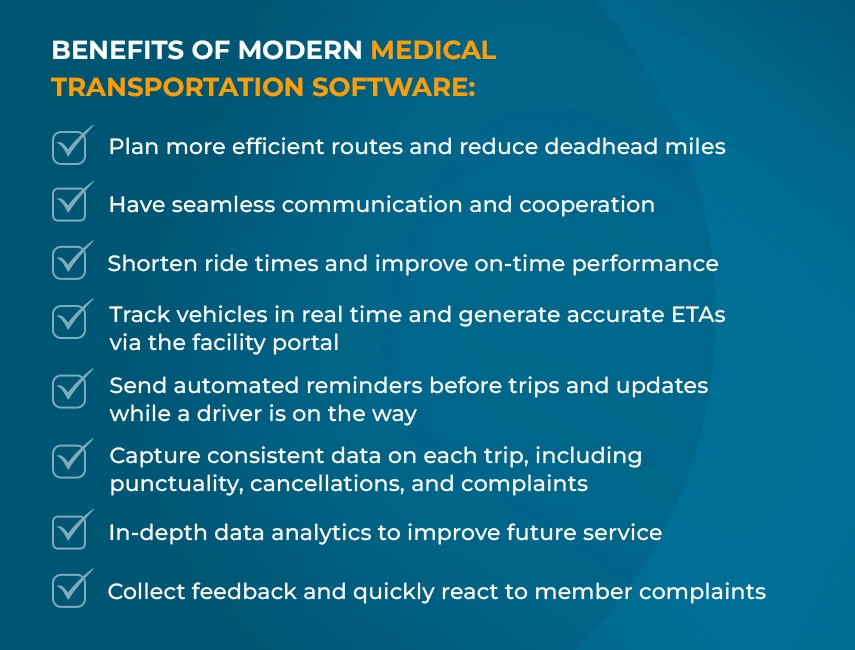
From the member’s point of view, a good experience is straightforward. Here are the common expectations of non-emergency medical transportation riders:
- The trip is easy to schedule, and the vehicle location can be easily monitored
- The properly equipped NEMT van arrives within the promised time frames in both directions
- The driver has NEMT driver training, understands the member’s needs, and treats them with respect
- If there is a delay, someone explains it and provides an updated time rather than leaving them guessing
For a passenger going through a nervous medical experience, these aspects of the ride carry outsized emotional weight. Consistently getting the positive curbside experience builds trust that carries into every other interaction with the health plan.
Given this outsized impact of transportation, health plans should have robust tools to oversee this crucial leg of the healthcare network.
The value-based NEMT model promoted by NEMTAC prioritizes passenger outcomes over ride volumes. Modern NEMT software platforms enable this approach by giving health systems, plans, brokers, and providers the visibility and accountability tools needed to measure what actually matters: on-time performance, member satisfaction, and health outcomes rather than just trip counts.
Here are the major benefits of implementing medical transportation software for health plans:
- Plan more efficient routes and reduce deadhead miles
- Have seamless communication and cooperation
- Shorten ride times and improve on-time performance
- Track vehicles in real time and generate accurate ETAs via the facility portal
- Send automated reminders before trips and updates while a driver is on the way
- Capture consistent data on each trip, including punctuality, cancellations, and complaints
- In-depth data analytics to improve future service
- Collect feedback and quickly react to member complaints
If a plan implements the use of a robust software solution like RouteGenie, this changes the transportation side of their business from a black box into a manageable network. With the added visibility, plans can align service level expectations with actual performance, address underperforming vendors, and identify where additional member education or support is needed.
Conclusion: Retention Starts Outside the Clinic Door
Health plan member experience does not begin in the hospital’s examination room. It begins when a driver pulls up to the curb and calls a member’s name. The importance of that short interaction cannot be overstated. It influences how safe, supported, and valued the member feels and how likely they are to continue entrusting their health to the plan.
Health systems that recognize transportation as a core part of their promise work with reliable NEMT providers and software like RouteGenie. As a result, they retain more members while spending less to acquire new ones. Plans that ignore what happens at the curb watch their members and their premiums walk away to competitors.
About the author


As RouteGenie's Marketing Director, Yurii gained deep knowledge in the NEMT industry. He is an expert in marketing, leveraging all channels to build RouteGenie's brand and ensure NEMT providers have access to powerful NEMT software that can boost their growth. Yurii shares his knowledge by writing content on marketing and healthcare topics, including medical transportation, home care, and medical billing.