How to Use Social Media to Grow Your Medical Transportation Business
The latest data suggests that about 70% of the US population uses social media. Impressively, this number has already surpassed traditional media viewers, like TV. Keeping this in mind, businesses in the 21st century cannot ignore the social media realm if they want to achieve any meaningful digital marketing results.
Therefore, social media is an invaluable outreach tool for the non-emergency medical transportation (NEMT) providers for boosting awareness of potential passenger-clients, brokers, and facility-partners. This guide will give you an overview of the existing platforms that should be used today and will provide content guidelines for the established businesses or those who want to start an NEMT company.
Contents:
- Why social media matters for NEMT?
- How to Choose the Right Social Media Platform for NEMT
- How to Build An Effective Social Media Strategy for a Medical Transportation Business
- Conclusion
Why social media matters for NEMT?
Traditional advertising has long been a medium for the established businesses with high promotional budgets. TV spots, radio, and printed ads are expensive. If you can afford a Super Bowl commercial, then great. Classic marketing channels still work, but the costs of client conversion can be disproportionately higher compared to SMM tools
Brand visibility without a big ad budget
Even a short mention on your local channel can run thousands of dollars, while a social media post can be created simply by turning on your phone camera to record a spotlight of your daily operations. If your content is any good and resonates with your audience, the algorithms will boost it to the viewers for free.
Consistent social posting creates name recognition and trust. If your vehicles pop up on Instagram posts or YouTube reels, then your business becomes more than just another company, but rather a relatable “group of friendly neighborhood superheroes” who help the community.
Statistically, medical transportation users are indeed older, but they are no longer offline. Facebook and YouTube report that adults aged and older currently belong to the fastest-growing demographics on the platforms. Moreover, social media outreach helps you focus your marketing efforts on the caregivers as well. These people are active across all social media and often arrange transportation for the senior and disabled members of the family.
Engagement and professional connections
Besides attracting private-pay clients, actively managed social media that generate comments, messages, and reviews become more than just feedback channels. They broadcast to the world that your business is active and puts you on the map of potential business partners. Medicaid brokers and facilities that look at two providers with equal performance data are likely to choose to work with a company with a “digital face”. If you respond quickly to customer complaints and openly demonstrate your operations from within, it paints you as a reliable partner who has nothing to hide and cares about your own reputation.
Additionally, on the business-to-business side of relationships, platforms like LinkedIn allow you to strengthen ties with partners on another level. You get a chance to become a source of industry knowledge, an expert in the field of NEMT. And who wouldn’t want to work with an expert?
LinkedIn posts can help you share corporate news, probably more effectively than formal announcements. You can connect with healthcare facilities, discharge coordinators, and NEMT brokers without scheduling a formal meeting. Those relationships often lead to referral contracts. Social media shortens the runway to that kind of partnership.
How to Choose the Right Social Media Platform for NEMT
There are over 100 social media platforms today. You don't need most of them. Spreading your effort across too many networks leads to mediocre content everywhere. Today, nearly all platforms support text, image, audio, and video formats, but there are platform-specific content types. Pick two or three platforms based on your audience and the type of content you're actually willing and able to produce.
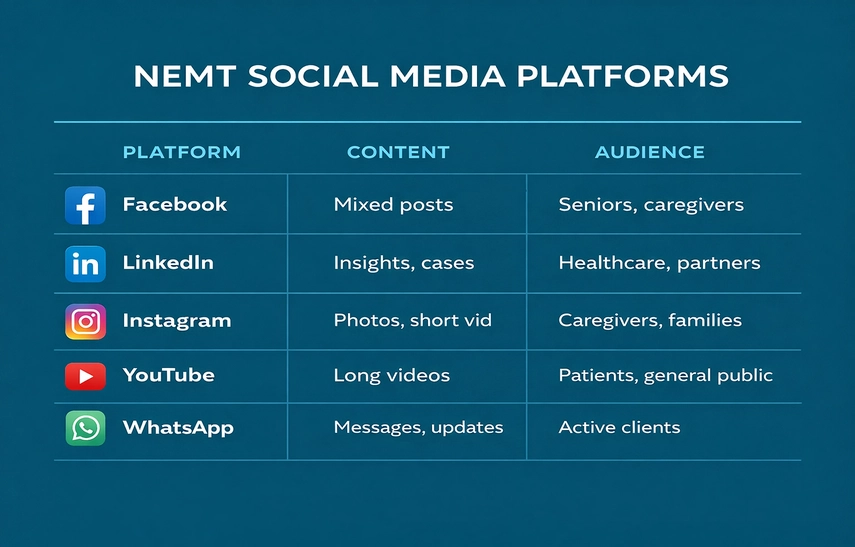
Here's what each major platform offers NEMT providers:
Facebook is the farthest-reaching social network in the U.S. The Pew Research Center study suggests that roughly 70% of adults in the broadest age range have an account on the platform. It’s easily the most practical starting point for NEMT operators. You can post updates, run ads targeting seniors or caregivers within a specific geographic radius, share client stories, and join local community groups where your audience already spends time.
Facebook's paid advertising tools are particularly useful for NEMT operators looking to expand into new service areas. You can cap spending at whatever your budget allows and measure results directly.
Given today’s medical transportation landscape, your growth strategy most likely involves contracts with brokers, hospitals, and health systems. LinkedIn is where those conversations begin.
Promote your medical transportation fleet and team capabilities, share service descriptions, case studies, expert articles, and operational insights. Connecting with discharge planners, care coordinators, and MCO representatives on LinkedIn is faster and less formal than traditional sales outreach.
Instagram works best for visual content. Photos of your fleet, team members, and short clips of daily operations tend to perform well here. Unlike Facebook, Instagram is less text-heavy, so it tends to feel less cluttered. A well-maintained Instagram page can function almost like a visual business card, which is ideal for local marketing efforts.
Stories and Reels (short vertical videos) get strong algorithmic distribution. A 30-second Reel showing a day in the life of one of your drivers costs nothing to produce and can reach thousands of people in your market who want relatable, real-life content. This is a great opportunity to attract privatepay clients.
Threads, X (Twitter), and Bluesky
These platforms are better suited for real-time commentary than for building a local client base. They're useful if you want to participate in healthcare transportation policy discussions or establish a presence in industry conversations. For most NEMT operators focused on local growth, they're a lower priority.
YouTube and short-form videos
YouTube is the second-largest search engine in the world. Educational videos about NEMT services, how Medicaid transportation works, or what to expect from your first ride have genuine search traffic potential. These videos take longer to produce but tend to stay relevant for months or years. You can provide value to the viewer in the form of knowledge or infotainment, while also organically plugging in info about your company.
Other Channels: Messaging apps and Google Business Posts
WhatsApp, Facebook Messenger, and Snapchat sit somewhere between direct communication and social media. They work well for appointment reminders, follow-ups with existing clients, and small promotional pushes to your contact list.
Google Business Profile posts deserve a mention here, too. They're not social media in the traditional sense, but posting updates, photos, and service descriptions directly to your Google listing improves local search visibility and gives potential clients a reason to choose you over a competitor with a stale or empty profile. It takes maybe 10 minutes a week and shows up right where people are already searching.
How to Build An Effective Social Media Strategy for a Medical Transportation Business
Random posting will occasionally get your content some traction, but you will not get any meaningful results. You need a social media strategy for an NEMT business. But do not feel overwhelmed; this strategy doesn't have to be complicated; it has to be consistent.
Here's how to build one:
1. Start with your audience, then pick your platforms
Before creating any content, decide who you're trying to reach. Brokers and payers? Riders and their families? Healthcare facilities? The answer changes which platforms you prioritize and what you post. Most small NEMT operators do best focusing on Facebook and Instagram for consumer reach and LinkedIn for B2B connections.
2. Create content that's actually useful
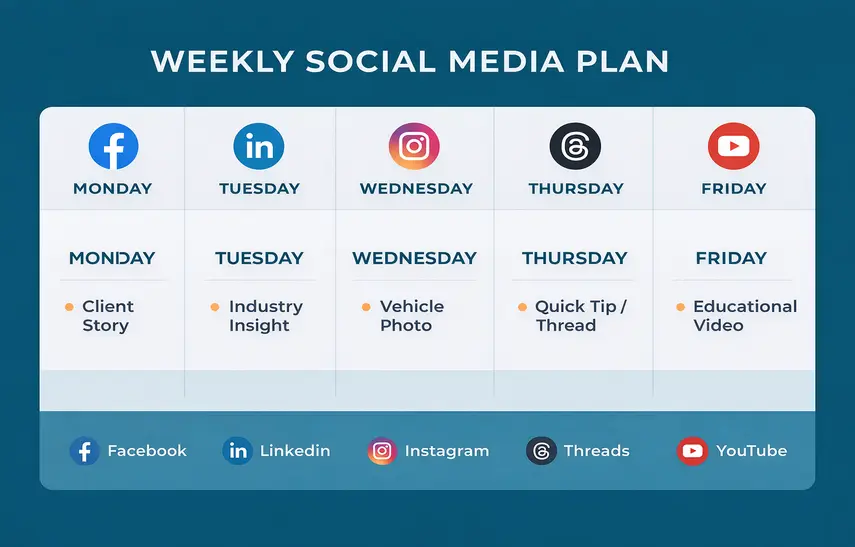
The best-performing content on any platform teaches, entertains, or reassures. For NEMT, that means posts that explain how Medicaid transportation scheduling works, introduce a driver, show what your NEMT vehicles look like, or share a client success story. Content that feels like a brochure gets ignored. Content that helps people understand something tends to get shared.
3. Use every feature the platform offers
Every platform rewards users who engage with its full feature set. On Facebook, that means using Stories and uploading full-length videos alongside regular posts. On Instagram, it means mixing Reels with static photos. On LinkedIn, it means commenting on others' posts, not just publishing your own. The more features you use, the more the algorithm promotes your content.
4. Collaborate with others in your space
Guest appearances, co-authored posts, and cross-promotions with other providers or healthcare professionals expand your reach into audiences you'd never reach alone. A physical therapist recommending your services, or a NEMT software partner sharing your content, can bring in followers who are already primed to engage with your brand.
5. Post on a schedule and keep up with responses
Social media algorithms favor consistency. Posting once or twice a week beats posting five times one week and nothing the next. Pick a pace you can maintain, block time for it, and treat it like any other operational task. The same discipline applies to responding: messages and comments that go unanswered for two days send a signal that your business doesn't prioritize communication.
6. Check your numbers
Every major platform provides free analytics. Check which posts generate the most reach, engagement, and clicks. Look at follower growth over time. These numbers tell you what's actually working versus what you just thought would work. Adjust accordingly. Quarterly reviews are enough to spot meaningful trends.
7. Handle negative feedback publicly
Bad reviews and critical comments are inevitable. How you respond matters more than the complaint itself. Address concerns directly, stay professional, and offer to resolve issues through a direct message or phone call. Potential clients often read negative reviews specifically to see how businesses respond. A measured, solution-focused reply does more for your reputation than the original complaint hurts it.
8. Run paid ads strategically
Organic reach only goes so far, especially on Facebook and Instagram. Paid advertising lets you target specific demographics in your service area, whether that's adults over 65, caregivers, or healthcare administrators. You don't need a large budget. Even $200 to $300 per month on well-targeted Facebook ads can generate meaningful visibility for a local NEMT operator.
Track click-through rates, leads generated, and cost per result. If an ad isn't performing after a week, adjust the creative or the targeting rather than letting underperforming spend continue.
Conclusion
Social media won't replace word-of-mouth or broker relationships, but it does something those channels can't: it keeps your brand visible to potential clients and partners between conversations. A steady presence across one or two platforms, backed by content that's actually useful, is enough to make a difference. RouteGenie helps NEMT operators run more efficient operations once the business comes in. See how RouteGenie works.
About the author


As RouteGenie's Marketing Director, Yurii gained deep knowledge in the NEMT industry. He is an expert in marketing, leveraging all channels to build RouteGenie's brand and ensure NEMT providers have access to powerful NEMT software that can boost their growth. Yurii shares his knowledge by writing content on marketing and healthcare topics, including medical transportation, home care, and medical billing.