
What Is NEMT? Non-Emergency Medical Transportation Explained

Nearly 2 percent of Americans delay medical care each year due to the lack of available transportation. Behind this seemingly small data point, there are 6 million people who jeopardize their health because they simply can't get a ride to the doctor. NEMT exists to close that gap. Here's what it is, who it serves, and how the system works.
Contents:
- What Is NEMT?
- A brief history
- Who Uses NEMT
- Who Pays for NEMT
- Types of NEMT Service
- How an NEMT Trip Works
- The Business Opportunity
What Is NEMT?
NEMT stands for non-emergency medical transportation. It is a benefit that covers scheduled, non-ambulance rides to and from medical appointments for people who have no other way to get there. That means patients who can't drive, don't have access to a car, or can't use public transit due to age, disability, or medical condition.
The "non-emergency" part matters; it means exactly that. These aren't 911 calls. They're planned trips to dialysis three times a week, to chemotherapy, to a primary care visit, or to a mental health appointment. The patient isn't in crisis. They just need a ride, because without one, they miss care and might end up in the emergency room, an outcome that the NEMT service is designed to prevent.
A brief history
Let’s explore the main milestones in the history of NEMT that turned a basic logistical need into a $5+ billion annual industry.
Who Uses NEMT
In the United States, nearly 80 million people are enrolled in Medicaid, and about 35 million in Medicare Advantage. Any Medicaid enrollee who has a covered medical appointment and no other way to get there can use NEMT. Medicare Advantage members can too, as long as their plan includes the transportation benefit. That's a much broader population than most people picture.
Patients with recurring medical needs
The most common riders are dialysis patients, who make up to three round trips a week, every week. A single dialysis patient can generate more than 150 trips in a year. Chemotherapy patients, people attending physical therapy, rehabilitation, psychiatric appointments, and routine primary care visits are all eligible too.
Seniors
The U.S. population is aging fast. By 2030, all baby boomers will be 65 or older, and a large share of them will no longer be able to drive. Many live alone, far from family, with chronic conditions that require regular medical visits. Getting to those appointments isn't optional. It's how they can avoid long-term hospitalizations. Besides traditional medical transportation services, there are specially designed PACE programs for seniors (Program of All-Inclusive Care for the Elderly) that run their own fleets and transport participants to and from the PACE center daily. Adult day centers operate similarly, often with 1 to 5 vehicles handling fixed morning and afternoon routes.
People with disabilities
People with physical or cognitive disabilities who can't use fixed-route public transit are another cohort of NEMT users. This includes wheelchair users, people with vision impairments, and those with conditions that make independent travel unsafe.
Children and families
Children on Medicaid being taken to specialty appointments qualify. So do pregnant women getting prenatal care, and parents taking kids to developmental or behavioral health services. NEMT isn't just for elderly or disabled adults.
Who Pays for NEMT
The short answer: taxpayers, through Medicaid. Most NEMT trips are funded with public money, split between the federal government and state budgets. That's why the industry is so tightly regulated. Credentialing requirements, trip documentation standards, GPS verification, audit-ready records: all of it exists because public funds are being spent, and both federal and state agencies are accountable for how.
The structure of who actually cuts the check to a transportation provider is more layered than it looks.
Medicaid
Medicaid is jointly funded by the federal government and each state, with the federal share covering at least 50 percent of costs in every state. But the money rarely flows directly from a state agency to a transportation provider. Most states run Medicaid through private health plans called MCOs, which then contract with NEMT brokers to manage trips.
Medicare Advantage
Medicare fee-for-service doesn't cover routine NEMT. But Medicare Advantage plans can offer it as a supplemental benefit, and many do, especially Special Needs Plans. The plan pays for transportation out of its own benefit budget, not through Medicaid.
Private pay
A small share of NEMT trips are paid out of pocket or through private insurance. This comes up most often for patients who are between coverage periods, who need a trip type not covered under their plan, or who use a provider outside the broker's network. Rates for private pay trips are set by the provider, not a state contract.
Types of NEMT Service
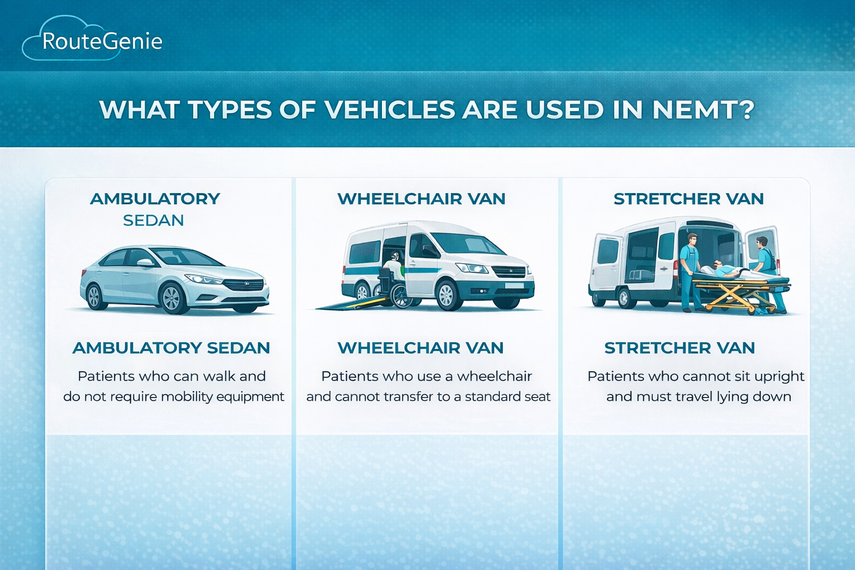 Not every patient needs and gets the same type of ride. Service level is determined by an ambulatory assessment on file with the broker or Medicaid agency, which dictates the type of NEMT vehicle that will take the passenger to an appointment.
Ambulatory transport
The patient can walk and doesn't use mobility equipment. A standard sedan or rideshare-style vehicle works. It's the most common trip type and the cheapest per mile.
Wheelchair-accessible vehicle (WAV)
Usually, a small van with a ramp or lift, for patients who use a manual or power wheelchair and can't transfer to a standard seat. The vehicle has to be properly converted and equipped, while the driver requires training to secure the chair.
Stretcher transport
For patients who can't sit upright. Requires a gurney and typically two attendants. This comes up most often post-surgery or for patients with serious mobility limitations. Some stretcher trips also require door-through-door assistance, where the driver or attendant helps the patient from inside their home all the way into the facility.
How an NEMT Trip Works
The process follows a consistent pattern across most Medicaid programs, though details vary by state.
1. Trip request. The patient or their facility submits a request to the broker, typically 48 to 72 hours in advance. Some states require more notice, but with the help of NEMT software, some providers can deliver more urgent on-demand hospital discharges.
2. Eligibility and authorization. The broker checks Medicaid eligibility, confirms the appointment is a covered service, and verifies the patient's ambulatory status on file.
3. Provider assignment. The broker routes the trip to a credentialed provider in their network. The provider receives trip details through a software integration or manual import and assigns a driver.
4. The trip. The driver picks up the patient, documents pickup and dropoff times, and collects a signature or GPS-verified confirmation depending on the broker's requirements.
5. Billing. The provider submits a claim to the broker or directly to the Medicaid agency. Rates are set by the state contract. Payment timelines vary.

This is where NEMT software like RouteGenie connects all the pieces. Trip imports from brokers, automated routing, driver dispatch, GPS verification, and billing run through one platform instead of being spread across spreadsheets, phone calls, and separate systems. For providers handling dozens or hundreds of trips a day, that matters.
The Business Opportunity
The importance of NEMT is hard to ignore, and for anyone thinking about starting a NEMT business, the fundamentals are strong. The U.S. population is aging, Medicaid enrollment is at historic highs, and Medicare Advantage plans continue to offer transportation benefits to the most vulnerable members. Every one of those trends points in the same direction: more patients who need rides, more trips to be run, and more revenue available for providers who are set up to handle the volume.
About the author


Serhii Taborovskyi is the founder and author of the Automotive Territory YouTube Channel, with 300,000 subscribers and counting. He is an avid automotive enthusiast and a fan of any and all motorized vehicles. Serhii is a visiting author at RouteGenie, sharing his expertise for the benefit of the NEMT community.