

How H&M Transport Scaled to 1,800 Trips a Week on RouteGenie
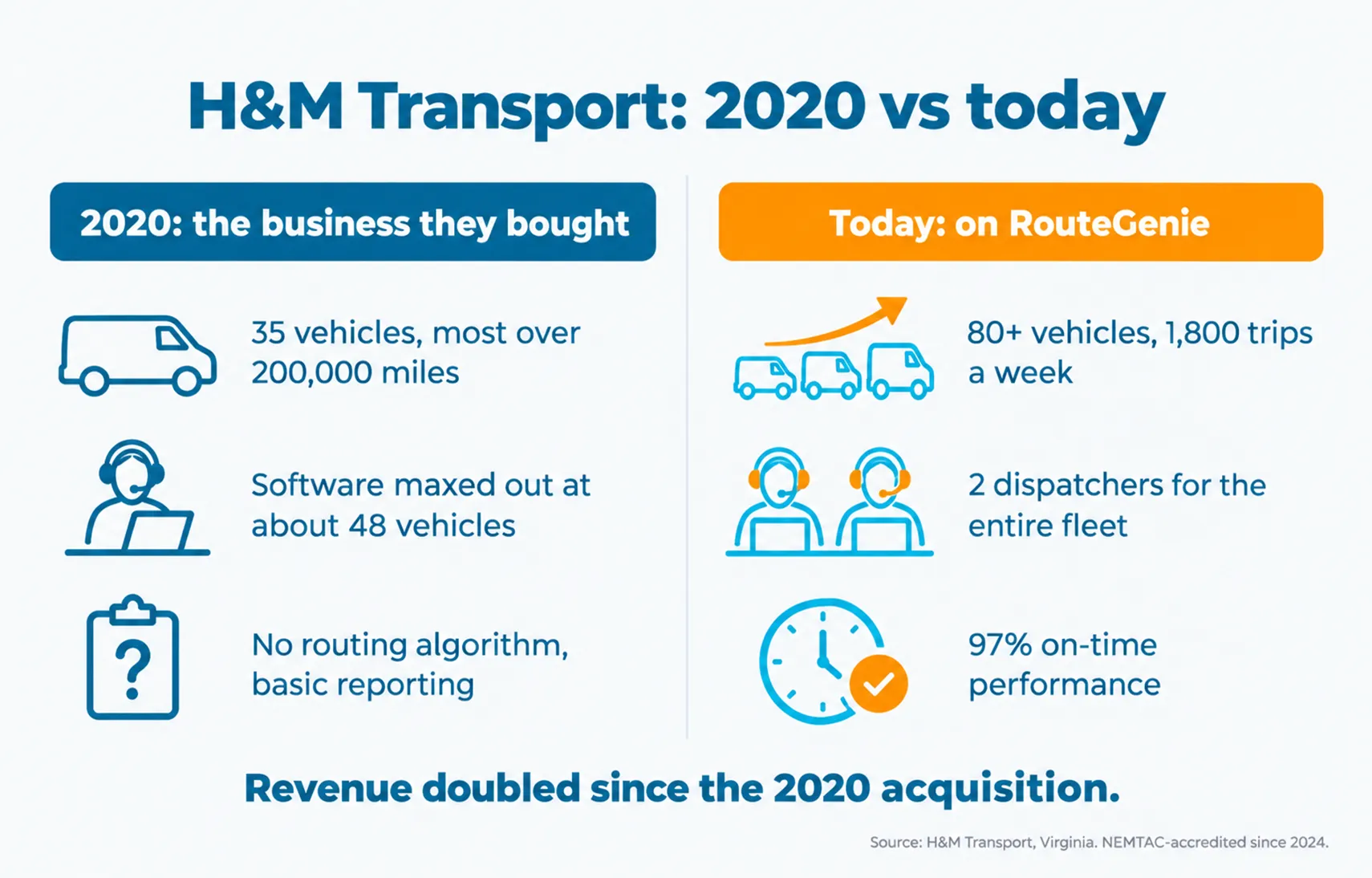
Since buying H&M Transport in September 2020, the leadership team has doubled revenue while deliberately reshaping the fleet toward higher-margin work. Their 80+ vans complete 1,800 trips per week and are dispatched by 2 dispatchers, while 10 call center agents handle the phones. H&M runs all of it on RouteGenie.


H&M Transport in 2020 – Great Fundamentals that Needed Scaling
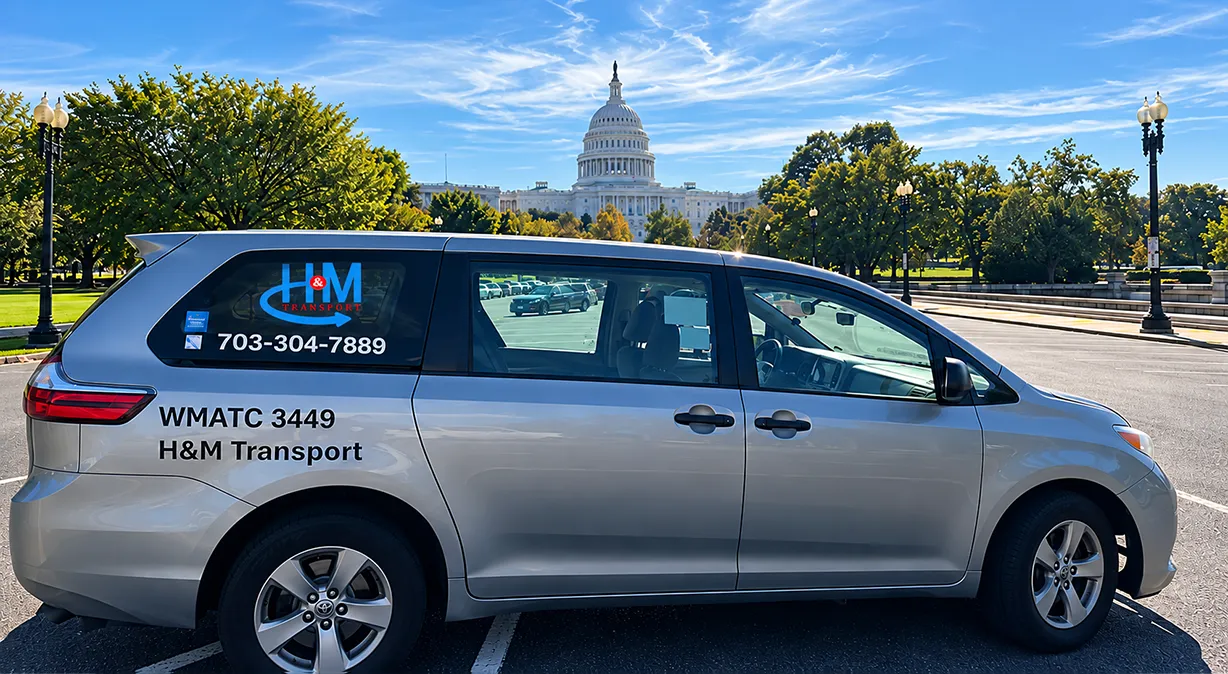
Founded in 2010, H&M Transport operated for years as a local medical transportation provider. When the current ownership arrived in September 2020, the version of the company that they acquired was on an upward trajectory and had solid fundamentals. However, newly gained access to capital and a clear mandate to expand across Washington, D.C., Virginia, Maryland, and West Virginia required a new framework that would enable fast and efficient growth.

We were able to just grow quickly. Focus on high-margin accounts… we were always ready to expand or add capacity as needed.
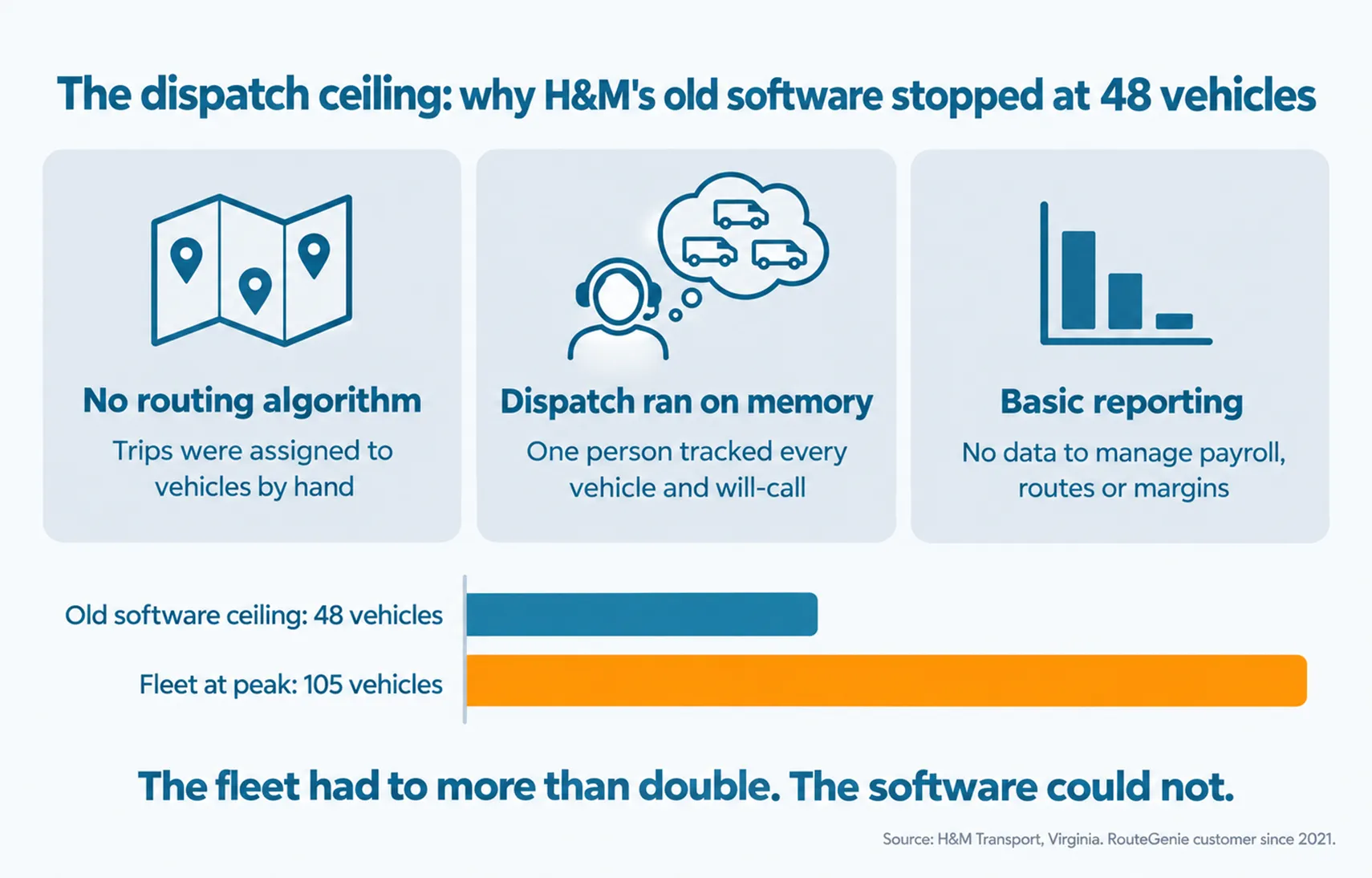
The software they were running could not keep up. “It didn’t really lead to scaling. I think the max we ever had on there was probably about 48 vehicles, and it was definitely pushing our dispatchers to the limit.”
The Challenge: Overwhelmed Dispatchers and Non-Scalable Software
At the acquisition, H&M ran 35 NEMT vehicles, most with more than 200,000 miles on them. Those were retired over the following years, and the company needed to roughly double its fleet to cover the target service areas. With a commitment to capital discipline, every new vehicle had to contribute to margin.
Compounding the scaling challenge was the loss of a long-tenured dispatcher during the transition, along with the years of institutional knowledge that person carried.
At our peak of about 105 vehicles, once we were running contracts, there’s just absolutely no chance that we could have done it without adding a ton of extra overhead costs on our dispatch team.
When H&M was facing these growth-related difficulties, they relied on a basic NEMT platform that functioned primarily as a trip assignment tool and lacked any meaningful routing algorithm. The reporting feature was very rudimentary, while dispatch efficiency depended heavily on individual experience and mental tracking. Managing the growing will-call volume, precise hospital discharge timing, and multi-state operations without reliable automated routing and reporting was no longer viable.
H&M Transport needed a more powerful software solution with a short learning curve, and RouteGenie was exactly what they were looking for.
Turning Each Medical Van Into a Profit-Driven Business
Jacob Lafferty, now VP of Operations, joined the company in 2021 to implement RouteGenie and make the transition as smooth as possible. The platform’s intuitive design made onboarding new team members remarkably straightforward.
RouteGenie really cut down the learning curve. It puts everything into a very digestible format, to where anyone that can look ahead and put together a puzzle can figure out this industry relatively quickly.
Today, if anyone is working in the office in any capacity, they’re using RouteGenie a few times a week at minimum, plus there is 100% adoption among drivers. Since everyone works in a shared RouteGenie environment, H&M collects extensive operational data. Chase pulls RouteGenie reporting data through an API connection into a Power BI model, where it’s combined with Samsara telematics and payroll data.
The result is a daily P&L for each driver and vehicle. Chase describes a typical day: “One of our drivers was clocked in for nine hours yesterday. He drove 300 miles. He did eight trips for a total of $500 in revenue. And he had 60% loaded miles.” From there, H&M can see which routes, markets and areas are profitable, and where to look for more trips.
With a fleet this size, Chase tracks NEMT KPIs at the median rather than the average, then goes after the outliers. “There’s five vans here that are underneath the daily target. Let’s focus on them while maintaining everything else… each van’s an independent business in a sense.”
Tackling Margin Pressure: Efficiency and High-Value Services
Margins in non-emergency medical transportation are under constant pressure. Vehicle prices, insurance and wages keep rising, while reimbursement rates, often locked into PMPM (Per Member Per Month) broker models and multi-year contracts, lag behind.
When I got into the industry, you could buy a vehicle for $35,000. Now to get that same comparable van, it’s $65,000.
H&M Transport has responded by focusing on higher-value work, with stretcher service at the center. The fleet peaked at about 105 active vehicles, then was deliberately cut back, shedding aging vans inherited in the acquisition, to concentrate on stretcher and wheelchair transportation. “It’s more strategic than anything,” Chase says. Stretcher is the clearest case: a small share of trips drives a large share of revenue.
Winning these high-margin contracts requires operational precision. Healthcare facilities and health plans have to be convinced that paying more for transportation saves them money in the long run.

Note
Running dispatch on RouteGenie, H&M reports ~97% OTP (≤15 min late) and ~93% at zero minutes. Chase calculates both in Power BI, comparing vehicle arrival times against appointment times.
That reliability matters because a missed trip gets expensive downstream. If a hospital misses a skilled nursing facility’s admission window, it keeps the patient another day, which Chase puts at roughly $4,500. A transport error that sends a patient back to the hospital can cost up to twice that. “Whatever they saved on using the cheaper transport just… cost them $4,500 to $9,000.”
The Results: Productivity, Compliance, and Reliability
As H&M grew into a multi-state, 80+ vehicle operation, RouteGenie became the system the business runs on. “That’s our operating software for the business,” Chase says. Here is where that shows up day to day:
Operational Consistency
Chase counts getting more trips, and more appropriate trips, to the right drivers among the productivity gains from the switch, and ranks timely response to hospital discharges second only to preventing the incidents that send patients back to the hospital.
We have up to 50 hospital discharges on a busy day. Being able to have the capacity and the know-how from the dispatch side to move pieces around and get people out of the hospital at the requested times, that’s a big deal.
Back-Office Efficiency
Chase also counts compliance and credentialing among the productivity gains, citing the value of “being able to plug all that information into a central place and be able to keep track of it.” Payroll verification improved too: trip timestamps reconcile against clock-in data.
Critical RouteGenie Features for H&M Scaling
- Find Vehicle tool for vehicle matching and routing suggestions
- Two-team functionality for coordinated stretcher operations, a feature H&M conceived and co-funded
- Payer-type templates for payer automation
- Facility portal that enables facility and health plan visibility
- Passenger app for rider notifications
- Broker API integrations
- Improved routing algorithm compared to the old software
NEMTAC Recognition as an Operating Standard
H&M earned NEMTAC accreditation in 2024 to back its training claims with an external standard. As Chase Lafferty explains, “We went through the process to get to the highest available standard out there… we actually have something to back up those claims.” Chase says it carries weight in facility conversations. It matters inside the company too.
Our drivers are proud to know that we’re the only one in the region, from the DMV to Mid-Atlantic, that have the NEMTAC accreditation.
Faster Employee Training and Future Prospects
Jacob Lafferty expects the biggest effect on training as H&M grows. “It’s going to cut down the barrier to entry for training new people to get in,” he says. His view is that once new hires have a good foundation in the software, they can onboard quickly and pick up the rest of the industry without the long wait that used to come with training someone up.
Conclusion
H&M Transport grew by being selective. With thin margins and a commitment to capital discipline, the team doubled revenue, cut the fleet back from a peak near 105 vehicles, and shifted toward stretcher and hospital discharge work, reporting about 97% on-time performance within a 15-minute tolerance.
Note
RouteGenie is the system the business runs on. Its data feeds the Power BI model that gives leadership a daily P&L for each driver and vehicle, so the team can go after the vans under target instead of micromanaging all of them.
Dispatch, billing, credentialing, the facility portal and the passenger app sit on one platform. The NEMTAC accreditation came from H&M’s own team and gives its hospital conversations an external standard to point to.
Drive Growth with RouteGenie
- Protect Margins: Export trip-level data through the API to build vehicle-level profitability reporting.
- Scale Efficiently: Optimize routes and handle will-calls without dispatch bloat.
- Strengthen Partnerships: Use portals and APIs to build trust with hospitals and brokers.
- Simplify Compliance: Centralize compliance and credentialing records in one place.
Related Case Studies

In a volume-driven NEMT market, 360 Quality Care + Transport Services refused to play the volume game. They built a trademarked premium tier, while keeping 98% on-time performance across 750 weekly trips, and the fleet tripled along the way. RouteGenie is what lets them enforce the model every day.
Read More

In 2019, Ride YourWay was stuck at 300 trips per year with a single vehicle and an Apple calendar. Seven years later, they're managing 1 million miles across 36 vehicles, and they're the only NEMTAC-accredited NEMT provider in Michigan. The turning point? RouteGenie’s data they could finally trust.
Read More
Ready To Join 600+ Fleets Already Transforming Their Operations?
Schedule a personalized demo today and discover how we can optimize your fleet, improve patient satisfaction, and boost your bottom line.
Schedule a Demo