
7 NEMT KPIs That Protect Your Contracts and Margin

There's no single national standard for NEMT metrics. Ask ten transportation providers a simple question, “How do you define on-time performance?” and you'll get ten different answers. What clears the bar with one broker falls short with another.
Providers are left navigating the maze of KPIs on their own, and these numbers cannot be ignored. They decide whether you keep your contracts and whether the work turns a profit. We have narrowed them down to a short list. The seven metrics below are the ones brokers and facilities judge you on, and the ones that tell you whether the business is actually making money. Track them, act on them, and you protect both your contracts and your margin.
Contents:
- 1. On-Time Performance
- 2. Complaint Rate
- 3. Will-Call and Discharge Response Time
- 4. Trip Completion and No-Shows
- 5. Billing Accuracy and Timely Filing
- 6. Cost per Trip
- 7. Vehicle Utilization
- A Quick Reference for the Thresholds Brokers Watch
- Where the Standard Is Headed
- How to Track All This Without Drowning in Spreadsheets
- The Bottom Line
1. On-Time Performance
This is the number brokers look at first, and it's usually the one that decides whether your contract gets renewed.
Most broker contracts want on-time rates in the low-to-mid 90s. Some states set the floor lower, around 85%. Others push toward the high end. A 2025 review of state NEMT contracts by Health Management Associates found that stakeholders consider a target of 95 to 99% "reasonable and attainable." Individual brokers put a hard number on it: SafeRide Health requires a 95% on-time rate to stay in its network. Aim low, and you're leaving contracts on the table.
One important caveat: How "on time" gets counted is where providers slip. A trip only counts if the vehicle arrives inside a set window, often about 15 minutes on either side of the scheduled pickup, and each trip either lands in the window or it's a miss. The only way to prove it landed there, at the right place and the right time, is GPS coordinates and timestamps on every pickup and drop-off. That clean data feed is what brokers require to verify performance and guard against fraud and abuse, so track against your contract's definition, not an average.
The fix for on-time pickups and drop-offs is mostly operational. You can improve on-time performance by factoring in real buffers into the routes that keep running long, and by cutting the wait time that quietly pushes trips past the window.
2. Complaint Rate
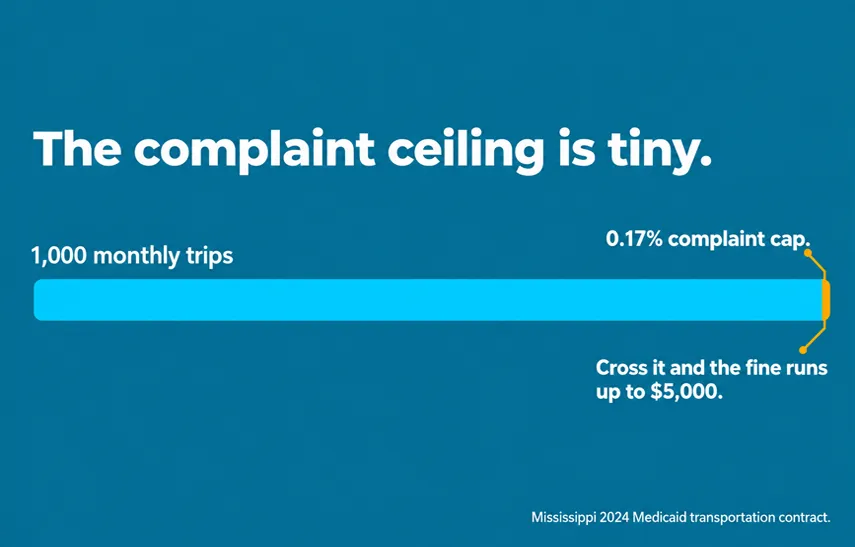
Brokers track complaints as a share of your total trips, and the ceilings are tight. In Mississippi's 2024 Medicaid transportation contract, combined complaints from members, facilities, and providers can't cross 0.17% of monthly trips. Go over, and the fine runs up to $5,000 per breach.
A ceiling that small sounds impossible until you realize most complaints come from the same root causes as your on-time problem: late pickups and no-shows. Fix those and your complaint rate usually follows. Track it monthly, and log the reason behind every complaint. The pattern tells you where the operation is leaking.
3. Will-Call and Discharge Response Time
This is the metric that matters most to hospitals, and it's the one most providers overlook.
When a facility calls to say a patient is ready to go home, that's a will-call, and the clock usually starts at one hour. Hospital discharges often get a longer window, a few hours, because they can be planned ahead. Modivcare, for example, tells its Texas facilities to expect discharge pickups within a set number of hours.
Here's why a hospital cares so much. A patient sitting in a room waiting for a ride is a bed that can't be used for the next admission. Every hour your driver is late is an hour that bed stays occupied. If you want contracts directly with health systems, this number is your audition. Winning hospital discharge work comes down to how fast you can respond, and a facility portal that lets facilities request and track rides directly is usually what makes that speed possible. Michigan provider Ride YourWay cut its discharge time from four to eight hours down to essentially on-demand once it coordinated with facilities through a portal, and it used that result to prove its value to hospital partners.
4. Trip Completion and No-Shows
Completion rate is the flip side of missed trips, and brokers cap the misses. Contracts often limit late and missed trips to around 2% of everything you're assigned. Modivcare's Kansas provider manual, for one, warns that providers whose missed pickups top 1% of assigned trips may have Keep the completion rate as high as possible, and separate the failure types so you know how to act on each:
- A driver no-show is a service failure with your name on it.
- A rider no-show, where the member isn't there at pickup, usually isn't your fault but still costs you a trip you already staffed.
- A turnback, where you hand the trip back for the broker to re-cover, is different again.
Finally, watch cancellations, not just no-shows. Wisconsin's 2025 Medicaid NEMT performance reports logged more than 1.1 million cancelled trip legs against about 102,000 member no-shows, roughly 11 cancellations for every no-show. A successful provider tracks and tackles both no-show passengers and canceled trips before they pile up. Most effective strategies focus on better communication between the provider and the passenger: text and phone call reminders and a passenger app make a huge difference.
5. Billing Accuracy and Timely Filing
Unfortunately, you can run perfect trips and still lose the money if the paperwork is late or wrong.
Most brokers set a filing deadline, often 90 days from the date of service. Miss it, and your payment gets cut. Push past 180 days, and you may not get paid at all. So days-to-file is a metric worth watching as closely as any service number.
Denials are the other half. And the thing that sinks most NEMT claims isn't bad math; it's missing some properly filled-out “paper” or failure to capture electronic data. A signature, a trip log, a verification GPS coordinate that was never sent to the broker’s server. CMS reported that 82% of improper Medicaid payments in 2023 came down to missing or insufficient documentation, not fraud. Capture it at the trip, not at month-end, because that's where most billing errors start and where the numbers your billing team should watch are won or lost.
6. Cost per Trip
Everything above is about keeping the contract. This one's about whether the contract is worth keeping.
Cost per trip is simple to write down: total operating cost divided by the one-way trips you completed. The cost side has to sweep in everything you spend to put a vehicle on the road:
- fuel and maintenance
- driver wages
- insurance
- dispatch, software, and overhead
One warning. Don't confuse your cost with the rate you're paid. A Mississippi contract might pay in the high $30s for a basic ambulatory trip, but that's revenue, not what it costs you to run it.
The biggest hidden drain is deadhead: miles driven with no passenger in the vehicle. Empty miles burn fuel and pay a driver while earning nothing. There's no official industry benchmark for deadhead, so set your own baseline and work it down. The routing work that crushes empty miles is also one of the surest ways to cut cost across the operation.
7. Vehicle Utilization
Utilization tells you how much of your available vehicle time is actually carrying people versus sitting idle or running empty. A common working target is around 75% during your core hours. Below that, you're paying for capacity you're not using.
The strongest lever for pushing utilization up is multiloading: putting more than one rider on the same run. Done well, it lifts utilization and cuts your cost per trip at the same time, because the same miles now earn two fares instead of one. Done carelessly, it blows up ride times and generates the complaints from metric two. It's a powerful tool that has to be used with judgment. Handled right, multiloading and disciplined fleet management move utilization further than any single dispatch change.
A Quick Reference for the Thresholds Brokers Watch
Every contract is different, so treat these as typical ranges, not rules. Your agreement is the final word.
|
Metric |
Common requirement |
|
On-time performance |
90% to 99%, depending on state and broker |
|
Late or missed trips |
Capped around 2% of assigned trips |
|
Complaint rate |
A fraction of 1% of monthly trips |
|
Will-call response |
Within about 1 hour of ready notice |
|
Discharge response |
Within a few hours |
|
Timely filing |
90 days, with payment lost past 180 |
Where the Standard Is Headed
Good news is the patchwork of NEMT metrics and KPIs won't last forever. NEMTAC is developing a metrics standard, sometimes referenced as NEMTAC 1004, that would put shared definitions behind terms like on-time pickup, trip denials, and late cancellations. It's still an early draft, not a finished rule. As NEMTAC's executive director Peter Hicks has put it, the group is "developing the ruler, not telling the industry how to use the ruler."
Until that ruler is finished and adopted, you measure against whatever your contracts say. Watch this space, but don't wait for it. Pursuing NEMT accreditation now is one way to get ahead of where the standards are heading.
How to Track All This Without Drowning in Spreadsheets
These numbers also pull against each other, so read them together. Push utilization too hard and on-time performance slips. And the cleanest on-time record won't rescue a contract that loses money on every trip.
Seven metrics is a lot to pull by hand, and numbers rebuilt after the fact are the ones that get you in trouble at audit. The point of good software is that these numbers come to you. RouteGenie logs pickup and drop-off times, trip completion, mileage, and billing status as trips happen, so your metrics show up in reports instead of getting stitched together from driver notes. Its built-in reporting and analytics tools turn that logged data into the on-time and cost numbers you're judged on, which is the difference between managing your metrics and finding out about them after a broker does.
The Bottom Line
There's no universal NEMT scorecard yet, but your brokers and facilities are keeping score anyway. Track these seven metrics against your own contracts, and you'll see problems while you can still fix them instead of when someone else points them out. Book a demo to see how RouteGenie captures all of it automatically.
About the author


Serhii Taborovskyi is the founder and author of the Automotive Territory YouTube Channel, with 300,000 subscribers and counting. He is an avid automotive enthusiast and a fan of any and all motorized vehicles. Serhii is a visiting author at RouteGenie, sharing his expertise for the benefit of the NEMT community.