
Hospital Discharge Transportation: An NEMT Provider and Health System Guide

An ambulance call is urgent because a patient is getting worse. A discharge call is urgent because a patient got better, and the bed now belongs to someone else. Same clock, opposite cause.
That inversion is why hospital discharge transportation behaves differently from every other trip type in NEMT. Dialysis runs on a fixed calendar you can plan a week out. A discharge order gets written at 11:40 a.m. and needs a vehicle before the afternoon admissions start stacking up downstairs. The patient needs to go home as soon as cleared. Every extra day that patient stays put costs the hospital about $3,297, while the ride home starts at just $20.
Contents:
- What Makes Hospital Discharge Transportation Different From Scheduled NEMT
- What Hospital Discharge Delays Cost Health Systems
- Choosing the Right Mode for Hospital Discharge Transport
- Partnering on Hospital Discharge Transportation
- Final Thoughts
What Makes Hospital Discharge Transportation Different From Scheduled NEMT
Hospital discharge transportation is basically the ride home after an inpatient stay ends. And home means wherever the patient goes next: a private residence, a skilled nursing facility, a rehab center, or a family member's house. This NEMT service is unique since it carries constraints the scheduled side of the business doesn't. Moreover, the discharged passengers can be in a vulnerable state since they have spent the last several days in a hospital bed. Some will need an ambulatory vehicle, some a wheelchair or a stretcher van, but most will need special attention from the driver. Harlan Krumholz named that window post-hospital syndrome, which is why driver training for discharge work has to cover post-procedure handling and not just safe driving.
Typically, the hospital discharge trip comes in as a will call. It gets ordered when a physician signs off, and that happens across a wide window that clusters in the afternoon. This is the return-home trip, so there is no return leg. Dispatchers cannot balance the day around a round trip the same way they do with routine doctor's appointments, dialysis, or other recurring NEMT services.
The order also comes from a case manager or discharge planner rather than a broker queue. That person is juggling several discharges at once, usually by phone, and wants a confirmed pickup time rather than a promise to look into it.
What Hospital Discharge Delays Cost Health Systems
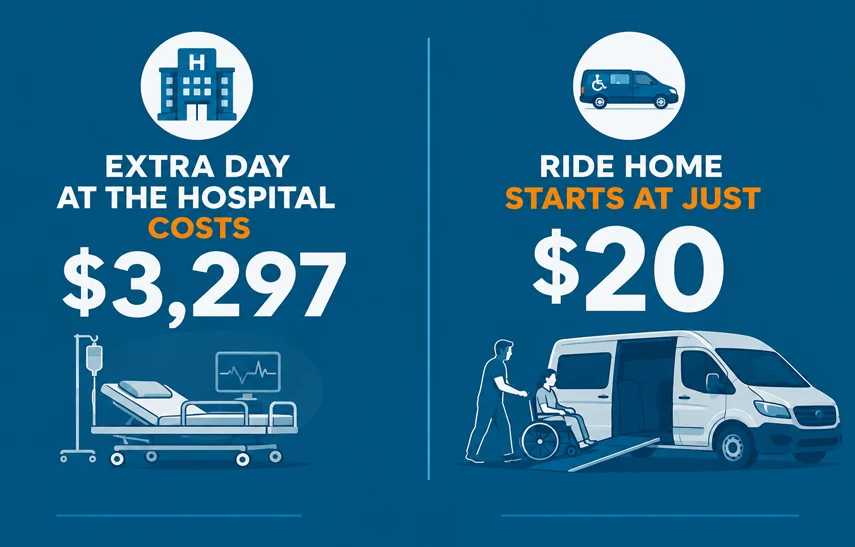
The Florida Hospital Association tracked patients who stayed past the point of medical readiness and found 117,000 of them waited more than a day to leave. That produced 403,000 avoidable bed days, in one state, in one year. After the discharge papers are signed, no extra hour at the hospital is billable; this comes straight out of the hospital's margin.
Transportation failure is among several reasons why a patient might not leave the hospital on time. A 2022 quality improvement study in Professional Case Management timed discharge order to exit on two academic medical units and found medical transport averaged 122 to 156 minutes against a 90-minute goal. Every trip that needs medical transport runs half an hour to an hour past the target, and the bed stays occupied for all of it.
It can be much faster. Ride YourWay, a Grand Rapids provider, took discharge response from four to eight hours down to on demand for its hospital partners. Move a two-hour wait toward minutes and the freed time scales quickly.
Every hour a discharged patient stays is an hour the next admission waits. That's why hospitals work to move people out quickly, and why it's in their interest to offer options and arrange transportation for patients who have no way to get home on their own.
Choosing the Right Mode for Hospital Discharge Transport
If moving patients out faster is worth money to a hospital, the ride has to be the right one. Too often it isn't. The default at many discharge desks is whatever is easiest to call, which is how a patient who could sit in a wheelchair ends up in an ambulance.
When an Ambulance Is the Right Call
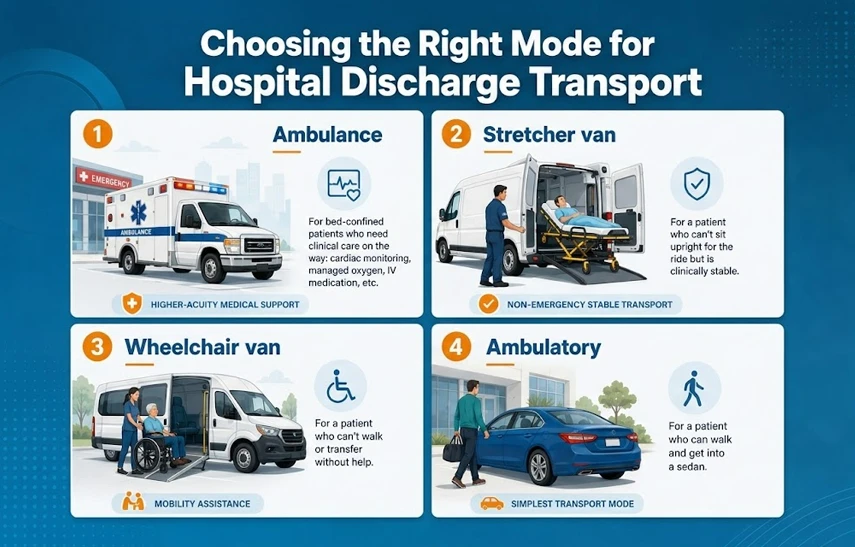
An ambulance earns its cost when the patient needs clinical care on the way: cardiac monitoring, managed oxygen, IV medication, an airway that needs watching. It's also right for a patient who is genuinely bed-confined. Medicare sets a strict three-part test there: the patient can't get up from bed unaided, can't walk, and can't sit in a chair or wheelchair. All three have to be true.
Outside those cases, something cheaper does the same job:
- Stretcher van, for a patient who can't sit upright for the ride but is clinically stable
- Wheelchair van, for a patient who can't walk or transfer without help
- Ambulatory, for a patient who can walk and get into a sedan
Weighing the Four Options
Ambulance is expensive overkill for a stable patient. Medicare pays around $285 for a non-emergency ambulance run, several times what the same trip costs by van on any payer's schedule, and every unnecessary run pulls a unit a real emergency may need.
An internal fleet gives a hospital control, but it means buying vehicles and hiring drivers, then running scheduling, maintenance, insurance, and compliance around them. That's a transportation company inside a health system.
Rideshare is fast and cheap for someone who can walk out unaided, and falls apart for anyone else. There's no wheelchair securement or stretcher option, and the driver isn't trained to get a weak patient from the curb to the door.
NEMT is a universal solution that covers the range in between. The vehicle gets matched to the patient's condition, the driver is trained for post-discharge handling, and the trip bills through benefits the patient already has.
Partnering on Hospital Discharge Transportation
Picking NEMT solves the mode question, not the timing one. Most discharge transport failures happen because two organizations that don't share a system are trying to coordinate by phone. The hospital signs an order and calls out. A driver gets assigned somewhere on the other end, and the discharge desk finds out whenever someone thinks to call back.
That's what the NEMT software is for: it helps manage the ride from start to finish, in a single place. A facility portal puts the request, the confirmation, and live vehicle status in one place both sides can see. Case managers stop calling for updates, and dispatchers stop fielding those calls. It replaces a phone tree with a shared queue, which is the difference between hoping a ride shows up and knowing when it will arrive.
What to Require From a Discharge Transport Partner
Health systems evaluating a provider should ask for four things:
- A committed time from discharge order to pickup
- A live ETA visible at the discharge desk
- Confirmed drop-off, logged
- Monthly performance data broken out by unit
Any provider running real reporting can produce all four. One who can't is asking to be taken on faith.
How Providers Win and Keep Discharge Work
Those four requirements are also the pitch.
Discharge work arrives two ways. Medicaid brokers assign it, which is the faster path in, but rates are preset and the broker controls your volume. Partnering with a hospital directly pays better, because the hospital isn't buying a ride at a Medicaid rate. It's buying bed turnover. Approach case management rather than procurement, bring on-time data from work you already do, and start with one unit before expanding. Getting medical transportation contracts through facilities can be challenging, but the higher margins speak for themselves.
When you succeed, then hold the window you promised. Discharge orders peak in the afternoon, exactly when vehicles sit furthest from the hospital. The fix is staging capacity near campuses instead of sending every driver to the edge of the service area. RouteGenie shows dispatch which vehicles are nearby and what each is committed to, so a staged vehicle takes scheduled work between discharge calls rather than idling. That's reserved capacity instead of wasted capacity, and it runs on the same deadhead planning and multi-loading discipline as the rest of the operation.
Final Thoughts
Hospital discharge transportation is the rare NEMT problem where the provider's operational metric and the hospital's financial metric are the same number. Minutes from order to pickup decide whether a bed turns over and whether a provider keeps the contract. RouteGenie handles the dispatching and the facility-side visibility that make that number small enough to sell. Request a RouteGenie demo to see how it handles discharge operations.
About the author


Serhii Taborovskyi is the founder and author of the Automotive Territory YouTube Channel, with 300,000 subscribers and counting. He is an avid automotive enthusiast and a fan of any and all motorized vehicles. Serhii is a visiting author at RouteGenie, sharing his expertise for the benefit of the NEMT community.