
How to Get Medical Transportation Contracts
Contracts are the bread and butter of the non-emergency transportation business. Without enough contracts, you'll have a business but no services to provide. That’s why winning them is as important as getting the right fleet.
When you are starting out, you should actively approach potential sources of ridership. But where should you look for the sources? How to get non-emergency medical transportation contracts?
In this post, we’ve consolidated all necessary information so that you know how to become a NEMT provider and ink contracts to get your name out there and make a profit from non-emergency medical transportation.
Contents:
- NEMT Market Is on the Rise
- What You Should Do Before Getting a Contract
- Where You Can Get NEMT Contracts
- Contracts vs. Service Agreements
- Final Thoughts
NEMT Market Is on the Rise
Non-emergency medical transportation is the fastest-growing sector of all medical transportation industries.
 According to Research and Markets, the non-emergency medical transportation industry in the USA is valued at about $18.2 billion in 2026. Through 2032, it’s estimated to grow at a CAGR of 5.52%, reaching $25.43 billion.
Medicaid alone funds tens of millions of NEMT trips each year, with some large state programs coordinating more than one million trips annually through managed care organizations and contracted brokers.
However, the growing demand for NEMT does not mean that contracts can be won easily. The recent turmoil in Medicaid funding and the ongoing Medicare crisis have led to a situation where access for new providers is controlled by payers, brokers, and healthcare facilities, not by riders themselves. These factors require medical transportation companies to dedicate a great deal of time and effort to reach the increasingly-demanding compliance and service standards of the NEMT contracts.
What You Should Do Before Getting a Contract
Starting a NEMT business can seem overwhelming and take a considerable amount of work if you don’t know where to start. The steps below will give you the right idea of what to do and where to begin in order to learn how to make money in NEMT faster.
- Consider your company's legal structure – you can choose from a sole proprietorship, partnership, or limited liability corporation (LLC). Consult an attorney to determine the most suitable legal status for you.
- Legal documents – you’ll need certificates, NEMT license, and operational permits. They vary from state to state, so you have to contact the local authorities to find out the requirements and prepare a set of the necessary documents.
- Insurance – before you start operating, you must buy proper NEMT insurance coverage; it needs to cover your operations and vehicles. Don’t go for the cheapest quotes, as you may end up with less coverage than you need.
- Establish a fleet – all vehicles must be safe, reliable, customizable, and convenient for your passengers. Before buying, ensure proper accessibility for wheelchairs, gurneys, and other equipment. Note that vehicles and equipment have to be ADA-compliant.
- In addition, most brokers, health plans, and facilities will evaluate providers on operational readiness before awarding contracts. This often includes driver credentialing, background checks, drug testing programs, trip documentation accuracy, and the ability to provide performance reports such as on-time pickup rates and cancellation statistics.
- In order to fulfill these requirements, providers have to choose high-quality NEMT dispatch software – it’ll optimize all NEMT operations such as dispatching, routing, scheduling, billing, communicating with drivers and clients, and more. Thanks to NEMT billing software, there will be fewer rejected claims, and you’ll get your payment faster.
Where You Can Get NEMT Contracts
 Regardless of the size of your company, you should focus your NEMT marketing efforts on two directions if you want to get enough contracts:
- Reach out to large service clients.
- Connect with local citizens to let them know about your NEMT company's existence.
You never know where more calls and offers will come from. See below your potential partners.
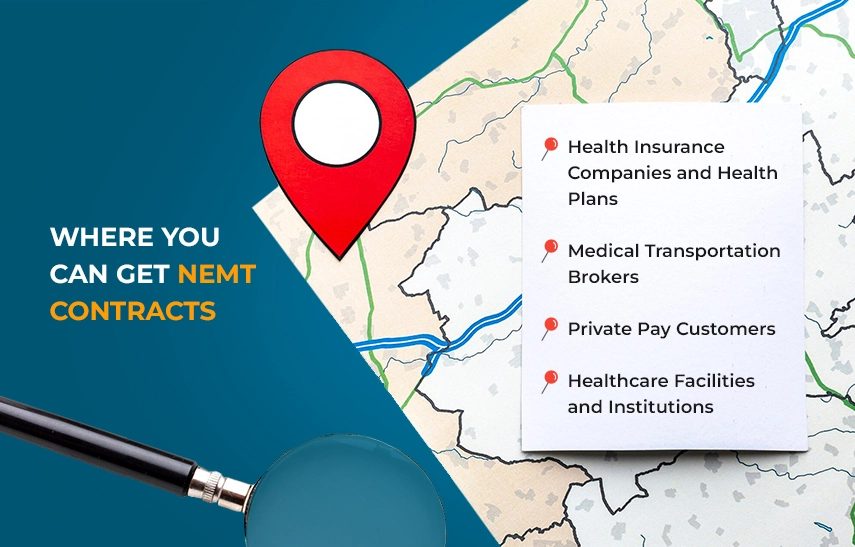
Health Insurance Companies and Health Plans
You should approach organizations that have clients in need of your service. Health insurance companies are among the most important sources of NEMT volume.
In practice, many Medicaid and Medicare Advantage plans do not contract directly with small transportation providers. Instead, they delegate transportation management to brokers or large regional operators. However, some plans and state Medicaid agencies still maintain direct provider networks, especially in rural or underserved areas.
These organizations evaluate transportation providers based on network adequacy, cost per completed trip, complaint rates, and compliance history. Providers that can demonstrate consistent on-time performance, low no-show rates, and strong reporting capabilities are more likely to be considered for direct or preferred-network contracts.
Medical Transportation Brokers
NEMT brokers are companies responsible for distributing jobs to NEMT providers, managing trips, and working as agents for insurance companies and healthcare facilities.
Brokers are contractually accountable to Managed Care Organizations (MCOs) or state agencies that set up strict service requirements and compliance standards. So medical transportation brokers have to monitor provider performance continuously. Missed pickups, late arrivals, and documentation errors can result in reduced trip volume or removal from the network. On the other hand, providers that handle standing orders reliably and maintain strong metrics often receive priority assignments.
Private Pay Customers
Private pay customers should be treated as a separate business line rather than a secondary option. These clients include seniors, family caregivers, assisted living residents, and individuals without qualifying insurance coverage.
Unlike Medicaid or brokered trips, private pay transportation allows providers to set their own pricing, cancellation policies, and service standards. While volumes may be lower, margins are often higher, and payment cycles are significantly shorter.
Successful providers frequently use private pay services to stabilize cash flow, fill scheduling gaps, and reduce dependence on a single payer or broker.
Healthcare Facilities and Institutions
To reach potential partners and customers mentioned below, you should find relevant organizations locally and connect with them using standard marketing tools and social media portals. Or, even better, physically knock at their doors and leave your business cards, brochures, and a sample of the agreement.
These organizations include:
Hospitals and discharge planners are a high-value channel, especially for same-day and time-sensitive rides. Discharge teams care about speed and clear communication via a facility portal, because delays can back up beds, extend length of stay, and create patient safety issues.
Long-term healthcare facilities can be one of the most stable and predictable sources of trips. Dialysis centers, rehabilitation centers, skilled nursing facilities, and behavioral health facilities require recurring transportation services and value reliability over the lowest cost.
Non-medical institutions such as daycare centers, retirement homes, group homes, and educational facilities often coordinate transportation on behalf of their residents or students and prioritize consistency and trust over ad hoc availability. These organizations typically value providers who can commit to fixed schedules, trained drivers, and clear communication, especially when serving seniors, individuals with disabilities, or students with special transportation needs.
How to get medical transportation contracts with the mentioned organizations and personas? Prepare a legal agreement and business certifications so that your proposition would look reasonable and well-weighted for them. Get all the documents ready and send them via email, offering your service.
But be careful not to take more contracts than your business can handle in terms of time, fleet, and hands-on-deck. Or you may end up breaking those contracts, and it’ll affect your reputation.
Contracts vs. Service Agreements
The difference between a service agreement and a contract for NEMT companies lies in the level of legal outcomes after the sides have signed one of them.
A contract is a legally restrictive document. It means that if one of the parties violates the contract for any reason, it can result in legal ramifications and even lead to litigation. Generally, contracts are required by health insurance companies or large medical institutions.
A service agreement is a legal document as well. However, it can be broken off more easily with fewer or even no consequences for both parties. For instance, if you’ve agreed to take 10 passengers a day and you rely on it, but for some reason your partner doesn’t bring you 10 passengers, you would likely talk things through rather than going to court.
Service agreement provides more flexibility to both parties and is more like a legal declaration of a mutually-profitable partnership than a mutually-frightening judicial document. It’s a more convenient mode of cooperation for brokers and non-medical institutions.
When you work with private clients, generally, you won’t need any contracts or agreements. All you need is an advanced NEMT client software app to communicate effectively with your private customers and cope with payments.
As soon as you get a contract or agreement, you’ll have to deal with Medicaid billing. It’s a complicated procedure; however, you won’t be able to get reimbursements without it. And, again, the right NEMT software will help you! It’ll create clean claims and ensure that NEMT providers are correctly reimbursed.
Final Thoughts
How to get contracts with a NEMT? Typically, you have to reach your potential partners and start communicating with them. Visit them yourself, send emails, gand makecalls to offer your NEMT service. Stay proactive! However, you must always bring proof of your professionalism and reliability in terms of licenses and certifications.
Use these tips and evaluate tools such as RouteGenie to support your operations as you work to grow your NEMT business.
About the author


As RouteGenie's Marketing Director, Yurii gained deep knowledge in the NEMT industry. He is an expert in marketing, leveraging all channels to build RouteGenie's brand and ensure NEMT providers have access to powerful NEMT software that can boost their growth. Yurii shares his knowledge by writing content on marketing and healthcare topics, including medical transportation, home care, and medical billing.