
Colorado's NEMT Broker Switch to MediDrive: a Provider Guide
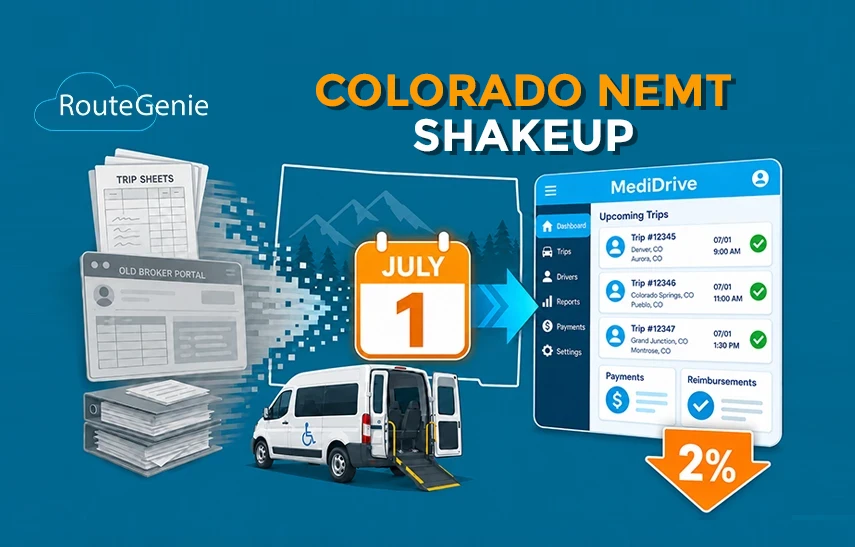
Colorado is replacing the company that assigns and pays for Medicaid transportation across the busiest part of the state. Starting July 1, 2026, the Department of Health Care Policy and Financing (HCPF) moves non-emergency medical transportation to a single statewide broker, MediDrive. If you move Health First Colorado members, the company that hands you trips and cuts your checks is about to change.
This guide covers what's changing, who MediDrive is, the dates that matter, and what NEMT providers should do now. It also covers a detail most write-ups have skipped: a Medicaid rate cut that lands the same day as the metro cutover.
Contents:
- What's Changing in Colorado NEMT in 2026
- Who MediDrive Is and What It Will Run
- The MediDrive Rollout Timeline and the July 1 Deadline
- What Providers Need to Do About the MediDrive Transition Now
- The Rate Cut Arriving the Same Day
- Why Colorado Is Making This Change to NEMT
- What Changes in Day-to-Day Operations
- What to Do Before July 1
What's Changing in Colorado NEMT in 2026
For years, Colorado has run NEMT two ways at once. A single broker, Transdev Health Solutions (formerly IntelliRide), handled the nine-county Denver metro area, and local providers covered the other 55 counties directly. HCPF is ending that split. The state is consolidating the whole program under one statewide broker, MediDrive, so intake, scheduling, credentialing, and payment run through one broker instead of varying by county.
For NEMT providers, the practical change is simple. The entity that assigns your trips and pays your claims is changing, and the contracts and portals you've used under the current broker don't carry over on their own. To keep getting trips after the switch, you have to be contracted and credentialed with MediDrive.
This isn't a billing tweak. Under the new model, transportation is arranged and managed through the broker rather than through direct provider or fee-for-service billing. If you've worked with a broker before, the shape of it will be familiar; however, there is only one NEMT broker in Colorado from now on.
Who MediDrive Is and What It Will Run
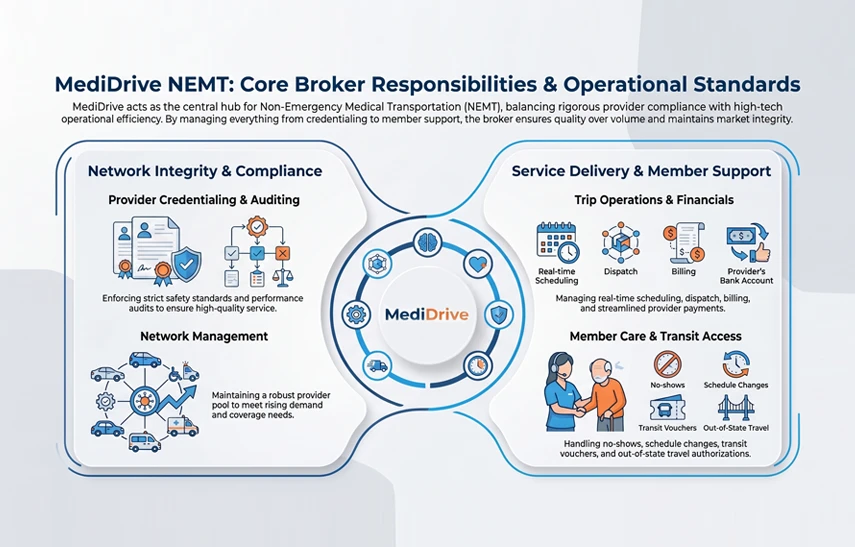
HCPF selected MediDrive, LLC to run the statewide program, and its remit is wide. The core functions are provider credentialing, network management, trip scheduling, dispatch, billing, and payment. The state's transition materials also mention the following responsibilities on top of that:
- Member support, including no-shows and schedule changes
- Out-of-state travel authorization
- Transit pass and voucher distribution
- Provider auditing
So MediDrive becomes the hub for nearly every operational and financial interaction a provider has with the program. Where you once dealt with some mix of the broker, the state's fiscal agent, and county contacts depending on the trip, you'll deal with the broker.
MediDrive was launched in January 2024 by Corporate Transportation Group, a four-decades-old ground-transportation operator. This venture was built specifically for the NEMT market and is currently run by Alan J. Murray, a former health-plan executive who led business development at Elevance Health and ran Empire BlueCross BlueShield. MediDrive sells itself on technology, with AI-assisted routing and real-time tracking on a provider-facing platform. Colorado is its first statewide Medicaid broker contract. With this transition, providers will get a tech-forward broker with a clean slate, but MediDrive still has to prove it can run the broker operation at state scale.
The MediDrive Rollout Timeline and the July 1 Deadline
The broker switch in Colorado happens in two phases so the state can move the whole program without cutting members off mid-treatment.
Phase 1 covers the nine-county metro service area: Adams, Arapahoe, Boulder, Broomfield, Denver, Douglas, Jefferson, Larimer, and Weld. That's the same footprint the current broker serves today. The date that matters is July 1, 2026. Trips for appointments on or after that date in those counties can't be assigned to providers who aren't contracted with MediDrive.
Phase 2 extends the statewide model to the remaining 55 counties. HCPF hasn't published a firm date for that phase, so providers outside the metro should watch the monthly provider bulletins rather than assume a timeline.
One thing to keep straight: Larimer and Weld counties are in the broker service area even though they sit north of the Denver metro proper. If you operate in Fort Collins or Greeley, you're in Phase 1.
What Providers Need to Do About the MediDrive Transition Now
Understandably, you would want to prevent any business interruption, so it’s tempting to scramble and update every driver and vehicle record before enrolling. But HCPF's current guidance says DON’T.
If you're already active in the Transdev network, you don't need to upload your driver and vehicle rosters when you submit the initial MediDrive contracting application. HCPF simplified that step to cut the administrative load during the transition. Routine roster maintenance and credentialing through MediDrive start after July 1, 2026, not before.
There's a second catch. If you haven't finished credentialing yet, whether you're in the metro or one of the other 55 counties, HCPF says not to enroll with MediDrive at this time. You'll be able to complete credentialing later, and more detail is coming through provider communications.
So the real to-do list for an active metro provider is short:
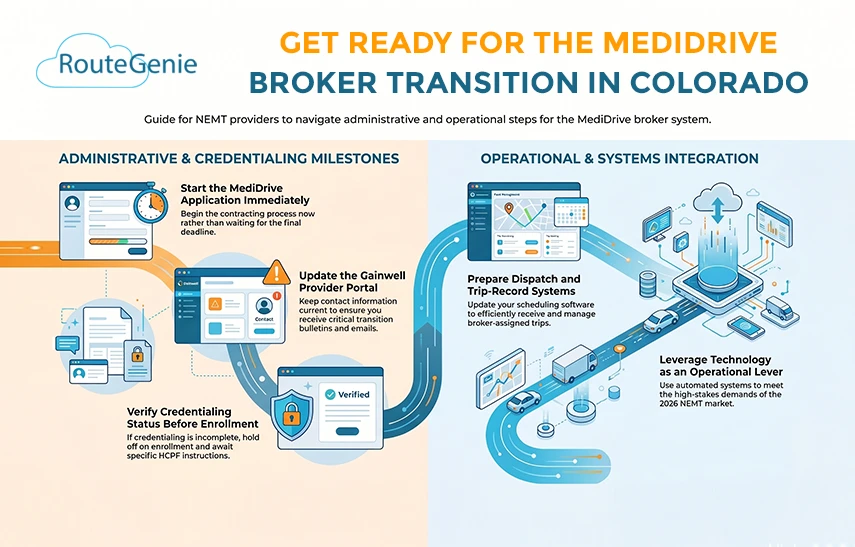
- Start the MediDrive contracting application now, rather than waiting for the deadline.
- Keep your contact information current in the Gainwell provider portal so you actually receive the transition emails and bulletins. The Gainwell Provider Web Portal is Colorado Medicaid's provider management system.
- Hold off on enrolling if your credentialing isn't complete, and watch for HCPF's instructions.
- Get your scheduling, dispatch, and trip-record systems ready to take broker-assigned trips.
Providers who aren't contracted by the cutover won't be assigned trips and won't be eligible for reimbursement once their region transitions. That's the part worth acting on early. If you're newer to Medicaid work, our guide on becoming a Medicaid transportation provider walks through credentialing and enrollment basics.
The Rate Cut Arriving the Same Day
There's a bigger change hiding in the same date, and it's easy to miss. On July 1, Colorado's Medicaid rates go down, and NEMT gets hit twice. Every provider takes a 2% across-the-board rate reduction effective for dates of service beginning July 1, 2026, which is still subject to CMS approval. NEMT isn't on the exemption list for that one, and the state's provider rate reduction fact sheet lays out targeted NEMT cuts on the same date:
- Base trip fees for taxicab and ambulatory-vehicle trips (codes A0100 and A0120) drop to a flat $12.40 per trip.
- Mileage for taxicab and ambulatory vehicles (S0215) and for wheelchair vans (S0209) drops to $2.80 per mile.
For a transportation provider already watching thin margins, that's two changes at once: a new broker relationship and a lower reimbursement floor, both on the same day. It raises the stakes on the things you can control, like deadhead miles, multi-loading where your contract allows it, and claims clean enough to get paid on the first pass.
Why Colorado Is Making This Change to NEMT
Colorado's NEMT program has been under fraud-and-integrity scrutiny for two years. New provider enrollment has been under a moratorium since October 1, 2023, now extended through September 30, 2026 over the potential for fraud, waste, and abuse. A single statewide broker gives the state one credentialing pathway, one rulebook, and one accountable party for trip data and payment. Colorado tried a statewide model once before, handing the whole program to IntelliRide in 2020 before pulling it back to the metro counties in 2021.
The switch is also backed by new law. In 2026, Colorado passed HB26-1328, a bipartisan NEMT bill that Governor Polis signed. Three parts land directly on providers:
- A new Transportation Community Advisory Board inside HCPF helps set safety and oversight rules alongside the broker.
- The broker has to give providers software, a communication toolkit, training, and technical assistance.
- Providers have to keep auditable electronic trip records: pickup and drop-off locations, GPS data with time stamps, mileage, and driver and vehicle identification.
The law also reclassifies NEMT spending as a medical service instead of an administrative cost, which lets Colorado claim higher federal match rates. So in the same year the state trims rates by 2%, it's restructuring NEMT to pull more federal money into the program.
What Changes in Day-to-Day Operations
Under a broker model, a chunk of the eligibility and verification work moves off your plate. Today, providers outside the broker network run the full verification process themselves: confirming active coverage on the date of service, checking that the member isn't in an excluded benefit plan such as QMB Only or SLMB Only, and documenting the nearest qualified provider within 25 miles. Inside the broker network, the broker performs those steps and assigns you the trip.
What doesn't move is your responsibility for the trip itself. Even with the broker assigning trips, you still own:
- Drivers, vehicles, routes, and on-time performance
- Accurate trip records and the correct level of service
- Producing documentation on audit, and protecting records under HIPAA
A broker assigning the trip doesn't make the paperwork someone else's problem, and how the broker gets paid still shapes the rates and utilization pressure you'll see.
That's why your own software still matters under the new model. Trips arrive from the broker, but you're the one optimizing the route, capturing the trip report, and reconciling what you got paid against what you ran.
What to Do Before July 1
If you run metro-county trips, start MediDrive contracting now and keep your contact info current with the state so you don't miss the transition notices. Wait to enroll until credentialing is done. The cutover and rate cut both hit July 1, so providers who contract early avoid a gap.
RouteGenie pulls broker trips, builds routes, captures compliant documentation, and reconciles payments in one place, with several brokers running at once. Book a demo to see how MediDrive fits before the switch.
About the author


Yurii Martynov is the Marketing Director at RouteGenie, the leading software platform for medical transportation. With years of experience in the NEMT industry, Yurii leads brand strategy, demand generation, and go-to-market efforts that help transportation providers and brokers discover the tools they need to grow. Working closely with NEMT providers, brokers, and healthcare organizations has given him a deep understanding of the challenges facing the industry. He writes about NEMT operations, healthcare transportation trends, and the evolving role of technology in connecting patients to care.