
NEMT Broker Landscape Is Changing: How to Stay Compliant with Everyone
2026 has already reshuffled major NEMT broker relationships. Georgia consolidated all five Medicaid NEMT regions under Verida. Colorado began its transition to MediDrive as its new statewide broker. Wisconsin announced its intent to replace MTM with Verida. Montana named Modivcare its new statewide broker effective October 1. And managed-care plans keep moving transportation contracts between national brokers, including Blue Cross Blue Shield of Texas replacing Modivcare with MTM Health the same day.
If you drive Medicaid trips for a living, the company that assigns your work and pays your claims may not be the same company a year from now. That is a reason to stop building your operation around a single broker. The goal is not to stay compliant with one medical transportation broker, but to run a compliance operation that adapts to any of them.
Contents:
- Why the NEMT Broker Landscape Is Changing
- The NEMT Brokers Reshaping the Market
- What Actually Changes When Your NEMT Broker Changes
- The Compliance Core That Follows You From Broker to Broker
- How to Build a Compliance Operation That Works With Any NEMT Broker
- The Secret Sauce to Staying Compliant With Major NEMT Brokers
Why the NEMT Broker Landscape Is Changing
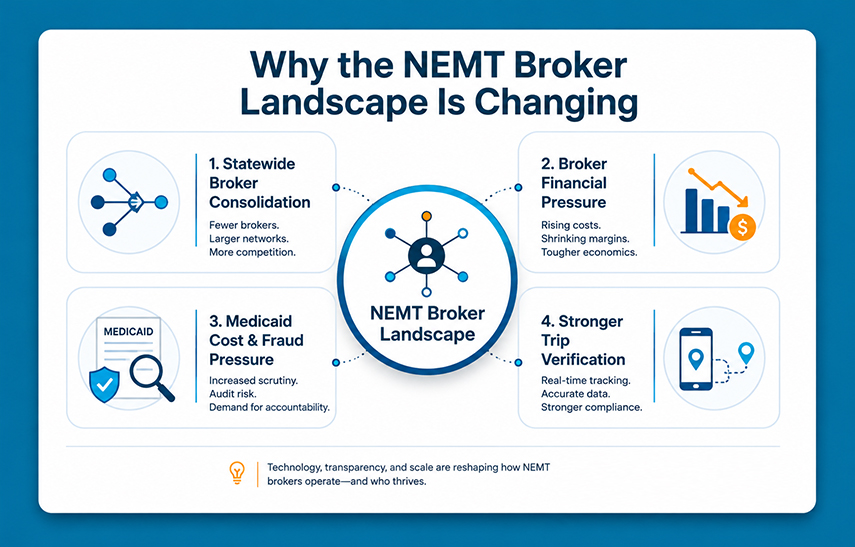
The recent broker turnover is not random. Several forces are at play, actively reshaping who manages Medicaid and Medicare Advantage transportation. The trend is clear: fewer brokers per market, higher expectations on trip data, and more pressure on providers to stay flexible.
Statewide Medical Transportation Broker Models Are Reshaping Some Markets
Several states have moved their entire Medicaid transportation program to one broker rather than splitting it by region or county. New York did it in 2023. Colorado began its phased transition to MediDrive on July 1, 2026, starting with the nine-county Denver metro and expanding to remaining counties later. Georgia now runs all five regions through Verida, and Wisconsin has proposed a similar replacement.
For now, this is a pattern, not a national rule, and plenty of states are not consolidating. But where it happens, the effect is obvious: the contracts you have today are not a guarantee; they can be replaced by a single entity controlling every Medicaid trip in your county.
NEMT Brokers Are Not Immune to Financial Problems
Modivcare, the largest NEMT broker in the country, filed for Chapter 11 in August 2025 and emerged that December, having shed more than $1.1 billion in debt. The company became privately held and promised to achieve stability through spending on new technology. After a lengthy uncertainty period, Modivcare is back in business, but its recent bankruptcy battle has left a mark on the providers and states that employ its services.
Medicaid Budget Pressure Is Reshaping Broker Contracts
This shakeup has a clear reason. State Medicaid agencies have come under heavy pressure to control costs and eliminate fraud, which is why broker procurement, program restructuring, and reimbursement changes often arrive together. Colorado reclassified NEMT to capture a higher federal match and enacted a provider rate reduction of 2% in July, effective the same day as its metro broker cutover, with NEMT not exempt.
Proving the Trip Happened Is Becoming the Real NEMT Compliance Bar
Broker contracts are changing at the same time as the evidence list required by the state Medicaid MCOs (Managed Care Organizations) to prove a trip happened is becoming more detailed. That second shift matters more to your operation than any contract award. Minnesota was among the first states to clash with the federal government’s demand to battle Medicaid waste, fraud, and abuse. CMS deferred $259.5 million in federal matching funds to the state, including $243.8 million tied to unsupported or potentially fraudulent claims. As a follow-up action, in April, 2026, CMS directed all 50 states to develop accelerated strategies for revalidating high-risk Medicaid providers, extending the same scrutiny to other states.
The controls are consistent. The Government Accountability Office identified provider and vehicle screening, trip logs, GPS data, and claims review as the tools states use to detect NEMT fraud. Each runs on documentation you either have or you do not.
Some states, like Colorado, began acting in advance to prevent any disruptions to the federal funding and preserve the Medicaid program. Their recently signed HB26-1328 law requires policies around digital dispatch records covering pickup and drop-off information, GPS data, routes, mileage, and driver and vehicle identification. At the same time, brokers are not waiting for legislation. They are moving the same direction on their own, using real-time tracking and electronic verification to confirm rides happened before paying for them. Montana's incoming NEMT program is a live example. Under DPHHS's anticipated October 1 transition to Modivcare, enrollment and billing move to Modivcare as the new broker, and members and providers get a digital app that creates, confirms, cancels, and tracks every trip, pairing live tracking with geofencing for a verified record of each ride. The rollout soft-launches September 1. For compliant providers, the signal is clear: as verification tightens, those who can document clean, on-time trips are best positioned to win the work.
The NEMT Brokers Reshaping the Market
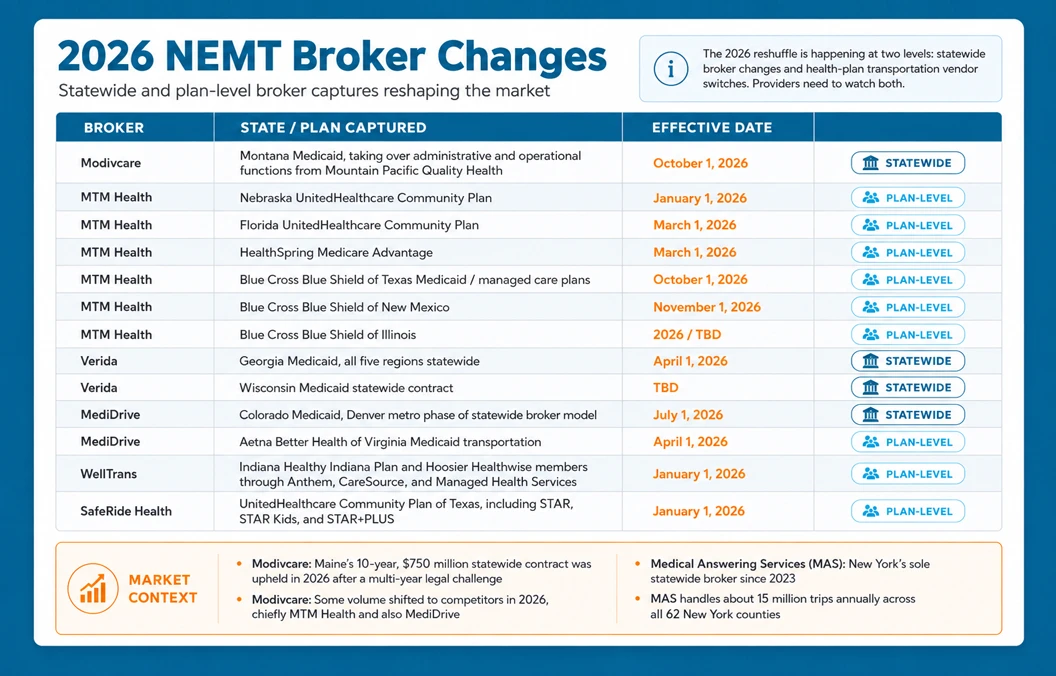
The 2026 reshuffle is happening at two levels. Some states are replacing or consolidating their statewide NEMT broker structure. At the same time, individual Medicaid managed-care plans are changing transportation vendors even when the state's broader NEMT program stays the same. Providers need to watch both.
Modivcare had the most turbulent year. It still coordinates tens of millions of trips a year, and 2026 was not one-way traffic: Montana's DPHHS named it the state's new NEMT broker effective October 1, taking over administrative and operational functions from Mountain Pacific Quality Health, and Maine's Supreme Judicial Court cleared its 10-year, $750 million statewide contract after a multi-year legal challenge. However, some volume came off the books this year and shifted to competitors, chiefly MTM Health but also MediDrive. Modivcare is winning and losing statewide books of business in the same year, which is the clearest sign that the market is genuinely in flux.
MTM Health took over Nebraska's and Florida's UnitedHealthcare Community Plans and picked up much of what Modivcare dropped. On March 1, they took over HealthSpring Medicare Advantage transportation and will become the non-emergency medical transportation broker for Blue Cross Blue Shield Medicaid/managed care plans in Texas (effective October 1, 2026), New Mexico (effective November 1, 2026), and Illinois.
Verida, formerly Southeastrans, took the rest. On April 1, the minority-owned broker consolidated all five Georgia Medicaid regions, replacing Modivcare statewide. Wisconsin has since issued a notice of intent to select Verida, though it is still contracted with MTM and no cutover date has been announced.
MediDrive is the newest major name here. Colorado selected it for the state's new statewide broker model, replacing a split between a metro contractor and the outstate counties. The nine-county Denver metro transitioned July 1, with remaining counties following in a second phase. Its reach already extends past that contract: Aetna Better Health of Virginia moved its Medicaid transportation to MediDrive on April 1, dropping Modivcare and giving the broker a plan-level win well outside Colorado. That makes MediDrive the entrant to watch as it scales.
WellTrans became the NEMT broker for Indiana's Anthem, CareSource, and Managed Health Services members enrolled in Healthy Indiana Plan and Hoosier Healthwise on January 1. Indiana's provider bulletin specifically warned that the previous arrangement would end and that these members would receive NEMT through WellTrans.
SafeRide Health took over NEMT for UnitedHealthcare Community Plan of Texas on January 1. The change covers eligible STAR, STAR Kids, and STAR+PLUS members and is another example of a major transportation vendor switch occurring at the health-plan level rather than through a statewide broker procurement.
Medical Answering Services shows what a consolidated market looks like once it settles. New York named MAS its sole statewide broker in 2023, and it now handles around 15 million trips a year across all 62 counties. For providers pursuing broker-assigned Medicaid NEMT there, MAS is the central contracting relationship.
Taken together, these changes show why following only statewide Medicaid broker awards is no longer enough. A provider can operate in a state where the statewide structure has not changed and still lose access to a meaningful block of trips because one managed-care plan selects a different transportation vendor. State Medicaid announcements, procurement notices, MCO provider bulletins, and health-plan transportation updates all belong on the same watchlist.
What Actually Changes When Your NEMT Broker Changes
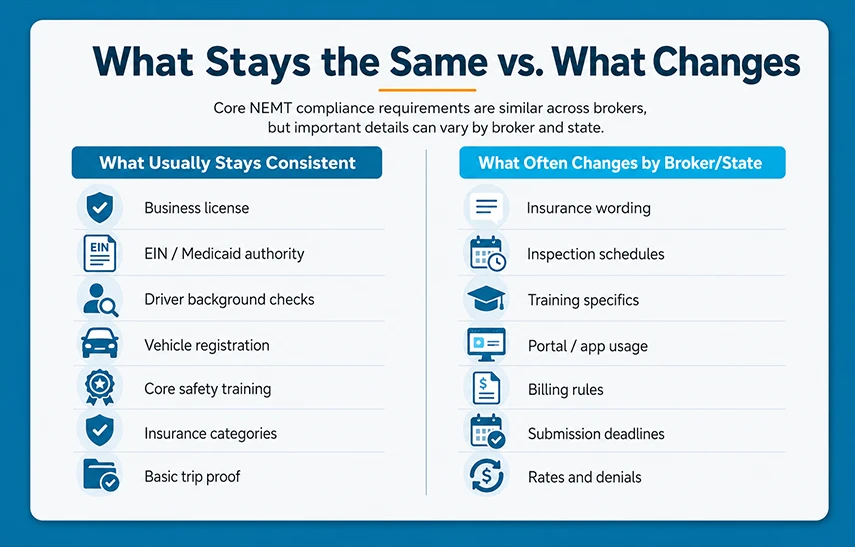
The above-mentioned transitions are the ones that have been announced in the first half of 2026. More are definitely to come. But before you can prepare for a transition, it helps to be specific about what it touches. It is more than a new logo on the trip assignment. A broker change can affect:
- Credentialing and network enrollment, with a fresh application and approval queue.
- Insurance limits and certificate language, including additional-insured wording.
- Driver and vehicle requirements, inspection schedules, and driver training.
- Trip assignment workflows, portals, driver apps, and any integration you rely on.
- Authorization procedures and eligibility verification at scheduling.
- Rates, billing rules, claim submission windows, denials, and payment cycles.
- Trip documentation requirements and the fields you must produce to get paid.
Some of those change with every contract. Others barely change at all. Knowing which is which separates a transition you manage from one you “survive”.
The Compliance Core That Follows You From Broker to Broker
The core credentialing categories are remarkably similar across brokers. Modivcare, MTM Health, and Verida all screen along the same lines, so a provider ready for one is rarely starting from zero with the next. Nearly all want:
- An active business license, a federal EIN, and Medicaid operating authority in your states.
- Commercial auto and general liability insurance naming the broker as additional insured, plus workers’ compensation.
- Current registration, passing safety inspections, and ADA-accessible vehicles for the service levels you offer.
- Driver background checks, motor vehicle record reviews, and drug and alcohol screening.
- CPR and first aid, defensive driving, passenger assistance and wheelchair securement training, ADA education, and annual HIPAA and fraud-waste-abuse training. Some want PASS certification within a set window after you join.
- Use of the broker’s portal and driver app, increasingly paired with the auditable electronic trip records that states now mandate.
Vehicle inspections show how much those details move. Whether federal DOT inspection rules reach your fleet depends on factors like vehicle weight and how you operate, so many medical transportation vans sit outside them while state and broker inspection schedules still apply in full. Insurance limits, additional-insured language, inspection schedules, training, documentation rules, and technology requirements vary by broker, contract, and state. These categories repeat, but their details do not, and this is not a problem. The goal is not a single credentialing packet you assume works everywhere. It is one compliance system that absorbs each broker’s variations without rebuilding itself.
How to Build a Compliance Operation That Works With Any NEMT Broker
The backbone of a universally compliant NEMT business comes down to a handful of habits. None are exotic. What matters is that they live in your operation, not in whichever broker portal you logged into last.
Keep One Master Credential Record
Business documents, insurance, driver credentials, training, background checks, MVRs, drug screens, vehicle registrations, and inspections belong in a central record you own. A broker portal is where you submit things, not your system of record.
Build a Broker and State Requirement Matrix
Constantly track the broker requirements in each state you serve, including where those requirements differ. This is the document that turns a surprise transition into a checklist.
Track Every Credential Expiration Date
This is the quiet one that costs real money. Brokers can and do withhold trip assignments from providers whose credentials have lapsed, and nobody calls to warn you first.
Capture a Minimum Trip-Proof Dataset on Every Ride
Store the evidence by default, whether or not today’s broker asks for every field. Audits and revalidation may come at any moment; be ready to present trip IDs, driver, vehicle, pickup and drop-off times and locations, mileage, route and status history, and any required passenger or facility confirmation. The exact fields vary by broker and state, but wherever we look, providers increasingly need electronic evidence connecting the authorized trip, passenger, driver, vehicle, time, and location.
Stay Integration-Ready
When a broker offers an API or direct integration, use it. A transition should not mean dispatchers manually reproducing a workflow inside somebody else’s portal. That difference shows up in payroll long before it shows up in compliance.
Reconcile Every NEMT Broker Separately
Compliance gets you into the network. Clean billing keeps the relationship worth having. Track billed, approved, denied, and paid amounts by broker rather than in a blended total, because rate and rule changes disappear inside aggregated revenue. Watch loaded versus unloaded mileage, multi-load billing, no-shows, wait time, submission windows, denials, and payment cycles. Those terms decide whether a contract is profitable, and they shift when a broker does. Knowing how NEMT brokers get paid upstream explains most of the rate pressure you feel downstream.
Treat Every Announced Broker Change as a Project
Follow the local news and government announcements to get notified about the broker transition in advance. If there is a change, credentialing is just the first step, not the whole strategy. Providers are told to enroll with the new broker well before the cutover, but readiness also means vehicle inspections, data exchange, trip acceptance, dispatch workflow, driver training, rate setup, and claims testing. Start before the cutover, not on it.
Manage Broker Concentration Risk
A provider that depends heavily on one broker carries concentration risk. One procurement decision can materially change trip volume, rates, or coverage area. Spreading across brokers and payer types softens that. Beyond the brokers moving contracts this year, that mix might include national networks like American Logistics, SafeRide Health, or Ride Health, or regional players like Call the Car in California, Provide A Ride in Ohio, Alivi Health across the Southeast, and MART and GATRA in Massachusetts.
Taken together, those habits describe infrastructure, not paperwork. That infrastructure is what RouteGenie is built to run: driver and vehicle credentials tracked in one place with expiration dates that surface before a broker withholds your trips, GPS-verified trip records captured on every ride, direct broker integrations instead of dispatchers retyping trips into somebody else’s portal, and billing reconciled broker by broker so a rate change cannot hide inside a blended total. Your broker relationships can change without forcing your operating system to change with them.
The Secret Sauce to Staying Compliant With Major NEMT Brokers
There is no trick here, and no relationship with any single broker that protects you when the contract moves. The closest thing to a secret is owning the requirements yourself instead of borrowing them from whoever is assigning your trips this year.
The broker that controls your Medicaid volume may change. Its portal may change. Rates and billing rules may change. But the underlying requirements stay familiar: credentialed drivers, compliant vehicles, current insurance, documented trips, and evidence the transportation actually happened.
Build those capabilities around your own operation rather than around one broker, and the next contract change costs you a credentialing application instead of a quarter of revenue. Ready to work with any broker in your market? See how RouteGenie helps you stay compliant and get paid across every broker you serve.
About the author


Serhii Taborovskyi is the founder and author of the Automotive Territory YouTube Channel, with 300,000 subscribers and counting. He is an avid automotive enthusiast and a fan of any and all motorized vehicles. Serhii is a visiting author at RouteGenie, sharing his expertise for the benefit of the NEMT community.