
Autonomous Vehicles in Medical Transportation: Will Self-Driving NEMT Arrive?
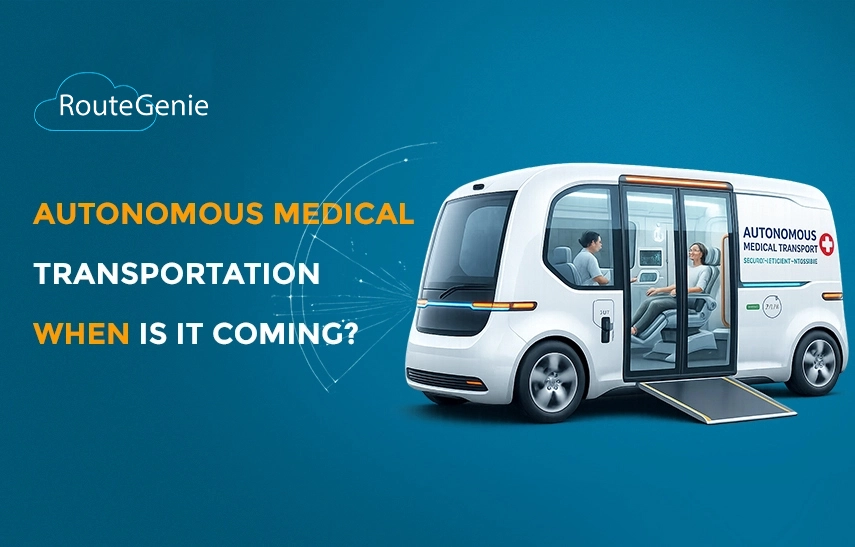
Autonomous Vehicles “AVs” are steadily crossing from prototypes to commercial reality. AVs are already in use in taxi services, public transportation, cargo hauling, and personal vehicles. In the US, the emergence of automotive autonomy is clearly evident by the scale of Alphabet-owned Waymo. As of February 2026, they operate approximately 2,500 robotaxis delivering 450,000 weekly paid rides across six U.S. cities.
Given this momentum, there has been speculation that autonomous medical transportation could be on the horizon. This article examines the state of self-driving vehicle technology to determine whether the Non Emergency Medical Transportation “NEMT” industry could adopt it in the future. We will also try to forecast a realistic timeline for AVs emergence and how providers and other medical transportation stakeholders could prepare for it.
Contents:
- How Self-Driving Vehicles Can Help Medical Transportation
- Autonomous Vehicles 101
- Where Autonomy Already Works Today: The Proving Grounds
- The Legislative Patchwork: No Federal Framework
- The Barriers: Technology Is Still Maturing, Passengers Lack Confidence, Labor Protests, and the Assistance Paradox
- Autonomous NEMT: Timeline and the Path Forward
- Prepare for the Semi-Autonomous NEMT in Advance
How Self-Driving Vehicles Can Help Medical Transportation
The value proposition of self-driving medical transportation is rather tempting. The shifting demographic trends our nation will face in the upcoming decades create a two-pronged challenge for the NEMT industry: the growing number of senior riders and a shrinking driver workforce.
Under these circumstances, AVs offer a potential solution that would enable providers to continue ensuring Americans' reliable access to healthcare. However, these projections assume technological maturity, regulatory approval, and public acceptance - outcomes that remain uncertain.
Self-driving NEMT transport could potentially:
- Lessen the impact of labor shortages: AV advocates project that every 1,000 AVs will need just 200 workers to manufacture and service them
- Lower ride costs: lower labor and more predictable insurance expenses
- Broader 24/7 service availability
- AVs free up transportation providers’ resources for higher acuity trips
- High safety ratings. AVs’ safety data reported by Swiss Re increasingly validates the technology: Waymo vehicles have 92% fewer bodily injury claims and 88% fewer property damage claims than human drivers across 25.3 million miles.
- Broader rural coverage
These are undeniable advantages that could someday create a demand for AVs in medical transportation. But when, if ever, will this technology reach the reliability standards required by healthcare transportation? How will assisted ride transportation fit in this model? To determine the timeline, we must first understand the autonomy levels and the current technology.
Autonomous Vehicles 101
The SAE autonomy framework defines six levels: 0 through 5, where 0 means that the driver fully controls the vehicle and 5 implies full self-driving under any scenarios.
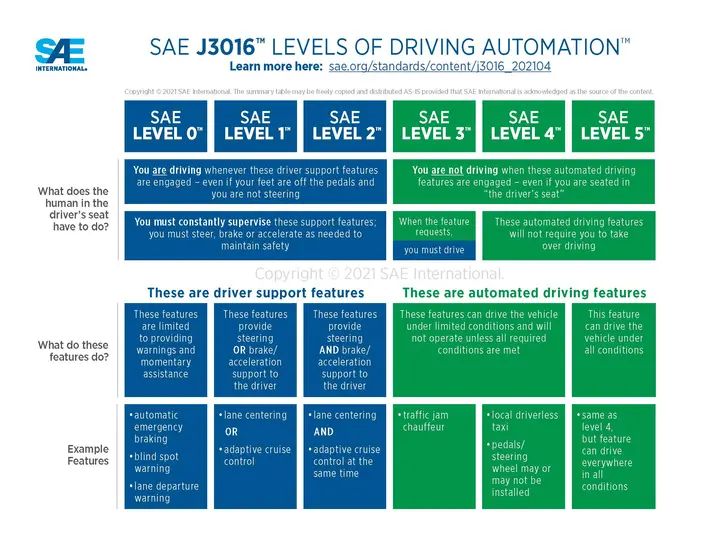
Today’s consumer market is dominated by Level 2/2+ (Driver Assistance) systems, which require constant human attention, and legal liability remains with the driver. Tesla's “FSD Supervised,” Ford’s “BlueCruise,” and GM's “Super Cruise” assistants all fall under this category.
For now, Level 3 (Conditional Autonomy) has proven commercially unviable. Mercedes-Benz launched Drive Pilot as America's only "hands-free, eyes-off" consumer system in 2023, then paused it in January 2026, citing "high costs, state-by-state regulatory burdens, and supplier issues."
Level 4 (High Automation) enables full autonomy within defined operational domains: no steering wheel required, manufacturer/operator assumes liability, and Level 5 is full self-driving (everywhere under all conditions). For NEMT, Level 4 represents the minimum viable threshold, since medical transportation liability requires the transportation provider, not the patient, to assume responsibility for vehicle safety. This liability issue is the primary reason McKinsey's January 2026 industry survey found 49% of experts believe Level 2+ will remain the mass-market standard through 2035.
So, can we conclude that AV progress will be stalled for another decade since automakers prefer to stick with lower-level autonomy that is easier (cheaper) to deploy commercially and legally? Not necessarily, since independent, autonomous startups are already moving forward with AV deployments in our cities, across campuses, and in areas directly connected to NEMT.
Where Autonomy Already Works Today: The Proving Grounds
According to the report released by the Autonomous Vehicle Industry Association (AVIA), as of mid-2025, the United States autonomous vehicle industry has surpassed 145 million autonomous miles driven on public roads. These numbers were accumulated by robotaxis, zero-occupancy vehicles, and long-haul trucks. Here are the most dominant representatives of the technology in passenger transportation.
Robotaxis: Waymo Dominates, Competitors Struggle
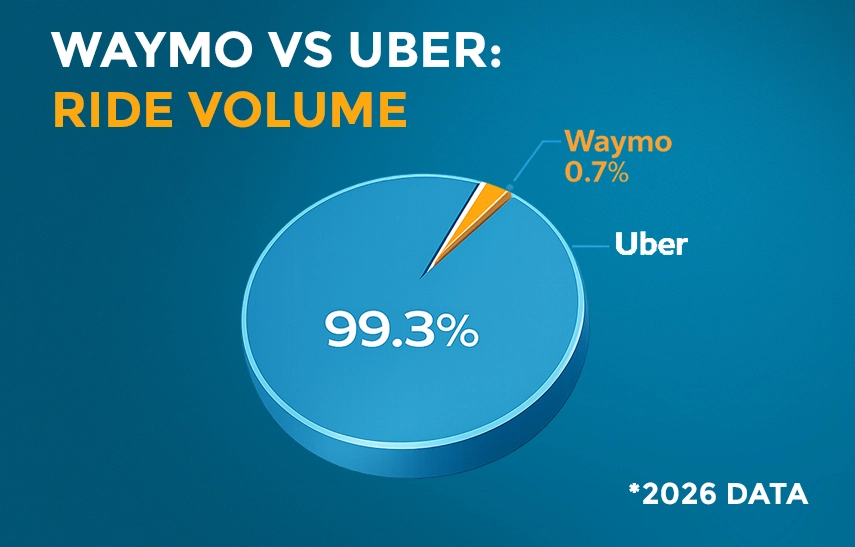
Waymo is the undisputed leader in robotaxis nationwide. In 2025, it delivered 15 million rides, tripling the 2024 volume. Alphabet’s subsidiary already operates in Phoenix, San Francisco, Los Angeles, Atlanta, Austin, Miami, and as of April 2026 in Nashville and Orlando. These cities offer 24/7 service in all-electric Jaguar I-PACE vehicles, with recent expansions into highway driving in top-tier markets. Their ambitious goal is to deliver 1 million fully autonomous rides every week by the end of 2026, and one strategy to achieve it is a partnership with their human-operated rival, Uber.
Waymo’s competitors are showing lower numbers, but let’s review them. Here are the other notable robotaxis of the US as of 2026:
- Amazon’s Zoox: operating in Las Vegas, using a unique electric mini-bus platform instead of retrofitting existing vehicles.
- Tesla's Robotaxi: operating in Austin, Texas, with supervised Model Y vehicles. Tesla's Cybercab – a purpose-built two-seater without a steering wheel or pedals – entered initial production in early 2026, but the underlying FSD software remains Level 2 supervised, and Tesla has not filed for federal exemptions to operate without manual controls.
- Motional: supported by Hyundai and their Ioniq 5 EVs.
- May Mobility x Lyft: operates a fleet of hybrid-electric Toyota Sienna minivans.
- Avride x Uber: Launched in Dallas, Texas, in December 2025.
- GM’s Cruise: Waymo’s former closest rival, but this 8-year, $12.1-billion investment collapsed in December 2024 following an incident involving a pedestrian.
U.S. Public Transit: Small-Scale Pilot Programs with Safety Operators
Unlike a noticeable push for AVs in the taxi cabs industry, public transit adoption remains limited. The majority of shuttle services are in testing stages. They operate at low speeds (often under 25 mph) and along fixed or geofenced routes with safety attendants on board.
Here are the most prominent examples of successful autonomous public transit implementation in American communities:
- NAVI (Jacksonville, Florida): Launched in June 2025 by Beep Inc. as "nation's first fully autonomous public transit system". 14 Ford E-Transit vehicles on 3.5-mile downtown route.
- goMARTI (Minnesota): Rural ADA-compliant service operating 90% autonomously through harsh winters, covers 20 sq miles, 150+ stops, 30,000+ rides delivered. First pilot targeting "mobility-isolated" populations with free on-demand rides.
- Waymo + Via (Chandler, Arizona): Waymo robotaxis integrated into the city's official Flex microtransit at $2/ride. Most successful public transit-robotaxi integration model to date.
- The Connect (Detroit): Mid-2025 relaunch; fully driverless by August 2025 (safety operators aboard). Free community transit loop.
- MiCa (West Palm Beach, Florida): Auve Tech Level 4 shuttle on a 0.9-mile downtown route. Fully autonomous with remote monitoring; no onboard human driver.
- Relay (Fairfax County, VA): autonomous shuttle pilot.
- RAPID (Arlington, TX): on-demand AV shuttle connecting to transit stations.
- Holon x Lyft: Lyft has announced plans to integrate "steerless" Holon autonomous shuttles into its network starting in late 2026, specifically targeting structured environments like campuses and business districts.
Healthcare-Adjacent Deployments: The Closest Analogs to Autonomous NEMT
Finally, we arrive at the first attempts to deploy autonomous vehicles to perform functions similar to those currently covered by non-emergency medical transportation fleets.
Detroit's Accessibili-D program represents the nearest NEMT equivalent. Launched in June 2024 and extended through 2026, it covers 11 square miles in the downtown Detroit area and targets residents aged 62+ and those with disabilities. The service uses three May Mobility vehicles (two wheelchair-accessible) to provide free rides to healthcare facilities across 110+ downtown locations. The service has been a huge success among users with a solid 5-star rating.
Additionally, Beep Inc. operates two electric bus programs. One is the VIVA Campus shuttles to address logistical challenges in patient transportation on the VA Palo Alto Hospital grounds. Plus, they run California's PRESTO Rossmoor program, which is a pilot autonomous shuttle service designed for residents of the 55+ senior community.
Due to the sensitive legal implications of transporting people with limited mobility, these programs are very low-key. However, legislators are carefully examining the developing situation, and potentially, the barriers for AV implementation in medical transportation will be lowered. Here is the current state of legislative affairs.
The Legislative Patchwork: No Federal Framework
A major barrier to achieving autonomy on the roads is the absence of a unified federal framework. Each state has a fragmented regulatory environment, and federal government agencies provide only non-binding guidance, not rules. For instance, NHTSA's April 2025 Automated Vehicle Framework established "three principles: prioritize safety, unleash innovation, enable commercial deployment".
Many federal pro-AV bills are constantly introduced, like the SELF DRIVE Act, but for now, final decisions remain with the states, which have dramatically divergent approaches. Over 60 state bills emerged in early 2025 on safety and liability, creating a patchwork that both enables adoption leaders and slows nationwide rollout via uncertainty.
Here are the most pro-autonomy parts of the nation and their approaches to dealing with the AV technology:
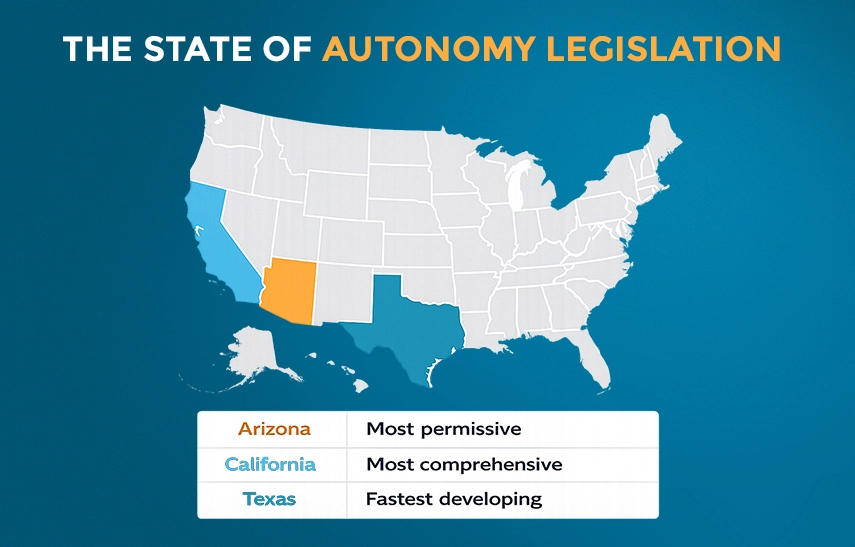
Arizona. Most permissive: no permit required, self-certification, state preempts local regulation.
California. Most comprehensive: three-tier permitting, $5 million insurance requirement, safety case documentation, and collision reporting.
Texas. Newly regulated under SB 2807 (September 2025), requiring TxDMV authorization before Level 4/5 deployment.
However, even in these states, a critical regulatory gap remains regarding medical transportation: there are no federal or state regulations, nor draft bills, governing autonomous vehicle use for NEMT.
The Barriers: Technology Is Still Maturing, Passengers Lack Confidence, Labor Protests, and the Assistance Paradox
The main reason legislators are not giving AVs a full go-ahead is their constituents' skepticism. Self-driving autos will have to overcome some major barriers before the takeover of the passenger transportation and non-emergency medical mobility, in particular, begins. Let’s sum them up.
- Despite flashy headlines about the imminent arrival of self-driving cars, the technology is not yet ready for full deployment. As noted earlier, car manufacturers scaled back their investment in self-driving tech, while autonomy companies (despite exponential growth) still account for a very small market share. In addition, recent Congressional testimony confirmed that even the industry’s leader, Waymo, still employs remote support agents in the U.S. and abroad to assist vehicles in rare edge cases. While this model is consistent with current Level 4 deployments, it highlights that fully autonomous systems still rely on human oversight in complex real-world conditions.
- Impressive safety data reported by autonomy startups is not enough; public trust remains the critical bottleneck. AAA's February 2025 survey found only 13% of U.S. drivers trust riding in self-driving vehicles, with older adults showing significantly lower trust in AVs, the exact demographic NEMT serves. However, experience changes minds: J.D. Power found 76% of people who've actually ridden in AVs reported confidence versus just 20% among non-riders.
- Higher ride costs: Obi data shows that, in 2025, Waymo remained on average 12.7% more expensive than Uber and 27.3% more than Lyft. But, to be fair, in 2025 Waymo prices dropped 3.62% while Uber and Lyft rose 12% and 7%. This gap is expected to narrow even further as labor costs for human-driven services continue to increase.
- Additionally, labor opposition to self-driving cars intensifies. More than 4 million jobs are at risk of disruption, including 2.2 million truck drivers and 448,000 taxi/shuttle drivers. Uber and Lyft drivers protest Waymo's robotaxi expansion, while the Teamsters Labor Union pushed California's AB 316 bill, which would require human operators in autonomous trucks. It passed with more than 90 percent bipartisan support before the governor vetoed it.
- But specifically for medical transportation, the fundamental barrier isn't trust or labor disruptions. The technology can't replace caregiving. Medical transportation is more than taking people from point A to Point B. The value-based NEMT model that is widely expected by the modern payers and riders needs skills beyond driving: door-to-door assistance, wheelchair and stretcher management, CPR certification, HIPAA compliance.
Indeed, many ambulatory NEMT trips can be handled without driver assistance, but the operator must take over in complex scenarios and assist the person with limited mobility. This will remain true until robots are there to offer help (but that timeline is even further away and is a topic for another conversation). Skilled human labor is of vital importance in the NEMT ecosystem.
Autonomous NEMT: Timeline and the Path Forward
So here is the key takeaway. As of 2026, no autonomous medical transportation services operate nationwide. The NEMT broker Modivcare, providing 64 million annual rides, acknowledges exploring AV technology but has announced no deployments.
The current state of technology and sceptical public opinion force industry analysts to offer widely divergent timelines for self-driving NEMTs. They range from optimistic 2030 pilots to skeptical assessments that autonomous NEMT may never achieve commercial viability.
The most commonly cited scenario suggests:
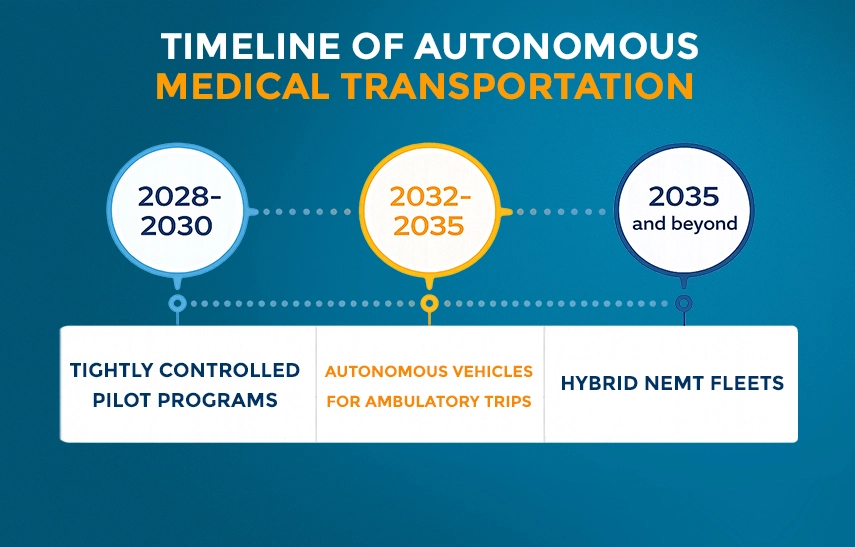
2028-2030: Tightly controlled pilot programs by large brokers, providers, and NEMT divisions of ridesharing platforms.
2032-2035: Autonomous vehicles begin to handle a growing number of low-acuity, ambulatory trips after the projected 2030 large-scale robotaxi deployment enables this transition.
2035 and beyond: Hybrid NEMT fleets become more common: robotaxi medical transport vehicles for routine trips and human drivers for complex cases.
Prepare for the Semi-Autonomous NEMT in Advance
There you have it. Even the most optimistic forecasts do not place the rise of AVs in NEMT before 2032. In the next decade, autonomous vehicles could potentially handle some volume of straightforward ambulatory trips, while human drivers and caregivers will remain essential in managing the bulk of orders and complex cases.
However, transportation providers have to prepare for the turbulent 2030s. The United States Census Bureau has recently revised its projection that in 2034 (previously 2035), seniors 65 and older will outnumber children under 18. This will inevitably lead to increased demand and labor shortages in medical transportation.
Whether AVs ultimately prove a viable solution for NEMT remains uncertain. If the autonomous future of medical transportation arrives, it will be augmentation, not replacement. The RouteGenie platform thrives on the operational complexity that adopting hybrid fleets could introduce. We provide operational flexibility, supporting current human-driven operations while maintaining the architectural capability to integrate emerging technologies if and when they mature.
Contact RouteGenie to discuss how our platform can support your long-term operational strategy.
-
About the authors
-
 Cameron CraigREAD MORE
Cameron Craig is CEO of RouteGenie, the leading software platform for medical transportation. Drawing on a career spanning operations, transit, and healthcare, Cameron joined RouteGenie in 2025 to lead the company's next phase of growth. He is focused on expanding the platform and building solutions that help NEMT providers and brokers run smarter, more scalable businesses. Cameron holds an MBA from the University of Michigan Ross School of Business and a BA from the University of Illinois, and writes about the future of technology, operations, and their impact on business growth.
 Yurii MartynovREAD MORE
Yurii Martynov is the Marketing Director at RouteGenie, the leading software platform for medical transportation. With years of experience in the NEMT industry, Yurii leads brand strategy, demand generation, and go-to-market efforts that help transportation providers and brokers discover the tools they need to grow. Working closely with NEMT providers, brokers, and healthcare organizations has given him a deep understanding of the challenges facing the industry. He writes about NEMT operations, healthcare transportation trends, and the evolving role of technology in connecting patients to care.
-
