
NEMT Scheduling Software: RouteGenie Feature Spotlight
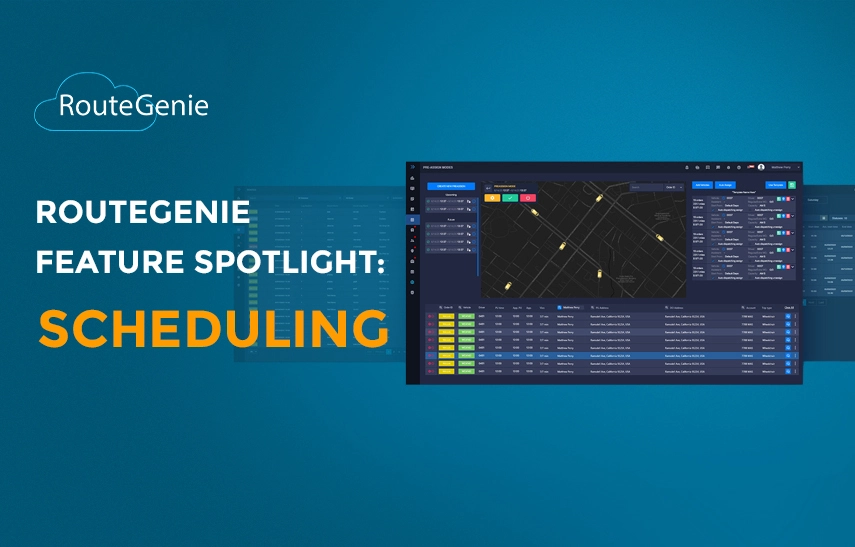
A new medical transportation owner with three vans can run the schedule out of a smartphone’s calendar app. For about a week. Past that, the same calendar app that runs your dentist appointments stops keeping up with what an NEMT operation actually has to track. Here's where it breaks, and what real NEMT scheduling software does instead.
This is the next entry in our feature spotlight series. We've covered NEMT routing, which builds the path drivers take, and dispatching, which assigns trips in the moment. Scheduling is the layer that sits above both. It's how trips get into your system, who they're assigned to, when they happen, and on which vehicle.
Contents:
- NEMT Scheduling Software: Why a Calendar in Your Phone Is Not Enough
- How Medical Transportation Scheduling Software Pulls Trips from Every Source
- Recurring Trips and Same-Day Changes in NEMT Scheduling
- Authorization, Vehicle, and Driver Checks at Intake
- Automated Medical Transportation Scheduling with Auto Preassign
- One Source of Truth for Scheduling, Dispatch, and Billing
- Test NEMT Scheduling Software on Your Own Trips
NEMT Scheduling Software: Why a Calendar in Your Phone Is Not Enough
With today’s technological advancements, every beginner entrepreneur expects to run their small business from their phone. But for medical transportation, the reality is a bit more complicated. Scheduling in a calendar app allows tracking one thing: the appointment. But NEMT requires tracking three at once. Every trip ties up a rider's pickup window, a driver's shift, and a specific vehicle. The mismatch shows up almost immediately, preventing any meaningful scaling and potentially breaking the law.
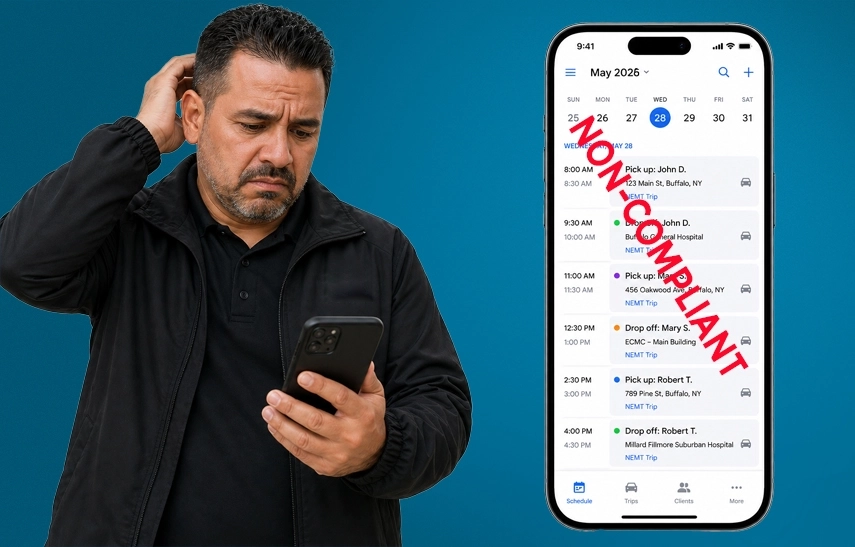
- Double-bookings go unnoticed. The same van you booked for Mrs. Chen's 9:00 a.m. dialysis run can quietly sit on a 9:05 wheelchair return ten miles away. Nothing flags the conflict. NEMT scheduling software refuses to place the second trip in the first place.
- Drive time isn't part of the math. A calendar will let you stack a 9:00 a.m. pickup in Brooklyn and a 9:30 a.m. pickup in the Bronx onto the same driver (for non-New Yorker readers, these places are far apart). Real scheduling software flags it as impossible before the trip locks in.
- Vehicle capability isn't tracked. A calendar event doesn't know the difference between an ambulatory sedan and a wheelchair-accessible van. Book a stretcher rider into a vehicle with no lift, and you get a refused trip and a call from the broker. Scheduling software stores rider needs (ambulatory, wheelchair, stretcher, bariatric, oxygen) and matches them to vehicle capabilities in the background.
- It can't find shared rides. Two riders going to the same dialysis clinic at 8:00 a.m. from neighborhoods on the same corridor should travel together. A calendar treats them as separate appointments and sends two vehicles. NEMT scheduling software flags the overlap and routes them as one trip, on one vehicle, with one driver. That single bit of math is the difference between paying for one shift and paying for two.
- Nothing flows through it. Trips from major medical transportation brokers like MAS, MTM, ModivCare, Verida, and Veyo arrive through APIs and provider portals, and none of that lands in iCloud. Billing on the other side needs every trip with its authorization number, codes, and CMS-1500 fields. With a calendar in the middle, you're retyping every trip on the way in from the broker and again on the way out to billing.
- It isn't HIPAA compliant. Storing a rider's name alongside a medical appointment time and location on a personal Google or Apple account isn't a gray area; it is a clear violation. To handle protected health information, one needs a HIPAA-compliant software platform. It's software built for the job, with audit logs, access controls, and a signed BAA from the vendor.
How Medical Transportation Scheduling Software Pulls Trips from Every Source
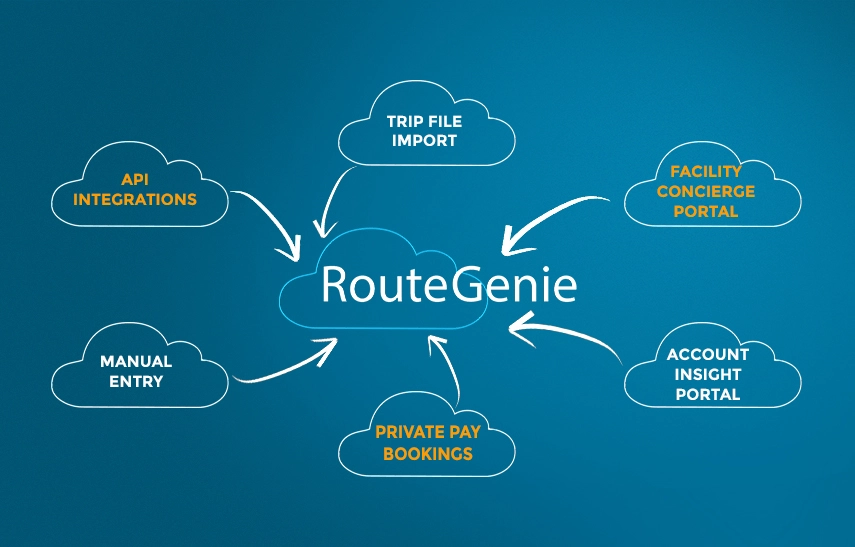
NEMT scheduling software has to be a funnel. For instance, RouteGenie pulls trips in through six routes: API integrations with major brokers (handled by RouteGenie's ImportGenie sync engine), a Trip File Import tool that handles .csv and some .pdf broker files, Account Insight and Facility Concierge portals so payers and adult day centers enter trips themselves, an iframe website widget for private pay bookings, a passenger app for self-service, and manual entry for phone-in trips.
What matters isn't that there are six options. It's that all six land in the same schedule. The dispatcher building tomorrow's day doesn't care how a trip arrived. They only need it to be there.
Recurring Trips and Same-Day Changes in NEMT Scheduling
A dialysis rider on a Monday, Wednesday, and Friday schedule books 156 trips a year. Each one carries the same authorization, the same pickup window, and the same vehicle requirement. Entering it 156 times by hand isn't a system. It's a way to get sick of your own business by April.
RouteGenie generates the recurring instances from a single standing order. When the rider goes into the hospital for a week, you pause that week without breaking the rest of the series. When the schedule shifts to Tuesdays, Thursdays, and Saturdays, you change one record. This matters for any operator running steady recurring volume: dialysis, adult day programs, behavioral health, and PACE participants on fixed clinic schedules.
Recurring trips are the predictable half of the schedule. The other half is unplanned. Brokers add same-day trips. Riders cancel. Discharge timing slips. A schedule built at 6:00 p.m. the night before is going to be wrong by 10:00 a.m. the next morning. Medical transportation scheduling software has to absorb the changes without forcing a rebuild. Add-ins drop into existing capacity instead of triggering a new vehicle, often as a multi-loading opportunity onto a route that's already running. Cancellations clear space and notify the affected driver. Will-call rides sit in a pending state until the rider is ready.
Authorization, Vehicle, and Driver Checks at Intake
A missing prior authorization caught at the moment a trip is created costs you nothing. The same missing authorization caught six weeks later, after the trip had run, costs the cost of the trip plus the cost of an appeal. RouteGenie checks eligibility and authorization at intake, before the trip is added to a driver's manifest. Trips that need verification get flagged. Trips with dead authorizations don't make it onto the schedule. A clean schedule going in means clean claims going out, which we discuss in the billing spotlight.
The system runs the physical match in the same step. Rider needs are one-half: ambulatory, wheelchair, stretcher, bariatric, oxygen, language preference, and regular driver requests. Vehicle and driver attributes are the other: capacity, lift type, equipment installed, driver certifications, and training. Mismatches get flagged before the trip locks in. A wheelchair rider can't be assigned to a van without a lift. A driver without a stretcher endorsement can't be put on a stretcher run.
This is the kind of check that's invisible when it works and disastrous when it doesn't. Most operators have at least one story about a rider showing up for a sedan when they needed a lift. Software that does this matching as a background step makes that story stop happening.
Automated Medical Transportation Scheduling with Auto Preassign
Auto Preassign is where the planning hours come back. The tool builds tomorrow's full schedule across drivers and vehicles in a few clicks. Over twenty configurable settings let you weight the result toward what your operation cares about: cost vs. service level, multiload opportunities, broker priority, single-load preferences for high-acuity riders.
There are two ways to run it. Tell RouteGenie which drivers and vehicles you have available, and the system fits the trips into them. Or hand it the trip volume and let it tell you what shifts you should staff. Operators using Auto Preassign end the night with a published schedule. They don't spend the next morning building one. Great Lakes PACE, an existing RouteGenie customer, has reported scheduling time dropping from six hours to 45 minutes after the switch.
One Source of Truth for Scheduling, Dispatch, and Billing
Drivers see the day in the driver app. Dispatchers work from the live board. Billing and reporting pull from the same trip records. The schedule isn't five different views of five different spreadsheets. It's one record set, served to whichever team needs it.
That's also why scheduling has to integrate cleanly with dispatching. The handoff between "this trip is planned" and "this trip is happening now" is where most NEMT operations leak time and money.
Test NEMT Scheduling Software on Your Own Trips
The only way to see how this fits your operation is a demo using your actual broker mix and recurring orders. Request a RouteGenie Demo, and we'll walk through your scheduling load.
NEMT Scheduling Software Q&A
What is NEMT scheduling software?
NEMT scheduling software is a system that coordinates medical transportation trips by matching riders, vehicles, drivers, authorizations, and timing in one platform, ensuring trips are compliant, efficient, and correctly assigned.
What does NEMT scheduling software do?
NEMT scheduling software organizes, assigns, and manages medical transportation trips by matching riders with the right vehicles and drivers, validating authorizations, handling recurring and same-day requests, and feeding accurate trip data into dispatch and billing systems.
What is the best NEMT software for scheduling?
The best NEMT scheduling software for most providers is RouteGenie, because it automates trip assignment, handles recurring and same-day scheduling, integrates with major brokers, and connects scheduling directly with dispatch and billing in one system.
About the author


Serhii Taborovskyi is the founder and author of the Automotive Territory YouTube Channel, with 300,000 subscribers and counting. He is an avid automotive enthusiast and a fan of any and all motorized vehicles. Serhii is a visiting author at RouteGenie, sharing his expertise for the benefit of the NEMT community.