
The Genie Journal, October 2026: A House Bill Would Verify Every Medicaid NEMT Trip

Originally sent to subscribers in October 2026. Issue #10 · October 15, 2026
Contents:
- The Signal
- What's Moving This Month
- Rideshare for the Trips Your Fleet Can't Cover
- AI for Transportation Providers. Prompt of the Month: Build a Transportation Performance Report for Health Plans
- One Thing Worth Your Time
- What's Going On Inside the Lamp
The Signal
A House bill would write electronic trip verification into federal Medicaid law, and the data points it names are ones GPS dispatch already records. CMS and thirty-seven states pledged to measure Medicaid on outcomes. Iowa proposes rides for its low-income adults, Michigan's audit found progress with health plans and gaps elsewhere, and Minnesota's mileage rates moved with fuel again.
What's Moving This Month
A House Bill Would Put Electronic Verification on Every Medicaid NEMT Trip
A bill introduced in the House on September 28 would require every state to adopt electronic verification for Medicaid non-emergency transportation furnished on or after January 1, 2027. H.R. 10618, the STOP Medicaid Fraud Act, is modeled on home care's electronic visit verification rules: each trip verified on six points, the service, who received it, who provided it, the date, the location, and when it began and ended. States already requiring it keep their systems. The bill is a proposal, not law.
Why this matters: Most introduced bills never move. But what this one describes is already the rule in states like Ohio and in many broker contracts, and the six data points it lists are the ones a GPS-equipped dispatch system records on every trip. Providers whose records already carry them are starting from the right place, whatever the final rules say.
CMS and 37 States Pledge to Measure Medicaid on Outcomes
CMS launched Investing in Health Outcomes on September 25 with 37 founding state partners. The initiative moves Medicaid and CHIP quality measurement away from process and paperwork and toward results in prevention, chronic disease management and behavioral health. States that sign the voluntary Medicaid Quality Pledge commit to outcomes over process, a smaller measure inventory, near-real-time digital measurement, and financial accountability tied to results. A CMS analysis from May found roughly 450 reporting requirements across 42 states, most of them process-focused. Participating states have committed to set outcome targets and look for ways to build outcome measures into quality strategies and upcoming procurements.
Why this matters: Dialysis adherence, diabetes control and behavioral health engagement all depend on the ride showing up. As states move procurements toward results, a transportation provider that can hand a health plan completed-trip rates, on-time arrival and no-show reduction is speaking the language the plan is now measured in. That is a different conversation than cost per trip.
Iowa Proposes Non-Emergency Medical Transportation for Its Low-Income Adult Medicaid Members Starting January 2027
Iowa's Department of Health and Human Services published notice on September 17 of State Plan Amendment IA-26-0010, which would add non-emergency medical transportation for the Iowa Health and Wellness Plan, the state's Medicaid coverage for low-income adults ages 19 to 64. Iowa has waived transportation for that group under a federal demonstration. CMS will no longer approve the waiver beginning January 1, 2027, so the state proposes adding NEMT for this group with the same coverage the rest of Medicaid receives. The annualized cost estimate for state fiscal 2027 is $129,367, of which $15,697 is state money. Public comments are open through October 17.
Why this matters: If approved, this is new covered trip volume for a group that didn't have the benefit, arriving on one date for every eligible adult. Providers working with Iowa's managed care plans have one quarter to talk capacity, and the CMS decision behind it is a signal to any other state still waiving rides for this population.
Michigan's NEMT Audit Finds Progress With Health Plans and Gaps Elsewhere
Michigan's Office of the Auditor General released a follow-up on October 13 to its 2022 audit of Medicaid non-emergency medical transportation and rated the state partially compliant on both original findings. The program spent $160.5 million between October 2024 and March 2026, $135.2 million of it through Medicaid health plans. A third of local offices completed no provider eligibility reviews in fiscal 2025. State checklists showed all nine health plans met the credentialing policy and reporting requirements for fiscal 2025 and 2026. The findings arrive as the state rebids its broker contract, with a statewide option on the table.
Why this matters: Eighty-four percent of Michigan's NEMT dollars move through health plans, and plan credentialing is the part the state's checklists show working. That means the file is being read: license, registration, insurance and background checks, current for every driver. A provider whose files pass a plan's review already holds the file any broker or plan will ask for.
How One State Keeps NEMT Rates Moving With Fuel
Minnesota raised its state-administered NEMT mileage rates on October 1, its latest quarterly adjustment under a fuel formula written into state law. Wheelchair mileage now pays $1.92 per loaded mile; it paid $1.76 in April. Protected transport and stretcher mileage pay $2.71, after $2.49 in April. The rate moves with fuel prices each quarter, automatically, and rural trips can qualify for an added mileage adjustment. These are fee-for-service codes, not broker contracts, but the mechanism is the point: when a mile costs more to run, it pays more on a published schedule.
Why this matters: A rate that ignores fuel becomes a service that thins out: fewer vehicles, longer waits, more declined trips. Minnesota's formula is one any state or broker can copy, and providers negotiating anywhere else can put it on the table. The argument isn't margin. It's whether the ride shows up.
Deep Read
Rideshare for the Trips Your Fleet Can't Cover
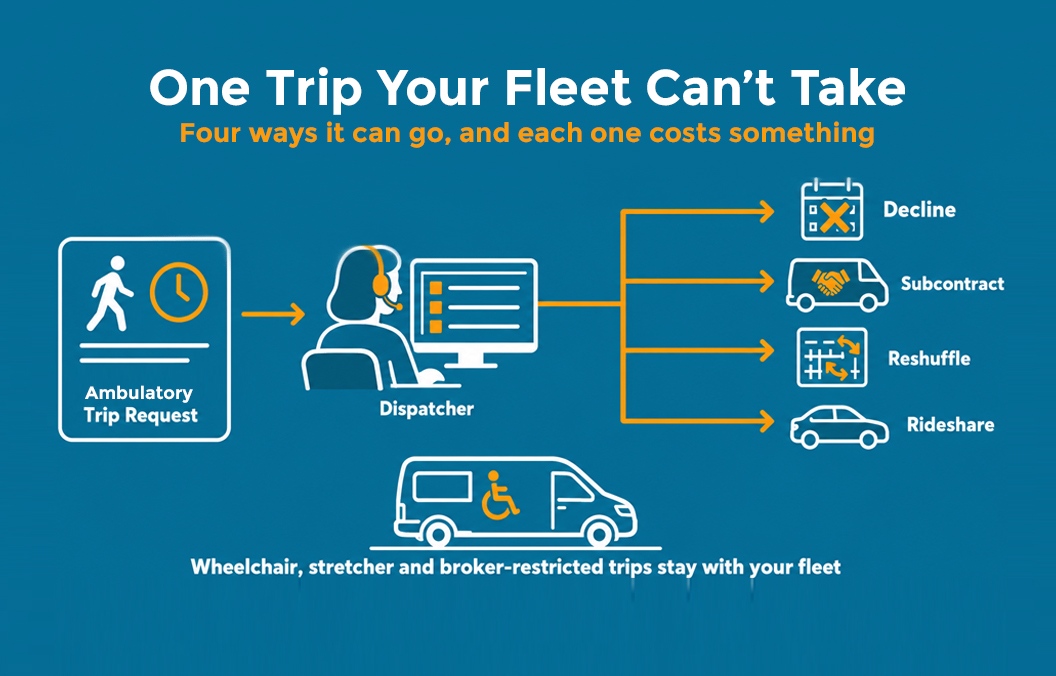
When your fleet can't take the trip. A trip comes in and no vehicle is free. You have three choices: decline it and lose the revenue, hand it to a subcontractor and lose the margin, or reshuffle the day and lose an afternoon of dispatch time. When that happens daily, with late discharges, out-of-area requests and surge weeks, the workarounds become the job. Rideshare adds a fourth choice: a standard passenger car for an ambulatory rider, sent from your own dispatch screen, while your fleet keeps every trip that needs it.
Two filters decide. Patient type first: ambulatory only, no wheelchair or stretcher. Funding source second: private pay and facility-contract trips are yours to route, and broker trips depend on whether the contract permits rideshare, so check before sending any. A trip that clears both can go out. Everything else stays with your fleet.
Where it fits. The dispatcher should see what the trip costs against the payer rate before sending, and the completed trip should land next to every other one. The fit is strongest for providers with regular ambulatory overflow. The full guide shows how one integration handles all of this in practice.
AI for Transportation Providers. Prompt of the Month: Build a Transportation Performance Report for Health Plans
Context: CMS just signed 37 states to a pledge that scores Medicaid on outcomes rather than paperwork, and states will write those targets into managed care procurements. The health plans you contract with are about to be measured on whether members got to dialysis, follow-ups and behavioral health visits. A report that shows your part of that is worth building before they ask for it.
Try this: Paste the prompt into Claude with artifacts enabled. Use aggregated totals only. No passenger names, Medicaid IDs or health details.
"Build an interactive transportation performance report builder for a non-emergency medical transportation company as an HTML artifact, designed so an owner or operations manager can produce a one-page report to share with a health plan or broker. Pre-fill six months of sample data so I can see the report before entering mine. Let me enter monthly totals for the last six months by typing them in or by pasting a CSV with one row per month: trips scheduled, trips completed, trips cancelled by the rider, by the provider, and by the facility or broker, no-shows, late arrivals, and trips by service type (ambulatory, wheelchair, stretcher). Let me optionally split trips by appointment category: dialysis, behavioral health, primary care follow-up, specialist, other, with scheduled, completed, late, cancelled and no-show totals for each category. Define each metric before calculating it: completion rate as completed trips divided by scheduled trips, on-time rate against both a pickup window and an appointment arrival time I can set, and no-show rate as rider no-shows divided by scheduled trips. Show how cancellations affect each denominator, calculate category-level rates only when the inputs are complete, and flag a metric as unavailable rather than estimating it. Show the month-over-month trend for each rate as a simple chart, and flag any month where a rate changed by more than five percentage points against the prior month. Generate a plain-language summary a health plan quality manager could read in two minutes, with the three numbers that matter most at the top, and let me add a one-line note on what changed operationally in any month. Produce a one-page version formatted for printing and let me copy the whole thing out as plain text. Use a clean readable layout, store nothing, and keep every input in the browser."
What it does: Turns six months of dispatch totals into the report a plan's quality team wants to see: completion, on-time and no-show by month and, where you enter the detail, by appointment type, with the trend visible and the outliers flagged. The one-page version is the one to attach when a plan or broker asks what you're contributing to their numbers.
Illustrative starting point, not a quality reporting standard. Check your plan contracts for the measures and definitions they actually use before sharing.
One Thing Worth Your Time
A Mayo Clinic study in the Journal of General Internal Medicine put a number on the ride. Across 859,346 in-person primary care visits in five states, patients with unmet transportation needs were 5.2 percentage points less likely to show up, a larger effect than food insecurity, housing instability or financial strain. Virtual visits showed no difference, as you would expect with no trip involved. For a health plan or broker conversation, this is the figure that makes transportation a measured outcome lever.
What's Going On Inside the Lamp
Inside the Lamp Podcast
Thirty-five years in, and the math is the whole job. Insurance on thirty-two vehicles ran past $500,000 this year, and New York keeps raising the minimum wage while Medicaid reimbursement, he says, hasn't kept up. Cameron Craig sits down with Jim Ingalls, Director of Operations at MediCab of Rochester, who started as a driver more than three decades ago and worked up through dispatch and HR. He's blunt about getting dragged onto routing software ahead of a broker GPS deadline, the two employees who left rather than learn it, the driver who stayed on the road past seventy-five because the tablet found his turns, and why, he says, private pay now gets scheduled first while Medicaid fills the gaps.
Want to Be on the Show?
We are booking guests for upcoming episodes of Inside the Lamp. If you run an NEMT operation, work on the broker or payer side, or build something the industry should know about, tell us about it and we will be in touch.
Want to see your own cost per trip before the next rate change lands? Request a RouteGenie demo and we will walk through the numbers with you.