
Behavioral Health Transportation: An NEMT Provider's Guide

Behavioral health transportation is the ride to mental health and substance use treatment: a therapy appointment, a methadone clinic at six in the morning. It's also a substantial share of how Medicaid members use NEMT. In CMS's 2018-2021 NEMT report, behavioral health was the fourth most common type of care people reached through the benefit, behind only preventive care, acute and chronic care, and lab and imaging.
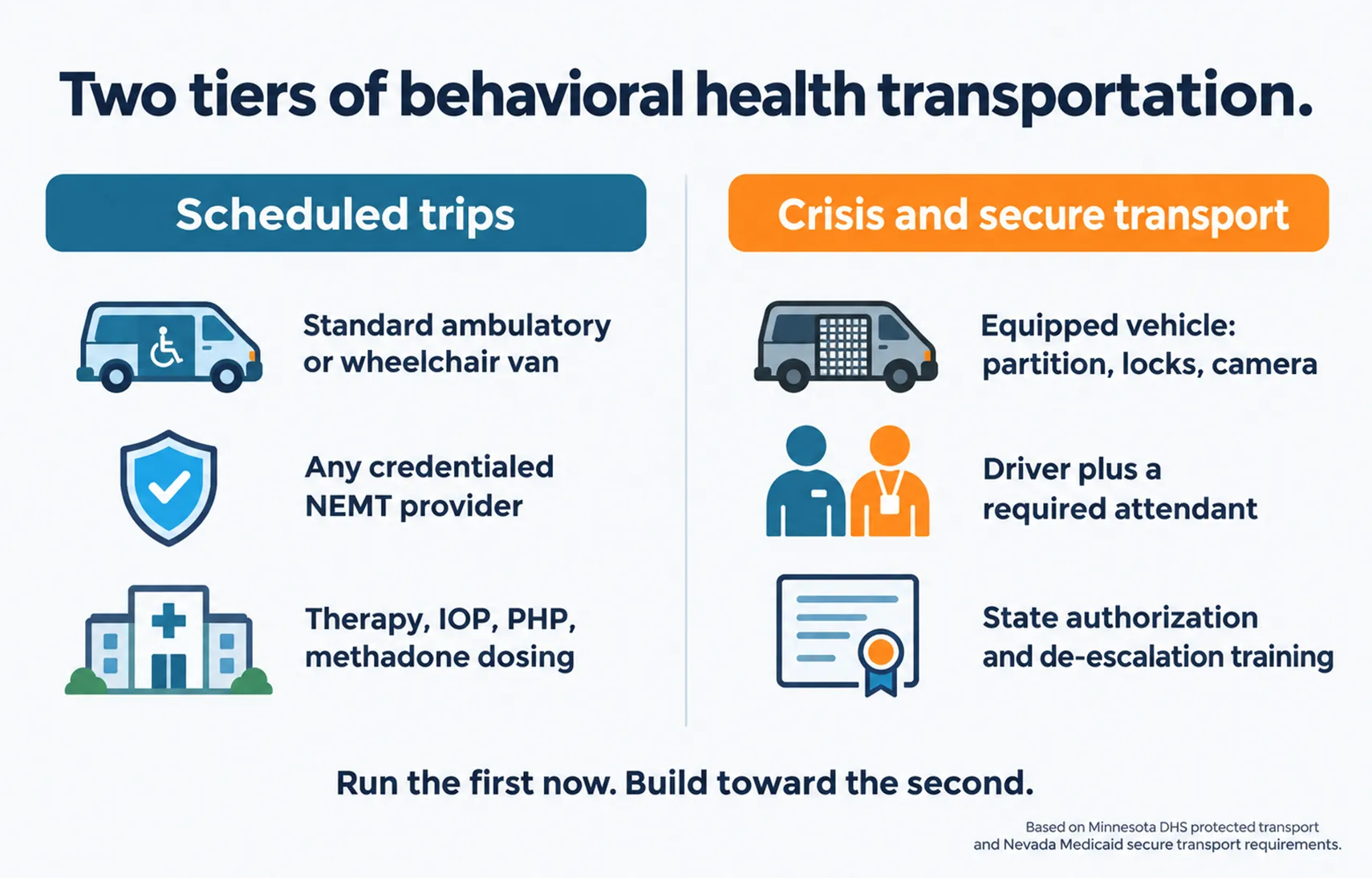
For a provider, the work splits into two tiers that look alike on a trip sheet but run differently: scheduled trips and crisis or secure transport. Run the first now and build toward the second. If you're new to the benefit, begin with what NEMT is.
Contents:
- Types of Behavioral Health Transportation
- Medicaid and Medicare Coverage for Mental Health Transportation
- Why Methadone and Outpatient Programs Create Recurring Trips
- How Reliable Rides Affect Treatment Retention
- Driver Training and Passenger Handling
- Crisis and Secure Mental Health Transportation
- Behavioral Health Transportation Rates and Contracts
- Final Thoughts
Types of Behavioral Health Transportation
The first thing to settle is what counts as behavioral health transportation, because it isn't a single service. It splits into two categories with very different requirements, and the rest of this guide follows that split. These aren't a federal classification, but they match how the work runs:
- Scheduled, voluntary trips. Rides to therapy and psychiatry, to partial hospitalization programs, and to opioid treatment programs for methadone dosing, the same standing-order work that makes dialysis routes predictable. A standard van does the job, and most credentialed providers can carry these, though brokers and MCOs can add conditions.
- Crisis and secure transport. Rides during a mental health emergency, for members certified by a crisis team or on an involuntary hold. Where a state regulates this, it calls for authorization, equipped vehicles, and trained staff, varying by state.
CMS guidance on transportation tells states to weigh behavioral health needs when choosing the mode, and lets them cover specialized transport by trained providers.
Medicaid and Medicare Coverage for Mental Health Transportation
Once the categories are clear, the next question is who pays, and for behavioral health transportation the answer is almost always Medicaid. It covers mental health and substance use treatment, so for eligible members with no other way there, it covers the ride. That doesn't mean a state pays for every trip; medical necessity and state rules still apply.
Medicaid is the single largest payer of behavioral health services in the country, KFF's Medicaid survey reports, and about 39% of enrollees live with a mental health or substance use condition. Not everyone with a condition uses NEMT, but this group leans on it harder than most.
It's fair to ask whether Medicare covers any of this. For routine trips, it doesn't: Original Medicare doesn't pay for NEMT, and the limited transport some Medicare Advantage plans add isn't a base to build on. This is Medicaid-funded work. For the Medicare side, see Medicare Advantage transportation.
Why Methadone and Outpatient Programs Create Recurring Trips
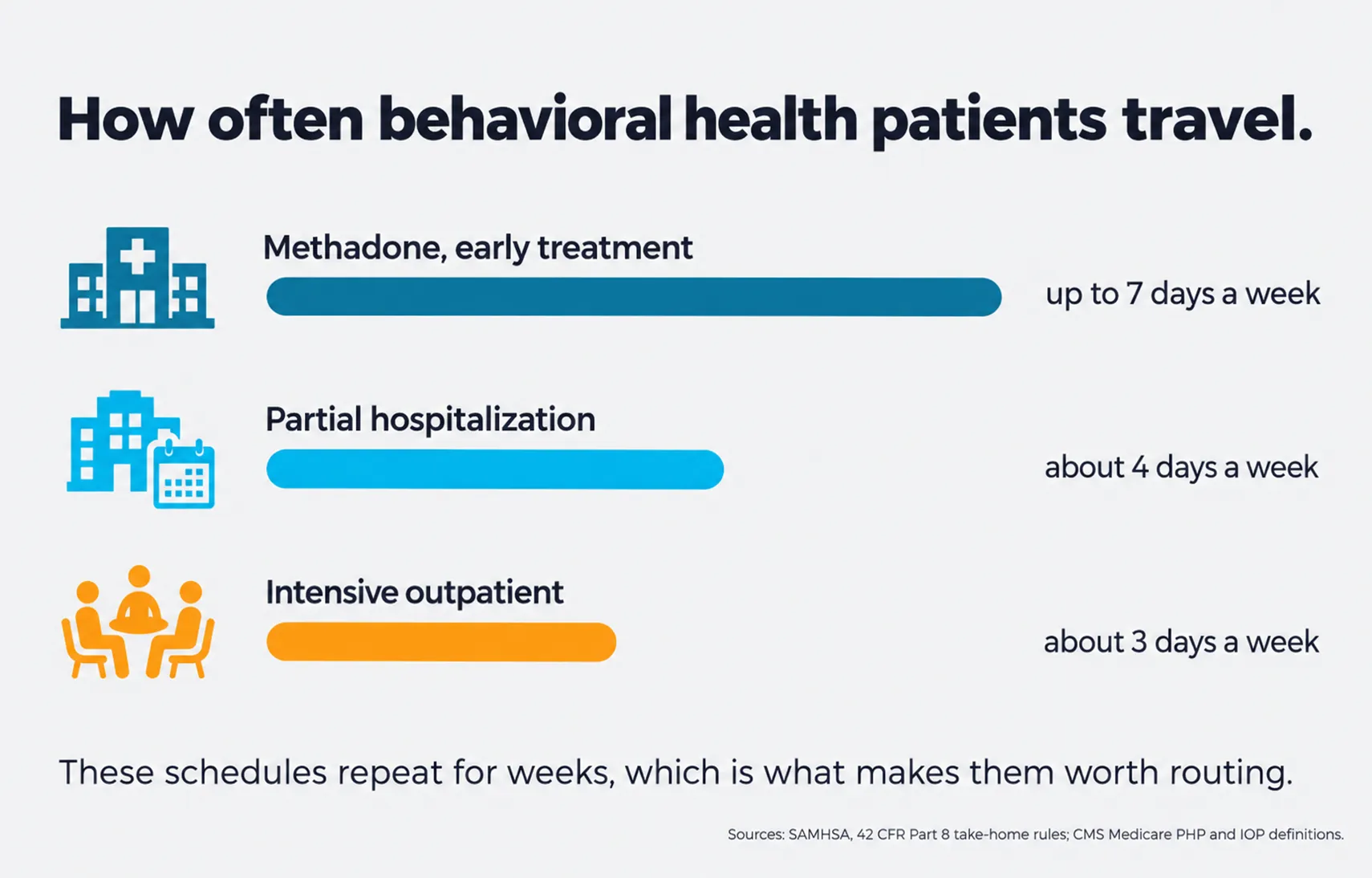
Coverage explains why these trips exist; the schedule is what makes them worth running. Behavioral health hides the same thing that makes dialysis the anchor contract in NEMT: a fixed, repeating schedule you can plan around.
Methadone is the clearest case. Federal rules cap take-home doses under the 2024 opioid treatment rule:
- First 14 days: up to 7 take-home doses.
- Day 15 onward: up to 14.
- Day 31 onward: up to 28.
Those are ceilings, not guarantees. Methadone for opioid use disorder is dispensed through a certified opioid treatment program, not a retail pharmacy, so it ties a patient to the clinic. Early on, take-home limits mean many patients still travel often, in some cases daily. MACPAC's NEMT report describes one Massachusetts patient who rides to a methadone clinic seven days a week.
The clinic visit itself is short. A methadone dose is usually a ten- or fifteen-minute stop, not the open-ended wait a broker's will-call window implies, so dispatching the return leg as a long idle wait strands a vehicle that could be running another trip.
Structured outpatient programs repeat too. Medicare defines partial hospitalization as at least 20 hours a week and intensive outpatient as at least 9, and one contractor's Medicare coverage policy puts partial hospitalization around four days a week. A member attending three to five days a week can generate six to ten one-way trips.
Some behavioral health care moved to a screen, but dosing visits are harder to replace. CMS's NEMT report shows that by late 2021, NEMT volume for opioid-use-disorder medication treatment had passed telehealth. That demand stays on the road.
Standing orders are how you run it. Cluster the pickups, batch the ambulatory riders where the intake window allows, and the economics follow the same multi-loading and deadhead miles discipline as the rest of your operation. NEMT scheduling software like RouteGenie keeps those recurring orders in place.
How Reliable Rides Affect Treatment Retention
A recurring schedule only pays if the trips happen on time, and in behavioral health reliability isn't a soft selling point. Transportation access is linked to whether patients stay in care, though the research shows association, not cause. Two points:
- The type of ride matters. A study of outpatient addiction treatment found that a car, van, or contracted ride was associated with better retention, while transit vouchers or fare reimbursement were not.
- Distance matters. A 2024 treatment retention study across 16 states found that patients within five miles of treatment were more likely to still be in care at 18 months.
You can't claim you lifted a program's retention without the data, but current NEMT reporting on completed trips and on-time arrivals is what a clinic or program director will ask for.
Driver Training and Passenger Handling
Reliability also depends on who's behind the wheel. Behavioral health passengers ask more of a driver than a standard trip, and federal law doesn't require you to be ready. CMS's driver standards ask little more than exclusion screening and a valid license. Nothing in that floor prepares a driver for a passenger in distress.
States that regulate this work set a higher bar worth following:
- Minnesota: drivers and attendants on protected transport complete at least six hours of de-escalation training, such as Crisis Intervention Team training or Mental Health First Aid.
- Nevada: the secure tier requires four hours of de-escalation plus eight hours of behavioral health training, with biennial recertification.
Folding de-escalation into your NEMT driver training is worth doing before a state makes you.
Behavioral health trips also carry handling rules a standard run doesn't: a same-gender driver, a ride with no other passengers, or a vehicle set up for secure transport. An operator with a mixed fleet has to match the right driver and vehicle to each trip, not just send whoever is closest.
Under ADA transport rules, a covered provider can't refuse someone because a disability produces involuntary or unusual behavior. Refusal is allowed only for violent, seriously disruptive, or illegal conduct, or a direct threat to others.
There's also a privacy wrinkle. A manifest showing a methadone-clinic trip can reveal a substance use disorder, so depending on how you got the data and who holds it, 42 CFR Part 2, HIPAA rules, state law, or your broker contract can apply. Either way, keep dispatch notes minimal, use neutral facility labels, and don't pass that information on.
Crisis and Secure Mental Health Transportation
Everything above covers the scheduled tier. The second tier, crisis and secure transport, is where mental health transportation becomes a specialty and the rates climb, a service worth building toward once you meet the requirements below.
What states require varies:
- Minnesota protected transport: for members certified by a crisis team or hospital, staffed with a driver and a required attendant, in vehicles with safety locks, a camera, and a transparent partition.
- Nevada secure tier: built to transport someone in a mental health crisis or on a legal hold, with trained and certified staff.
CMS crisis-care guidance lets mobile crisis teams provide medically necessary transport to crisis stabilization settings. Oklahoma's statewide program reported more than 12,000 transports in its first year. Several states run models like these; some aren't taking new providers, so treat them as proof of demand, not an open door everywhere.
Behavioral Health Transportation Rates and Contracts
Whichever tier you run, the last questions are what it pays and how you get the work. Routine behavioral health trips pay like any other NEMT, and the secure tier pays more. There's no single national rate, since states, brokers, and MCOs set payment differently, but the common shape is a base fare plus loaded mileage. Minnesota's published schedule shows the pattern:
- Scheduled trips: Minnesota pays assisted transport at about $14.30 base plus $1.43 a loaded mile.
- Secure transport: Minnesota publishes its protected transport rate too, at $75 base plus $2.40 a loaded mile, several times the scheduled rate.
Some states publish those secure rates; others set them by contract.
The work itself arrives two ways:
- The broker path. In most states you credential with a Medicaid broker, MCO, or the state to get into the network. Credentialing doesn't guarantee volume; networks can be full and trips assigned by other rules. If you're not enrolled, start by becoming a Medicaid transportation provider.
- The facility path. Approach opioid treatment programs, community mental health centers, and intensive outpatient programs directly, and bring what you'd bring a dialysis center: on-time data and a documented driver protocol. Medical transportation contracts through facilities start with proving you can run the trips reliably.
Many of these facilities already run an informal in-house shuttle, driving clients to housing, day programs, and appointments without billing Medicaid for any of it, sometimes while credentialed to bill. Turning that unbilled shuttle into an organized, billable service solves a problem they already feel.
MACPAC's NEMT report notes that rideshare drivers often aren't trained for members who ride several times a week. That gap is what a reliable operator fills.
Final Thoughts
A lot of behavioral health transport is recurring, Medicaid-funded, and handled by operators who run every trip the same way. The scheduled tier rewards standing-order discipline; the crisis tier rewards a higher bar. RouteGenie handles the recurring scheduling, matches vehicles and drivers to each trip, and produces the data these contracts turn on. Request a RouteGenie demo to see it in action.
About the author


Serhii Taborovskyi is the founder and author of the Automotive Territory YouTube Channel, with 300,000 subscribers and counting. He is an avid automotive enthusiast and a fan of any and all motorized vehicles. Serhii is a visiting author at RouteGenie, sharing his expertise for the benefit of the NEMT community.