
Rideshare Medical Transportation: How to Cover More Trips Without Adding Vehicles

A trip comes in that your fleet can't cover. You can turn it down, call a subcontractor, or reshuffle the schedule. All three cost something: revenue, margin, or an afternoon of dispatch time.
When this happens once, you work around it. When it happens every day (late-notice discharges, out-of-area trips, surge periods that break an optimized schedule), the workarounds become the job.
Rideshare medical transportation is the fourth option. This article covers what Uber Health is, how Uber Health, dispatched from inside RouteGenie, can aid your business, what it costs, who it suits, and how to get started.
Contents:
- What the Uber Health Integration Is
- How the Uber Health Integration Works in RouteGenie
- What the Uber Health Integration Costs
- Who the Uber Health Integration Suits, and Who It Doesn't
- Uber Health Coverage by Service Area
- Getting Started with the Uber Health Integration
What the Uber Health Integration Is
Uber Health is Uber's B2B healthcare transportation platform, separate from the consumer app. Hospitals, non-emergency medical transportation (NEMT) providers, health plans, and brokers use it to dispatch UberX rides (Uber's standard passenger car service, no specialized equipment) for ambulatory patients through an API. The patient doesn't need an Uber account. Documentation is HIPAA-aligned and billing data is available after each trip.
The distinction that matters: you're not joining Uber's driver network. You're accessing it to handle trips your own capacity can't cover, without leaving your existing system. Your fleet stays first. Uber only gets the trips you choose to send.
Why each type of organization uses it is different.
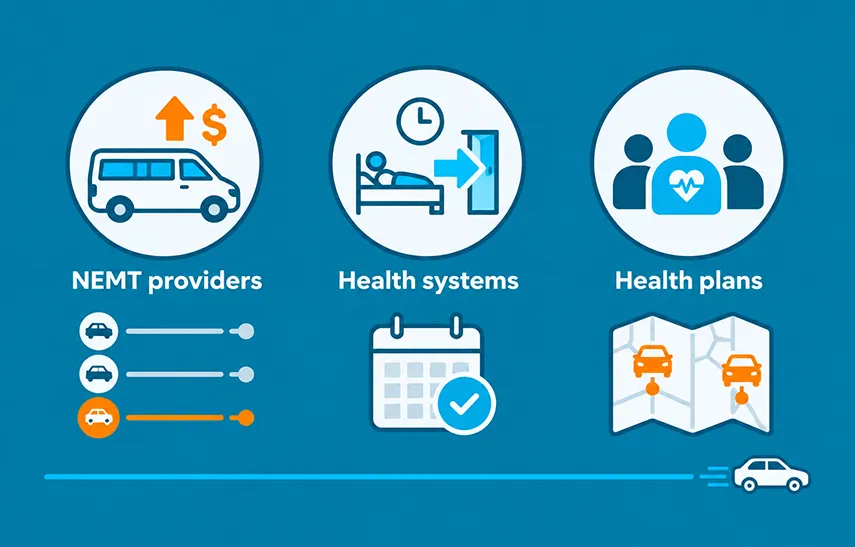
For NEMT providers:
- A trip you'd otherwise turn down becomes billable revenue. If the Uber fare for a short local trip runs below your payer rate, the difference stays with you. RouteGenie shows that margin before you commit, so the decision is informed, not a guess.
- Overflow moves without subcontracting calls or schedule reshuffling.
- Out-of-area trips that would cost more to run than they pay stop being forced declines.
For health systems:
- A discharged patient waiting four hours for a ride is a bed that can't turn over for the next admission. Faster discharges mean more admissions capacity without adding beds.
- Patients who make their follow-up appointments after discharge are less likely to deteriorate and return. Reliable transport after discharge is a direct readmission reduction lever.
For health plans:
- People managing chronic conditions are 1.49 times more likely to face transportation insecurity than those without, according to a 2026 peer-reviewed study across Dallas and Detroit. Those are the same members health plans most need to reach consistently for dialysis, infusion, behavioral health, and follow-up care. Filling ambulatory coverage gaps reduces missed appointments and the downstream costs that follow.
- Underserved markets and after-hours windows get a backstop where the contracted network has no capacity.
How the Uber Health Integration Works in RouteGenie
The typical alternative to this integration is a set of disconnected steps: call a subcontractor for availability, get a verbal estimate, hope the price holds, then manually track a trip that lives outside your system. By the time you have enough information to make a decision, the window may have closed.
RouteGenie brings Uber Health into the same interface your dispatchers already use to assign, track, and bill every other trip. Availability, estimated fare, and expected margin are all visible before you commit. Statuses update automatically. The completed trip stays in RouteGenie with the rest of your trips. No phone tag, no parallel systems, no guessing at cost until after the receipt arrives.
The sequence is the same for every Uber trip: assign, review the estimate, send, and track.
Assign the Trip to the Uber Driver Group
Uber Health appears in RouteGenie as a driver group (the Uber driver group) inside the standard assignment workflow. Assigning a trip to it is the same motion as assigning to any other driver or group. The trip enters the Uber network from there.
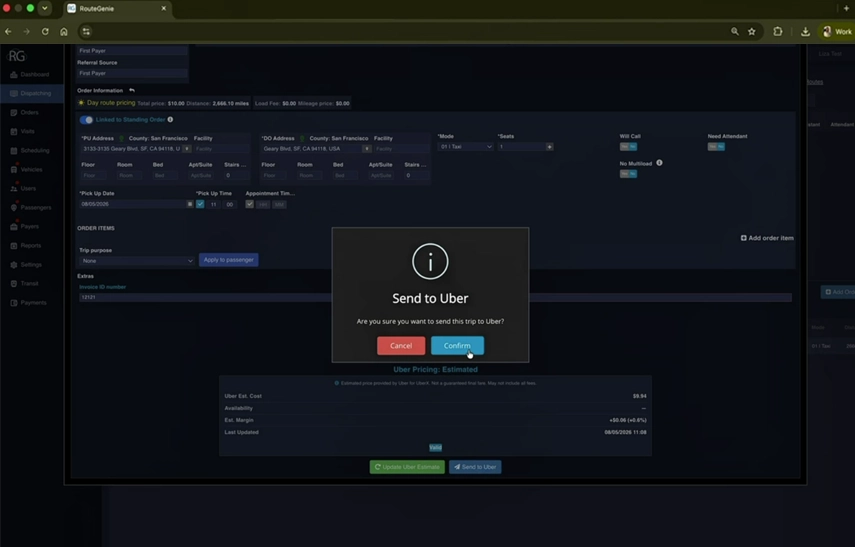 Review the Estimate Before Sending
Before the trip goes to Uber, dispatchers can request a pricing estimate. RouteGenie returns the estimated UberX fare, an availability indicator for the pickup location, and the expected margin in dollars and percent.
Margin only shows if payer pricing is configured for that trip. Without it, the field shows a dash.
The estimate is valid for around five minutes. If the margin doesn't work, the dispatcher doesn't send it. Will-Call trips return a price range rather than a fixed number, because the pickup time isn't fixed yet.
The current Uber cost and margin also appear in the Group Price column on Today's Orders and Reservations, so you can scan them across trips without opening each one.
Bulk Estimates Across Selected Trips
Dispatchers can request estimates for multiple trips at once. Select the eligible trips in Today's Orders or Reservations, use the bulk action, and RouteGenie processes them sequentially and updates each result as it comes back. You don't have to wait for all of them before acting on the ones that are ready.
Lock the Price at Send
When the dispatcher sends the trip, RouteGenie calls a fresh estimate at that exact moment to get a valid fare ID and passes it into the trip creation request. That locks the upfront price.
The locked price isn't a guaranteed final fare. Tolls, surcharges, wait time, and route changes can affect the final cost.
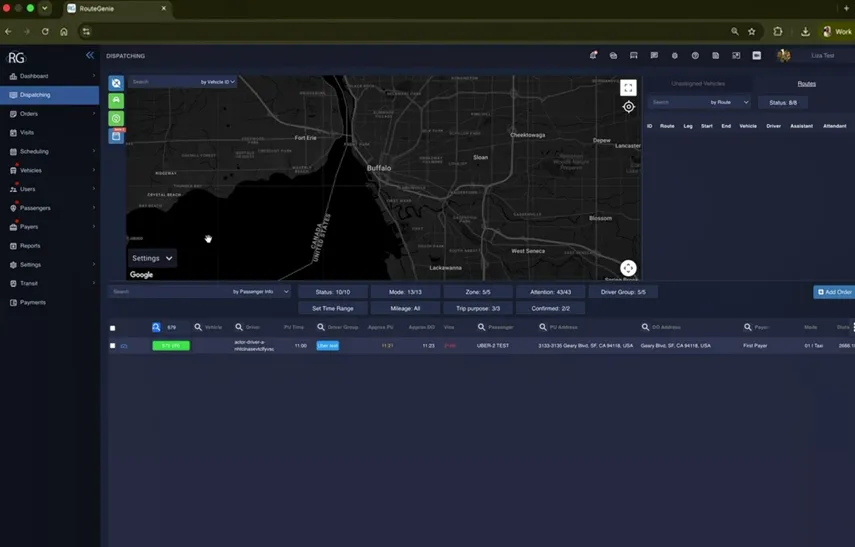
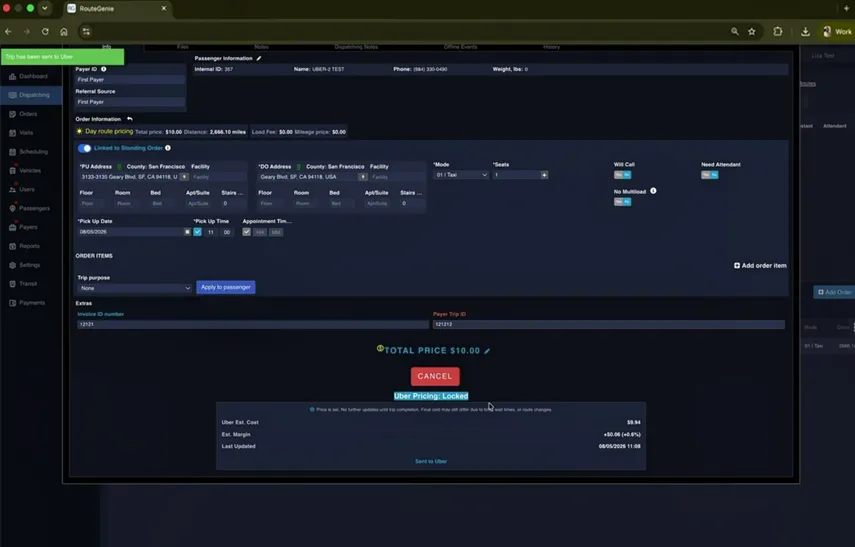 Uber Statuses Appear Natively in RouteGenie
After a driver accepts, Uber statuses map to the RouteGenie statuses your team already works from. Updates arrive automatically, no manual refresh needed.
Approximate pickup and drop-off times show on Dispatch, Reservations, and Today's Orders for Uber trips, and update as the driver moves. Violations show on Dispatch the same way they do for in-house trips. Riders get a text message when the trip is created, in the language set on their passenger profile (15 languages supported), with a tracking link that works without the Uber app. If Uber can't find a driver, the trip returns to your dispatch queue.
The Uber Trip ID appears in Trip Info across Reservations, Today's Orders, and Order Details, and trips can be searched by Provider Trip ID. If something needs resolving mid-trip, dispatchers also have the driver's relay phone number and PIN, a temporary Uber contact line valid only while the trip is in progress.
 After the Trip Completes
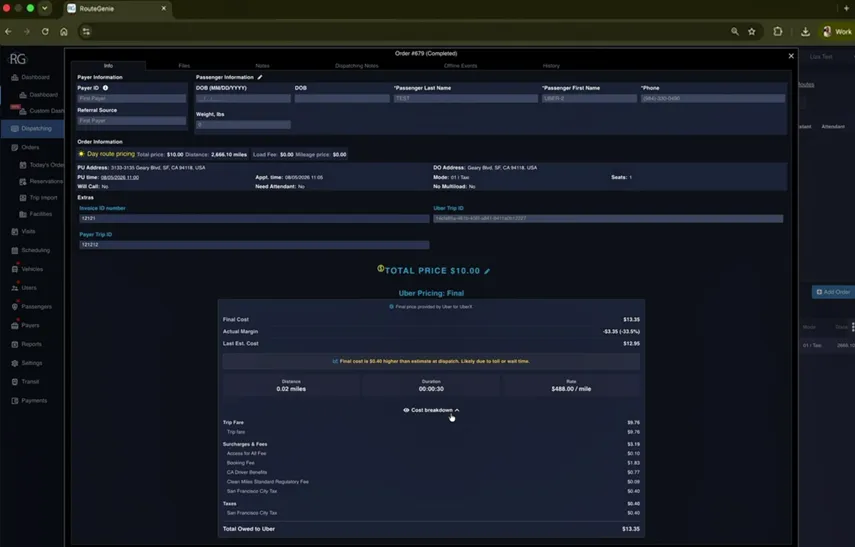
When the trip closes, RouteGenie pulls the receipt from Uber automatically. The pricing section updates to show final cost, actual margin, and the variance against the locked estimate, with an itemized breakdown: base fare, tolls, surcharges, taxes. The completed trip stays in RouteGenie with the rest of your trips.
 Cancellations, No-Shows, and Re-Sends
If a sent trip is canceled or the rider doesn't show, RouteGenie shows the outcome and any fee Uber charged, with a breakdown, next to the price that was locked at dispatch. If no fee was charged, it shows $0.
A trip can be unassigned and sent to Uber again. Each send keeps its own record in the trip's Uber pricing history, so no fee gets lost when a trip is reassigned.
What the Uber Health Integration Costs
RouteGenie charges a usage-based fee per completed rideshare trip, billed on your existing RouteGenie invoice. Your account team can confirm the current rate.
The Uber fare is separate. That's Uber's charge for the ride, and it runs through your organization's own Uber Health account.
Who the Uber Health Integration Suits, and Who It Doesn't

Fit comes down to two filters: patient type and trip funding source.
Uber Health dispatches UberX rides for ambulatory patients only. Trips requiring wheelchair-accessible vehicles, stretcher transport, or clinical supervision during the ride are outside this scope.
On funding source: private pay and facility contracts are clean. The organization controls the routing. Broker-sourced trips depend on the agreement between you and that broker. Some broker contracts permit rideshare and some don't, and RouteGenie doesn't block the send either way, so check your contract before routing any broker volume to Uber. Out-of-area trips sourced through a broker fall under the same contract terms.
From there, fit depends on your operation.
NEMT providers benefit most where the trip mix is private pay and facility-contract-heavy, with regular ambulatory overflow. Operations running primarily on volume from brokers whose contracts don't permit rideshare will find the addressable slice is smaller.
For health systems, the fit is structurally clean. They use patient transportation software to manage hospital discharge transportation and appointment rides, and Uber Health works alongside their contracted transportation providers to cover short-notice discharges those providers can't take.
Brokers and health plans benefit most where contracted networks have coverage gaps, particularly for ambulatory volume in underserved markets or after-hours periods.
Senior care and PACE programs typically see too low ambulatory volume, and payer restrictions often apply. Any operation where most addressable ambulatory trips run through brokers whose contracts don't permit rideshare won't find enough eligible volume to justify the setup. Transit agencies are outside scope.
Uber Health Coverage by Service Area
Uber Health draws on the same driver network as the consumer Uber app, so coverage maps to wherever UberX operates. Urban and metro markets are generally well-served. Rural and lower-density markets are more variable, and that's worth understanding before committing to setup.
Your account team can help gauge coverage for your service area before setup. Once the integration is live, the availability indicator in the pre-dispatch estimate gives dispatchers a real-time read per trip.
Getting Started with the Uber Health Integration
The integration isn't a toggle in settings. It's a short configuration project, and it has one external dependency your team doesn't control: your organization needs its own Uber Health account. RouteGenie connects to that account. It doesn't hold one centrally. Organizations with an existing Uber Health relationship can move quickly. If one doesn't exist, RouteGenie can make the introduction, but onboarding runs on Uber's timeline.
One data requirement to check before your first send: passenger profiles need a phone number. Without one, the trip can't be sent to Uber, because the rider's text notifications have nowhere to go.
Once connected, dispatchers don't need Uber-specific training. The workflow lives entirely inside RouteGenie.
Existing RouteGenie customers can reach out to their account manager or Customer Service to get started. If you're new to RouteGenie, request a demo.
NEMT x Rideshare FAQs
What trips can I send to Uber Health?
Ambulatory trips only, meaning the patient can walk to the vehicle and get in and out of a standard passenger car without help. Wheelchair-accessible, stretcher, and clinically supervised trips stay with your fleet or NEMT partners. On funding, private pay and facility-contract trips are fine because your organization controls the routing. Medicaid trips sourced through a broker need a written agreement from that broker before any go to Uber; without one, they don't, and that applies to out-of-area trips too.
Is the Uber price guaranteed?
No. The upfront price locks when you send the trip, but tolls, surcharges, wait time, and route changes can change the final amount. RouteGenie shows the final cost and the variance against the locked estimate after the trip completes.
What happens if Uber can't find a driver?
The trip returns to your dispatch queue and you handle it the way you would any unassigned trip.
Do I need my own Uber Health account?
Yes. RouteGenie connects to your organization's Uber Health account; it doesn't hold one centrally. If you already have one, activation is quick. If not, RouteGenie can introduce you to Uber Health, but onboarding runs on Uber's timeline.
About the author


Yurii Martynov is the Marketing Director at RouteGenie, the leading software platform for medical transportation. With years of experience in the NEMT industry, Yurii leads brand strategy, demand generation, and go-to-market efforts that help transportation providers and brokers discover the tools they need to grow. Working closely with NEMT providers, brokers, and healthcare organizations has given him a deep understanding of the challenges facing the industry. He writes about NEMT operations, healthcare transportation trends, and the evolving role of technology in connecting patients to care.