
Bariatric Transportation: An NEMT Provider's Guide
America's obesity rate stopped climbing about a decade ago. But the average is misleading, because the share of adults at the heaviest end kept rising the whole time.
That heaviest group drives bariatric demand. A 200-pound patient rides in a standard wheelchair van. A 480-pound patient needs a lift rated past the federal minimum and a stretcher built for the load, usually with a second attendant on the clock. Most NEMT operators can't take that trip, which is exactly why it's worth looking at.
Contents:
- Bariatric Transportation vs. Standard NEMT
- Demand for Bariatric Transportation Is Rising
- Bariatric Transport Requirements
- The Injury Risk in Bariatric Patient Handling
- What Bariatric Transportation Pays, and Where the Margin Is
- Final Thoughts
Bariatric Transportation vs. Standard NEMT
Bariatric transportation is non-emergency medical transport for patients whose weight or size exceeds what standard equipment handles. It sits inside the broader category of non-emergency medical transportation services, but almost every operational assumption changes.
There's no national weight threshold that defines it. Brokers treat bariatric as a level-of-service flag, not a number: Modivcare's medical necessity forms carry a bariatric checkbox under both wheelchair and stretcher service and require height and weight on every request, with no published cutoff. Operators draw their own line wherever their equipment stops working.
Four things separate a bariatric trip from a standard one:
- Equipment capacity, which governs whether you can accept the trip at all
- Crew size, since a safe transfer often needs a second or third set of hands
- Time on scene, because transfers take longer and doorways and hallways need assessing
- Vehicle selection, which has to be settled at dispatch, not at the curb
Demand for Bariatric Transportation Is Rising
Demand for bariatric transportation keeps growing even as the overall obesity picture has started to improve. Obesity isn't one category, and the improvement hasn't reached the heaviest end of it.
CDC splits adult obesity into three classes:
- Class 1 obesity (BMI 30 to 35): about 175 to 205 pounds at 5'4", 205 to 235 at 5'9"
- Class 2 obesity (BMI 35 to 40): up to roughly 235 pounds at 5'4", 270 at 5'9"
- Class 3 obesity, which CDC calls severe obesity (BMI 40 and above): starts there, with no ceiling
These are epidemiological categories, not transport categories. BMI doesn't determine the vehicle a patient needs; weight, mobility and equipment dimensions do. A 270-pound patient at the bottom of Class 3 usually rides in a standard wheelchair van. The classes matter because they show which part of the population has been moving.
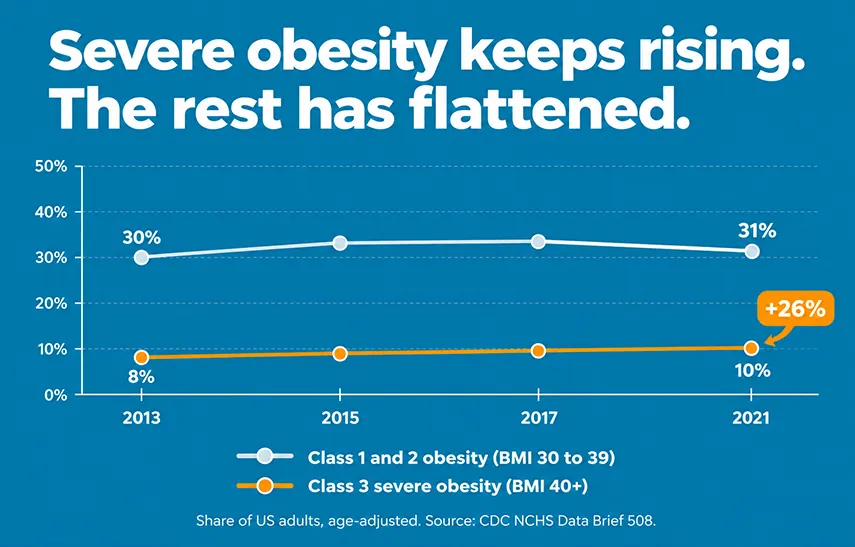
The headline obesity rate plateaued about a decade ago, and survey data since 2022 shows it falling. Better medical management, bariatric surgery, and GLP-1 medications have all changed what's possible. The decline coincides with rapidly rising use of semaglutide (Wegovy) and tirzepatide (Zepbound), which Gallup now puts at 11% of adults, up from 3% in 2024. Population surveys can't say how much of the decline the drugs caused, and Gallup is careful not to claim it.
Severe obesity didn't follow. In NCHS data covering August 2021 through August 2023, 9.7% of US adults had severe obesity on an age-adjusted basis, up from 7.7% a decade earlier. Over the same period the overall obesity trend wasn't statistically significant.
GLP-1 Drugs Won't Change That Overnight
Percentage weight loss doesn't translate into crossing an equipment threshold. A Cleveland Clinic study of 7,881 patients published in Obesity found mean weight loss of 8.7% at one year, well below trial results. For a patient at 480 pounds, that's about 40. The lift rating, stretcher capacity and crew requirement don't change.
Access is the other limit. As of January 2026, KFF counted 13 state Medicaid programs covering GLP-1s for obesity, down from 16 three months earlier. CMS's BALANCE model may widen that from May 2026, but it's voluntary and guarantees no one coverage. Without it, even manufacturers' cash programs run $300 to $450 a month. Medicaid enrollees are the population NEMT serves, and for now they're the least likely to get these drugs.
Nothing here suggests bariatric demand drops off soon.
Bariatric Transport Requirements
Vehicle and Equipment
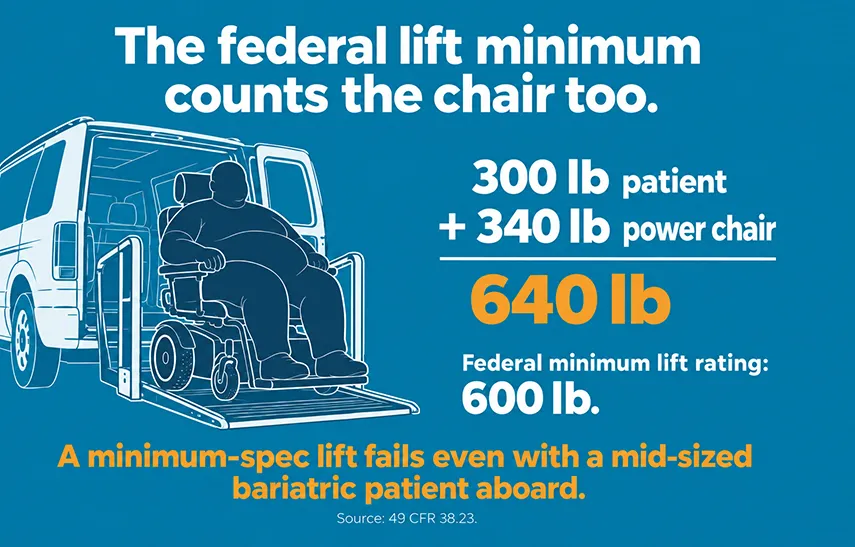 The federal accessibility standard is the floor, and it's lower than most assume. Under 49 CFR 38.23, a vehicle lift must carry a design load of at least 600 pounds, with a platform at least 28½ inches wide and 48 inches long. Ramps 30 inches or longer must support 600 pounds; shorter ramps, 300.
Here's the detail that catches operators out: the 600-pound rating is for the passenger and the wheelchair combined, not the passenger alone. Bariatric power chairs and stretchers are heavy by themselves. Pride's Jazzy 1450 wheelchair, a common 600-pound-capacity model, weighs about 340 pounds empty. Add a 300-pound passenger and the lift has to carry 640 pounds, which is over the federal minimum. So a lift that only meets the minimum can't handle most people who arrive in a bariatric power chair. The 600-pound figure is the lowest rating the law allows, not a bariatric standard.
Above the lift, the rest of the kit has to match: widened stretchers and reinforced cots, securement rated for the combined load, and room to work beside the patient rather than over them. The choice between a stretcher and a gurney decides what you can accept, and wheelchair passengers still bring the usual ADA securement requirements with less margin for error.
Crew and Handling
One driver alone is the wrong staffing model above a certain weight, and driver training has to cover transfer technique, not just safe driving.
Dispatch has to know the patient's weight before assigning the vehicle. That sounds obvious and fails constantly, because the information lives in a phone call instead of the trip record.
The Injury Risk in Bariatric Patient Handling
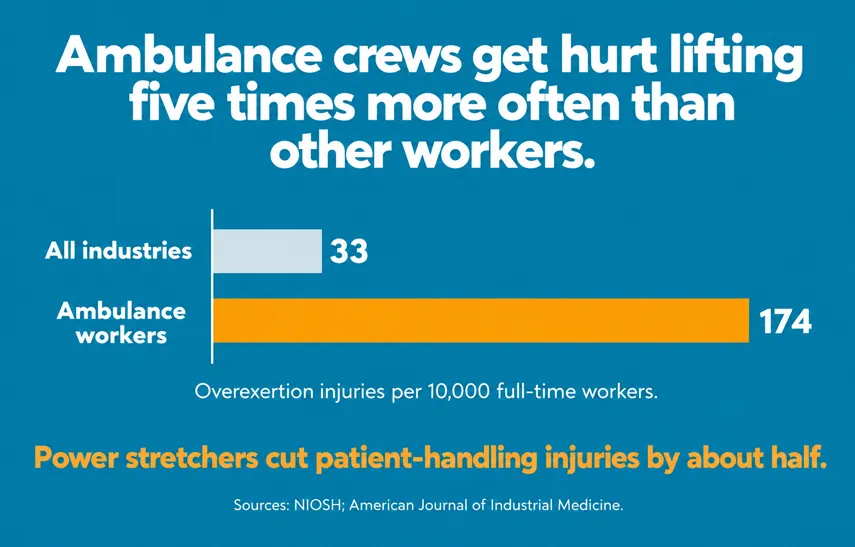
Bariatric patient handling carries an injury risk that falls on the crew as much as the patient, and on the provider's books it's the most expensive risk in the business. NIOSH, citing 2014 BLS data, puts overexertion injuries at 174 per 10,000 full-time ambulance workers against a 33 per 10,000 all-industry average, more than five times the rate. Hospital workers sat at 68, nursing home workers at 107.
Patient weight is directly implicated. In a NIOSH survey of EMS clinicians treated in emergency departments for lifting injuries, close to half described the patient as heavy or obese.
Powered equipment appears to help. An interrupted time-series study of a Winnipeg EMS system, published in the American Journal of Industrial Medicine, estimated patient-handling injuries fell by about half after power stretchers arrived. That's a modeled estimate from one Canadian agency, not a guarantee, but it points the right way for anyone weighing a capital purchase against workers' compensation exposure.
What Bariatric Transportation Pays, and Where the Margin Is
Here's the uncomfortable part. Medicare's ambulance fee schedule has no bariatric service level and no weight-based add-on. Payment runs by clinical level of service, so weight alone doesn't change what a transport is worth.
State Medicaid treatment varies. Massachusetts recognizes bariatric patients explicitly within an unlisted ambulance service code paid by individual consideration with prior authorization. Texas names extreme obesity as a circumstance that can justify an extra attendant on an ambulance, billed separately with prior authorization. Ohio pays a flat attendant fee of $15 to $18, which doesn't cover an hour of labor. Most of the dozen states we reviewed had nothing bariatric-specific in their public schedules.
Public fee schedules don't capture every payment arrangement. Managed-care organizations and brokers often use contracted rates, and programs variously bundle the added cost, reimburse extra attendants, use an unlisted-service mechanism, or offer no separate bariatric payment. The upshot is that the rate is negotiated rather than looked up, which is a different problem and a more workable one.
That's where the opportunity sits. When a service is scarce, hard to deliver and unpriced on any public schedule, the provider who can perform it has leverage that doesn't exist in standard wheelchair work. Three channels follow:
- Direct facility contracts, where hospitals and skilled nursing facilities can use NEMT software like RouteGenie to request bariatric capacity on short notice and have no alternative when nobody local can take the trip
- Private pay, which carries no fee schedule at all and prices on capability
- Broker negotiation, where documented bariatric capability becomes a reason to ask for a rate above the standard tier
All three turn on proving you can do the work. That means reporting on completed bariatric trips, on-time performance and incident history. Getting medical transportation contracts with facility partners starts there, and providers not yet enrolled on the payer side should begin with becoming a Medicaid transportation provider.
Final Thoughts
Bariatric transportation is one of the few corners of NEMT where capability itself is the competitive advantage. The equipment costs real money and the trips are harder to run, but providers with documented bariatric capability can compete for trips that equipment-constrained competitors may have to decline. RouteGenie tracks vehicle capability, matches it to patient requirements at dispatch, and produces the performance data these contracts are won with. Request a RouteGenie demo to see how it handles specialized transport.
About the author


Serhii Taborovskyi is the founder and author of the Automotive Territory YouTube Channel, with 300,000 subscribers and counting. He is an avid automotive enthusiast and a fan of any and all motorized vehicles. Serhii is a visiting author at RouteGenie, sharing his expertise for the benefit of the NEMT community.