
The Genie Journal, September 2026: Rural Health Dollars Are Buying NEMT Capacity
Originally sent to subscribers in September 2026. Issue #09 · September 17, 2026
The Signal
Rural health grants funded NEMT vehicles and driver hiring in Alabama and West Virginia, and Michigan and Ohio opened the next round of contracts. Colorado cut rates, and providers brought trip cost data to the state’s rate review committee, which voted to revisit its lowest-paying codes. Washington also published its first national roadmap for driverless vehicles.
Contents:
- What’s Moving This Month
- Deep Read
- AI for Providers. Prompt of the Month: Build Your Driver Safety Program
- One Thing Worth Your Time
- What’s Going On Inside the Lamp
What’s Moving This Month
Rural Health Dollars Are Buying NEMT Capacity
Federal Rural Health Transformation funding is turning into vehicles, drivers and transportation programs. Alabama announced 138 grants worth more than $144 million on August 24, several going straight to non-emergency medical transportation. The DCH Health Care Authority received $2 million for a dedicated NEMT program across west Alabama, and Touchstone Transport received $1.12 million for wheelchair-accessible electric vehicles. Smaller awards funded accessible vans, drivers, discharge transportation and scheduling technology. West Virginia opened a separate $2.34 million opportunity the same day, aimed at adding capacity rather than replacing it.
Why this matters: Transportation is being funded as healthcare infrastructure, and the money is reaching dispatch software as well as vehicles. Hospitals and rural health systems now hold grant dollars, and many will look for transportation partners rather than build a program from scratch. That is an opening for providers who already have accessible capacity, credentialed drivers and working technology.
Colorado Rate Cuts Reach the Street, and Providers Bring Cost Data to the State
Colorado’s July 1 Medicaid reductions are showing up in service. Base trip fees dropped to $12.40, roughly a third of the previous $36.40, and mileage fell to $2.75 against $3.00, with a 2 percent across-the-board cut on top. One provider ended ambulatory service in El Paso County in late August, and Transit-to-Care closed entirely on September 1. Providers brought cost data to the state’s August 21 rate review meeting, where the committee voted unanimously to lift the lowest-paying codes and ask the legislature to fund a study of real trip costs. Colorado also opened statewide broker contracting on September 1, ahead of a January 1 cutover.
Why this matters: A two-thirds cut to a base rate is a real hit, and Colorado providers are feeling it. What changed in August is that the rate became a matter of public record, and providers who showed up with numbers moved a committee to question its own benchmarks before it reports to the Joint Budget Committee November 1. The nearer deadline is the broker transition, and contracting is the step that determines whether you are carrying trips on January 1.
Washington Publishes Its Driverless Vehicle Roadmap
The U.S. Department of Transportation released America Leads, its national strategy for automated vehicles, on September 3, setting federal priorities through fiscal year 2030. It directs the National Highway Traffic Safety Administration to develop the first federal safety standards for automated driving system competency, and previews rulemakings adapting commercial vehicle regulations for driverless operation. The strategy creates no binding requirements, and it contains no wheelchair-accessible vehicle mandate.
Why this matters: This is the framework where any future accessibility requirement would be written, and right now it is silent. Worth watching rather than worrying about. Wheelchair securement, hands-on assistance, rural distance and higher acuity trips stay with trained people and accessible vehicles, and nothing here changes that.
A $12 Million Fake-Ride Operation Got Caught by the Data
The Justice Department charged four alleged members of a Bronx organization prosecutors call the “War Room” on August 20, connected to at least $12 million in allegedly fraudulent Medicaid transportation claims. Prosecutors say the group was not a transportation company at all. It recruited Medicaid members, paid them kickbacks, logged trips that never happened, and used spoofing software to fabricate coordinates, then sold that data to companies that billed Medicaid. The scheme unraveled because none of the rides matched a medical visit anyone had billed for. The defendants are presumed innocent.
Why this matters: Verification did its job here. Coordinates invented on a laptop behave nothing like location data a dispatch system produces while a trip is happening, and that mismatch is what investigators look for. Providers whose GPS, passenger records, appointment times, driver activity and billing come out of one connected workflow have nothing to reconstruct when a payer asks. Cases like this return trip volume to the providers serving it.
Two States Put the Next Round of NEMT Contracts in Play
Worth having on your radar even if neither affects you today. Michigan issued an NEMT broker RFP on August 27 for Medicaid fee-for-service beneficiaries, contemplating statewide service across both peninsulas rather than the three counties covered now, paid through a monthly capitated rate per eligible beneficiary. Proposals are due October 30. Ohio issued a Request for Information on August 25 on verifying Medicaid NEMT trips statewide, asking how trip verification data should connect to claims, managed care and fraud controls.
Why this matters: Neither has an outcome yet, but together they show where the industry is heading. Broker footprints are getting larger, and verification data is expected to move through the whole Medicaid system rather than sit in a driver app. Providers who keep credentialing files current and trip records complete are ready for either.
Deep Read
 NEMT Fuel Costs in 2026: What Providers Control When Prices Swing
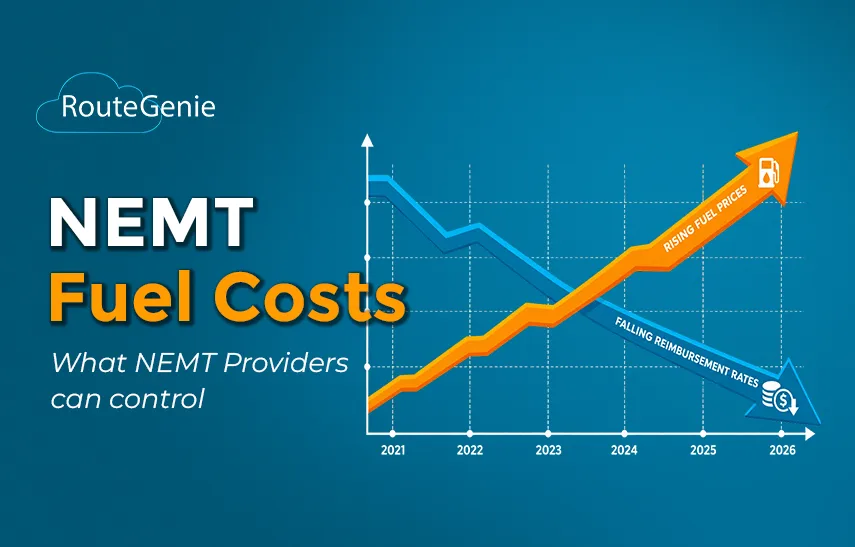
The swing. Gasoline did not move in one direction this year. It bottomed near $2.78 a gallon in mid-January, peaked at $4.50 in spring, fell back to $3.78 in midsummer, and sits at $4.16 in early September. The most expensive week cost 62 percent more than the cheapest. Diesel has been worse, passing $5.95 and already above its June 2022 peak. A budget can absorb a high price it planned for. It cannot absorb one it did not.
What it costs. On a twelve-and-a-half-mile trip, the year’s swing moved 60 cents in a converted Ford Transit and 25 cents in a Sienna hybrid. Annualized at 25,000 miles a vehicle, fuel is up roughly 50 percent across every platform, which runs $9,600 to $23,000 a year across ten vehicles depending on what you operate.
The three levers. Crude prices and fee schedules are set elsewhere. Gallons burned per completed trip is not. The article works through fleet composition and hybrid replacement cycles, dispatch precision against deadhead miles that run 30 to 40 percent of total miles driven, and payer mix breadth that lets a provider absorb a rate cut without cutting service.
AI for Providers. Prompt of the Month: Build Your Driver Safety Program
Context: The Department of Transportation’s revised roadway safety strategy puts commercial vehicle enforcement and crash prevention near the top of the federal list. A written safety program is what turns that into something your drivers, your insurer and your brokers can all see.
Try this: Paste the prompt into Claude with artifacts enabled. Fill it in with your own operational and financial details, not rider information.
“Build an interactive driver safety program builder for a non-emergency medical transportation company as an HTML artifact, designed so an owner or operations manager can produce a written program they could hand to a new driver or show to an insurer. Let me enter my fleet profile: number of vehicles by type (ambulatory, wheelchair-accessible, stretcher), number of drivers, average annual miles, the states I operate in, and whether my routes are mostly rural, urban or mixed. Give me a checklist of program elements covering hiring standards, motor vehicle record checks, defensive driving training, wheelchair securement training, passenger assistance, daily vehicle inspections, distracted driving policy, fatigue and hours management, incident reporting and post-incident review, and let me mark which ones I already have. Then generate a written program organized into sections: hiring and screening standards, an initial training curriculum with suggested hours, an ongoing refresher schedule, daily and monthly inspection checklists, in-vehicle conduct policy, an incident reporting and review process, and a coaching cadence for drivers who need support. Mark the elements I said I do not have as gaps, with a suggested order to add them and a rough time estimate for each. Include a one-page summary version I can share with a broker or an insurer. Let me edit any section inline and copy the whole program out as plain text. Use a clean readable layout with clear section headings, store nothing, and keep every input in the browser.”
What it does: Produces a document rather than advice. Hiring standards, a training curriculum, inspection checklists and a coaching cadence, plus an honest list of what you are missing and the order to build it in. The one-page version is the one to send when a broker or an insurer asks.
Illustrative starting point, not legal or compliance advice. Check the output against your state requirements and your insurer’s expectations before adopting it.
One Thing Worth Your Time
The Department of Transportation released a revised National Roadway Safety Strategy on August 5, organized around safer people, safer roads and safer vehicles. For transportation providers, the relevant sections are the emphasis on commercial vehicle enforcement, rural and Tribal road safety, and crash prevention. It is a useful reference for driver safety programs and for anticipating where enforcement attention is heading.
What’s Going On Inside the Lamp
Inside the Lamp Podcast
Buying your first accessible vehicle, without the sales pitch. Anyone can put a van in a garage and start cutting, but that is not the same as building something ADA compliant, crash tested, and safe to put a passenger in. Cameron Craig talks with Jake Craig and John Maselli of BraunAbility about what to ask before you buy your first NEMT van, why the minivan platform list keeps shrinking, and the thing nobody in the autonomous vehicle conversation mentions, which is that somebody still has to secure the wheelchair.
Inside the Lamp Podcast
Is rideshare a useful tool in the toolbox? Jonathon Anthon talks with Chas McCarthy of Orqa Group, who has spent nearly two decades in NEMT operations, provider relations and broker management. He explains why rideshare turned out to be helpful, and how it expands your network, freeing capacity for higher value trips that need a fit for purpose vehicle and a trained driver.
Want to Be on the Show?
We are booking guests for upcoming episodes of Inside the Lamp. If you run an NEMT operation, work on the broker or payer side, or build something the industry should know about, tell us about it and we will be in touch.
Want to see what your own fuel and deadhead numbers look like? Request a RouteGenie demo and we will walk through them with you.
Get The Genie Journal in your inbox
Medical transportation intelligence that matters, once a month. Sign up here.