
The Genie Journal, November 2026: Rural Health Dollars Return for Year Two, and Kansas Puts Some on the Road
Originally sent to subscribers in November 2026. Issue #11 · November 19, 2026
Contents:
- The Signal
- What's Moving This Month
- Medicaid's Transportation Benefit and the People Who Use It
- AI for Transportation Providers
- One Thing Worth Your Time
- What's Going On Inside the Lamp
The Signal
Rural health money is back for year two, and Kansas set aside part of it just for rides. Colorado will draw a higher federal match on eligible NEMT spending, and its broker now has to publish how trips get assigned. Three states set deadlines worth getting ahead of, and a CMS comment window closes in January. And Minnesota and a new CMS proposal put documentation front and center.
What's Moving This Month
Rural Health Dollars Return for Year Two, and Kansas Puts Some on the Road
CMS announced the second year of the Rural Health Transformation Program on November 9: $10 billion across all 50 states, half split evenly at $100 million each and half allocated by rural need, state policy commitments and first-year progress. Every state's award landed within 4 percent of its first-year amount, according to KFF.
Kansas received $225.9 million. Its draft Year 2 plan, still under CMS review, budgets $3 million for a dedicated non-emergency transportation grant for rural residents, funding local transportation that doesn't duplicate services already eligible for reimbursement. That round closed November 18.
Why this matters: The program runs at $10 billion a year through 2030, giving states a five-year runway to plan and expand rural care. States decide how to spend their share, and Kansas shows transportation can earn a line of its own. Ask your state's RHTP office whether its access projects include transportation, and bring the gaps you already see.
Colorado Reclassifies NEMT Spending to Capture Federal Match
CMS approved Colorado State Plan Amendment CO-26-0019 on November 10, retroactive to July 26. It moves some NEMT spending from administrative cost to medical service and adds language on how Colorado credentials drivers and vehicles. The fiscal note for House Bill 26-1328, the law behind the change, puts the federal match for medical services at about 65 percent on average, against 50 percent for administrative costs.
The law also bars the state's broker from owning or controlling a transportation provider in Colorado, and requires the broker's trip assignment rules to be state-approved and published.
Why this matters: More federal match means more federal money in the state's NEMT program, with provider rates set separately. The broker rules are the piece providers in other states will want to cite: published trip assignment rules show exactly how trips get distributed.
Five Dates to Put on Your Calendar
Three states and one federal comment window, in date order.
DEC
8
Louisiana. Bids open for the state's Medicaid fee-for-service transportation broker contract, moved from November 24 by a November 13 addendum.
DEC
9
Nebraska. Last day for carriers with a DHHS designation to email the Public Service Commission and convert it into the new license.
JAN
1
Nebraska. Every Medicaid NEMT carrier, rideshare companies included, needs a Medicaid NEMT license from the Public Service Commission, renewed yearly. The commission may hold a hearing on whether a carrier is fit, willing and able.
JAN
1
California. Medi-Cal members with Unsatisfactory Immigration Status move from managed care to fee-for-service. The state's provider toolkit says transportation providers must be enrolled in Medi-Cal fee-for-service to keep serving them, and DHCS has accepted Treatment Authorization Requests since November 1 for services on or after January 1.
JAN
19
Federal. Comments close on the CMS CRUSH proposed rule. More on what it covers below.
Why this matters: Each of these dates touches enrollment, licensing or contracting, the paperwork that keeps trips billable. A few minutes on each one now keeps January rides running without a gap.
Medicaid Documentation and Oversight Move Into Focus
On November 6, CMS issued a disallowance to Minnesota: it will not reimburse more than $112 million in Medicaid claims from July through September 2025. The action stems from a $259 million deferral in February that covered mostly high-risk services, a list that includes NEMT. Minnesota's Department of Human Services says CMS's findings point to administrative paperwork, such as signatures, dates and addresses, and disputes how CMS scaled 78 problem claims worth about $112,000 up to the full quarter.
Ten days later, CMS proposed the CRUSH rule. For Medicaid, it would add enrollment denial and termination grounds that mirror Medicare, require more disclosure about owners and managing employees, and set a 60-day deadline to report and return self-identified fee-for-service overpayments. It publishes in the Federal Register on November 19, and comments are due January 19, 2027.
Why this matters: Documentation is the part of oversight providers control. Consistent trip documentation, accurate billing records and clear internal controls help providers prepare for audits and show compliance to brokers and state agencies. The CRUSH comment period gives providers a say in the next rules, including what a 60-day clock means for a small fleet.
Deep Read
Medicaid's Transportation Benefit and the People Who Use It
KFF published a national profile of the NEMT benefit on November 2, built on federal Medicaid spending and claims data and the National Health Interview Survey.
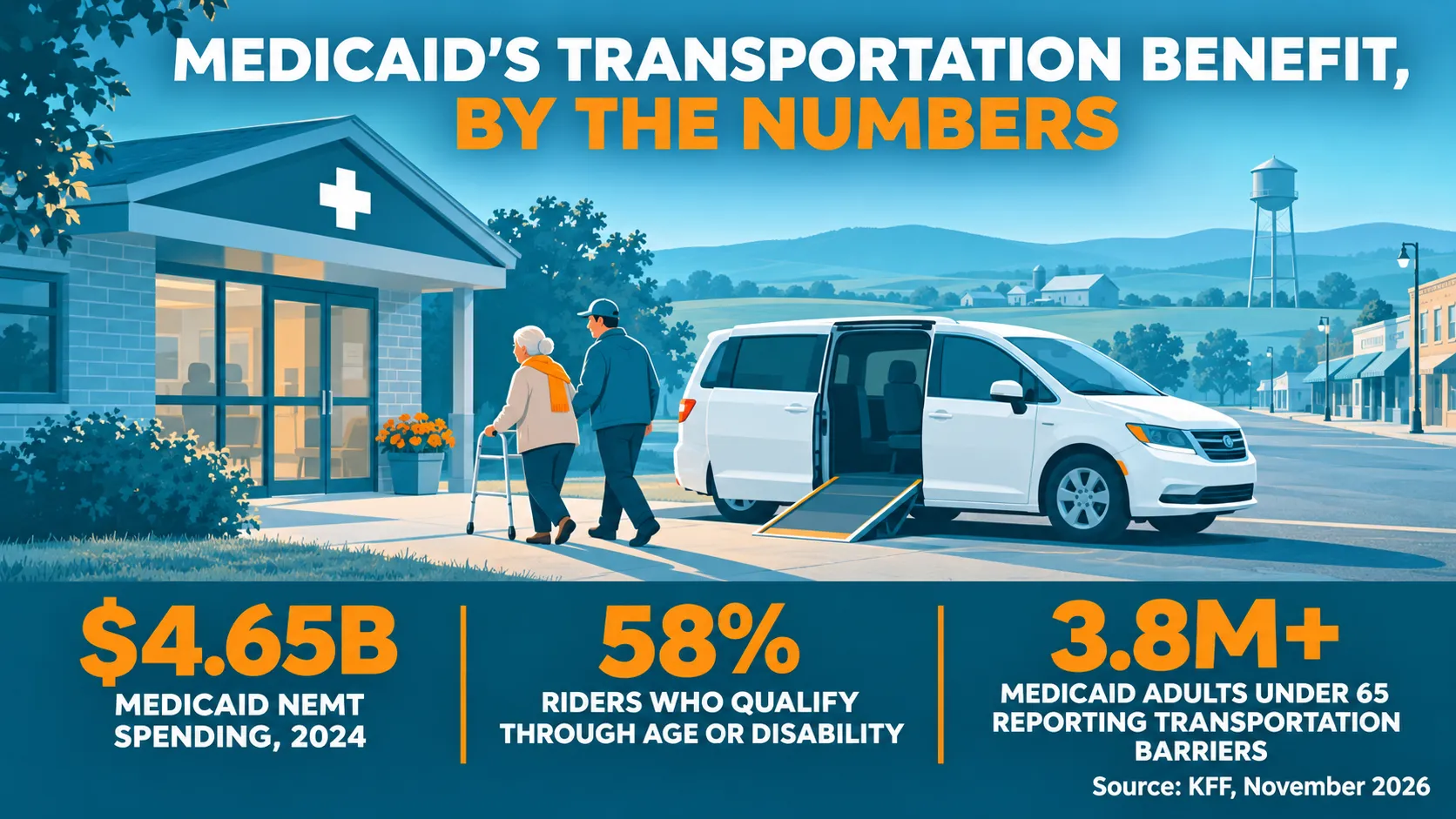
The spending. Medicaid spent $4.65 billion on NEMT in 2024, under 1 percent of total Medicaid spending. Van and taxi transportation accounted for 67 percent of that spending and 63 percent of claims.
The riders. 58 percent of NEMT users qualify for Medicaid through age or disability, against 23 percent of enrollees overall. 39 percent are dually eligible for Medicare and Medicaid, against 14 percent overall. Among users not also on Medicare, 85 percent have at least one chronic condition, against 36 percent of enrollees. This benefit serves the people in Medicaid with the most complex needs, which is where skilled, reliable providers make the biggest difference.
The models and the gap. KFF counts 30 states using brokers in some capacity, 19 using fee-for-service and 12 using managed care, with overlap between them. More than 3.8 million adult Medicaid enrollees under 65 reported that a lack of reliable transportation kept them from medical care or from other daily needs such as work. KFF also cautions that heavier administrative burden could mean fewer providers, which puts a premium on the ones who stay reliable and well documented.
AI for Transportation Providers
AI Workflow of the Month: The Grant Application Builder
Context: Rural Health Transformation money reaches every state each year through 2030, and each state decides what it funds. Not every state has a transportation grant, but where one exists, programs like Kansas's fund only local transportation that does not duplicate services already eligible for reimbursement. An application has to describe a gap rather than an existing route, and a narrative drafted ahead of time is ready when your state opens a round.
Try this: Copy the instructions below into the AI assistant you already use. Fill them in with your own operational details, not rider information.
"Act as a rural health grant writer. I run a non-emergency medical transportation company serving [counties or service area] with [number] vehicles, including [wheelchair, stretcher, ambulatory mix]. I want to be ready if my state offers Rural Health Transformation Program funding for transportation. First, ask me which state I operate in. Tell me to confirm on my state's RHTP website whether a transportation-related funding opportunity is open or planned, who is eligible, and the application deadline, and do not assume one exists. Then ask me what access gaps exist in my service area: which counties have no provider, which appointment types go unserved, where riders currently have no option. Then help me draft a project narrative that describes a sustainable local transportation solution addressing those gaps, and explicitly explain how the proposed service does not duplicate trips already eligible for Medicaid reimbursement. Flag anywhere my answer sounds like an existing billable route."
What it does: It turns the hardest part of a grant application, proving the service is additive rather than duplicative, into a structured conversation, so the draft exists before the deadline does.
Illustrative starting point. Check your state's own RHTP program requirements before submitting anything.
One Thing Worth Your Time
Insurance brokerage WTW published a risk framework in October to help healthcare organizations match each patient's ride to their clinical needs, weighing liability, insurance coverage and the choice of transportation provider. It treats private and family vehicles as a narrow, documented exception for low-risk patients, with purpose-built transport as the default. Its coverage table, showing where each insurance line stops covering patient transport, makes a strong talking point for your next conversation with a hospital or discharge planner.
What's Going On Inside the Lamp
Customer Story
1,800 trips a week, two dispatchers. Since new ownership took over in September 2020, H&M Transport reports it has doubled revenue and grown into an 80+ van operation across Virginia, Maryland, D.C. and West Virginia. Two dispatchers handle 1,800 trips a week, including up to 50 hospital discharges on a busy day, and the company reports about 97 percent on-time performance within 15 minutes.
The growth came from being selective. H&M pulls RouteGenie trip data into Power BI alongside telematics and payroll to build a daily P&L for every van, then works on the few running under target. That same margin focus drove the shift toward stretcher and discharge work, where on-time pickups save hospitals money: by H&M's estimate, a missed skilled nursing admission window costs a hospital about $4,500. "Each van's an independent business in a sense," says Chase Lafferty, H&M's president.
Want to Be on the Show?
We are booking guests for upcoming episodes of Inside the Lamp. If you run an NEMT operation, work on the broker or payer side, or build something the industry should know about, tell us about it and we will be in touch.
Want vehicle-level numbers like H&M's? Request a RouteGenie demo and we will show you what your own trip data can tell you.