
NEMT Standing Orders: How to Manage Recurring Trips
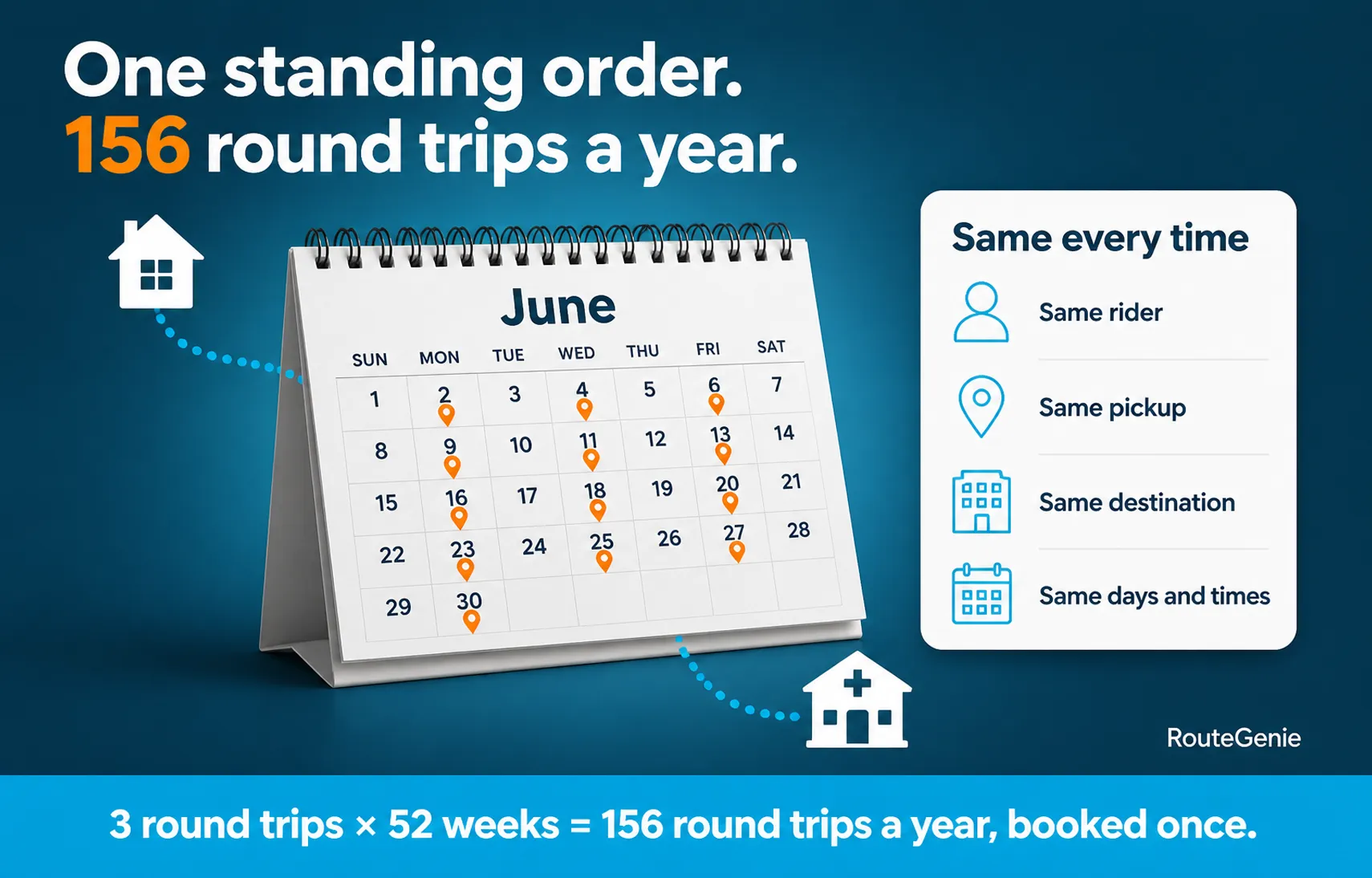
A dialysis patient on a Monday, Wednesday, Friday schedule needs 156 round trips a year. Nobody books those one at a time. They're booked once, as a standing order, and run until someone changes or ends them.
In MACPAC's 2021 report to Congress, Medicaid NEMT users with end-stage renal disease averaged 70.1 ride-days in FY 2018, compared with 12.8 for users with none of the conditions studied. Those riders are on your board every week.
Contents:
- What a Standing Order Is in NEMT
- Who Requests a Standing Order
- How Long a Standing Order Lasts
- How to Manage Standing Order Trips Day to Day
- Managing Standing Orders in RouteGenie
What a Standing Order Is in NEMT
A standing order is one request that books the same trip on a repeating schedule: same rider, same pickup, same destination, same days and times. Brokers also call it a subscription or recurring trip. Wisconsin Medicaid defines a standing order ride as one with the same pickup point, pickup time, destination and return. Typical uses are dialysis, chemotherapy, radiation, wound care, physical therapy, methadone programs, and adult day or PACE attendance.
The order is the template. Each trip it creates is still assigned, driven, documented and billed on its own.
Not every standing order is a Medicaid trip. A family paying for a parent's weekly therapy rides, or an assisted living facility contracting for its residents' dialysis runs, is one too.
Who Requests a Standing Order
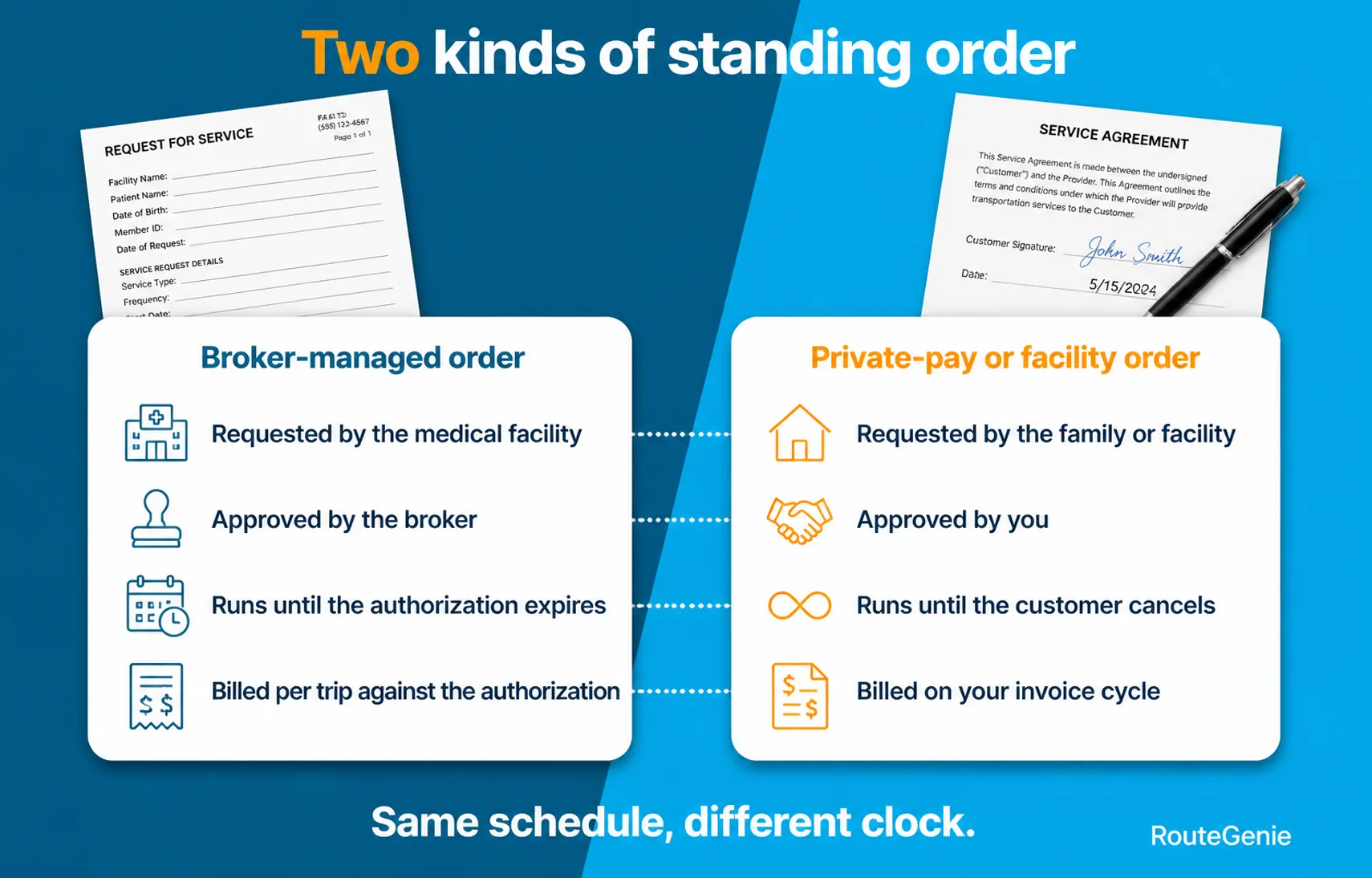
In broker-managed Medicaid, you don't create the order. The medical facility does, and the broker approves it and assigns a transportation provider. New York accepts standing orders only from the rider's medical provider, entered through MAS at least three business days before the start date. Most brokers use a request form that a dialysis clinician, social worker or case manager fills out, and changes go through the broker, not your driver.
Private-pay and facility-contract orders skip all of that. The family or facility sets the schedule with you.
|
Broker-managed order |
Private-pay or facility order |
|
|
Who requests it |
The medical facility |
The family or facility, with you |
|
Who approves it |
The broker |
You |
|
How long it runs |
Until the authorization expires |
Until the customer cancels |
|
How it's billed |
Per trip, against the authorization |
On your invoice cycle |
How Long a Standing Order Lasts
A broker standing order typically runs three to six months, and it doesn't renew itself. The facility has to resubmit before the end date, or trips run after it lapses may not be paid. The window depends on the state and broker:
- New York: six months
- Wisconsin: three months, or six for dialysis
- Louisiana: 12 months
- One California Medi-Cal plan: 90 days
An order can also end early. If the member loses Medicaid coverage, the broker cancels the remaining trips, and anything driven after the loss date goes unpaid.
How to Manage Standing Order Trips Day to Day
 Once an order is approved, the job is keeping its trips in step with the rider's life. The order itself rarely changes; everything around it does: a hospital stay, a new treatment time, a holiday closure, an authorization that quietly ran out. Each has to reach the trip before the driver does.
Know When Each Order Ends
Every broker order has an end date, and the renewal reminder goes to the facility, not to you. If the renewal is missed, the trips stop showing up in your import, the rider has no ride, and anything you run anyway can't be billed. Keep the end date on the order record, review the ones expiring in the next two to three weeks, and ask the facility whether a renewal is in.
Separate One-Off Changes From Permanent Ones
Every change is either a one-off or permanent, and it has to go in the right place. A rider in the hospital for a week is a one-off: cancel those trips and leave the order alone. A rider whose chair time moves from 6:00 a.m. to 11:00 a.m. is permanent: change the order, and every future trip follows. Mixing the two is how duplicate and missed rides start.
Plan Holidays Before the Month Starts
A standing order doesn't know about holidays. A Wednesday rider still has a Wednesday trip when Wednesday is Christmas. Dialysis centers usually shift their schedule around a holiday while day programs close outright, so get each facility's holiday calendar before the month starts and cancel or move those trips in one pass.
Build the Day Around Recurring Trips
Recurring trips are the one part of tomorrow you already know. The times and addresses are fixed, and the riders do better with a driver they recognize. So assign the recurring riders first, group the ones headed to the same center, keep their regular drivers where you can, and fit same-day requests and will-call returns into the gaps.
Managing Standing Orders in RouteGenie
Past a few dozen recurring riders, NEMT scheduling software has to do the repetitive work. In RouteGenie, one standing order per passenger carries different legs, times and addresses by weekday, runs with or without an end date, and generates trips up to 90 days ahead. Any single day can be changed without touching the rest of the series. Authorization is checked as trips are created, and trips flow through broker integrations into routing and billing without being retyped.
If dialysis or behavioral NEMT trips are among your anchor contracts, then request RouteGenie demo to see how we can handle your most complicated cases.
About the author


Serhii Taborovskyi is the founder and author of the Automotive Territory YouTube Channel, with 300,000 subscribers and counting. He is an avid automotive enthusiast and a fan of any and all motorized vehicles. Serhii is a visiting author at RouteGenie, sharing his expertise for the benefit of the NEMT community.