
Medicaid Work Requirements: The NEMT Impact
Medicaid work requirements start January 1, 2027, in most of the states they apply to. Under the 2025 budget reconciliation law (H.R. 1), many adults covered through the Affordable Care Act expansion or a similar state waiver must show 80 hours a month of work, volunteering, school, or job training. People who qualify for an exemption don't have to, according to CMS.
For non-emergency medical transportation (NEMT) providers, the change doesn't mean Medicaid's transportation benefit is going away. Federal rules still require state Medicaid programs to ensure necessary transportation for members to and from their providers. And many NEMT riders aren't the adults this requirement targets. KFF's analysis of 2024 Medicaid data found that 58% of NEMT users qualify for Medicaid through age or disability, compared with 23% of enrollees overall.
The rollout will also vary by state. On November 13, CMS gave states an option to keep checking compliance but delay the consequences. With CMS approval, a state can wait up to six months, until July 1, 2027, before ending anyone's coverage for not meeting the requirement.
For providers, the practical work is knowing when their state starts and keeping trip authorizations and eligibility checks in sync with their brokers.
Contents:
- What the 2027 Medicaid Work Requirements Ask of Members
- What the Work Requirements Mean for Medicaid Transportation
- When Medicaid Work Requirements Start: Key Dates Through 2028
- How Many Medicaid Members Could Be Affected
- How NEMT Providers Can Prepare Now
- The Bottom Line for NEMT Providers
What the 2027 Medicaid Work Requirements Ask of Members
The requirement applies to adults ages 19 to 64 who aren't pregnant, aren't on Medicare, and get Medicaid in one of two ways. Most qualify through the Affordable Care Act's Medicaid expansion, which covers adults with incomes up to 138% of the federal poverty level. This group is usually called expansion adults, and it's the main group the work rule targets.
The rest get coverage through a section 1115 waiver, a federally approved state pilot that bends normal Medicaid rules. Georgia, Tennessee, and Wisconsin use waivers like this to cover some low-income adults, and those groups are covered too. Altogether, CMS counts 43 states and DC. In states that never expanded Medicaid and don't use a waiver like this, such as Texas and Florida, the requirement doesn't apply, based on KFF's state tracker.
Note
Coverage rules differ across these waiver programs. Georgia's Pathways program, for example, doesn't cover NEMT except for members ages 19 and 20, so changes in Pathways enrollment have little direct effect on NEMT trips.
Members can meet the requirement with 80 hours a month of work, community service, a work program, or at least half-time school, in any mix. Earning at least $580 a month, which is 80 hours at the federal minimum wage, also counts. States check at application and at each renewal, and they can check more often. A member who gets a notice that they haven't met the requirement has 30 days to show they qualify before the state can end coverage.
Who Is Exempt From Medicaid Work Requirements
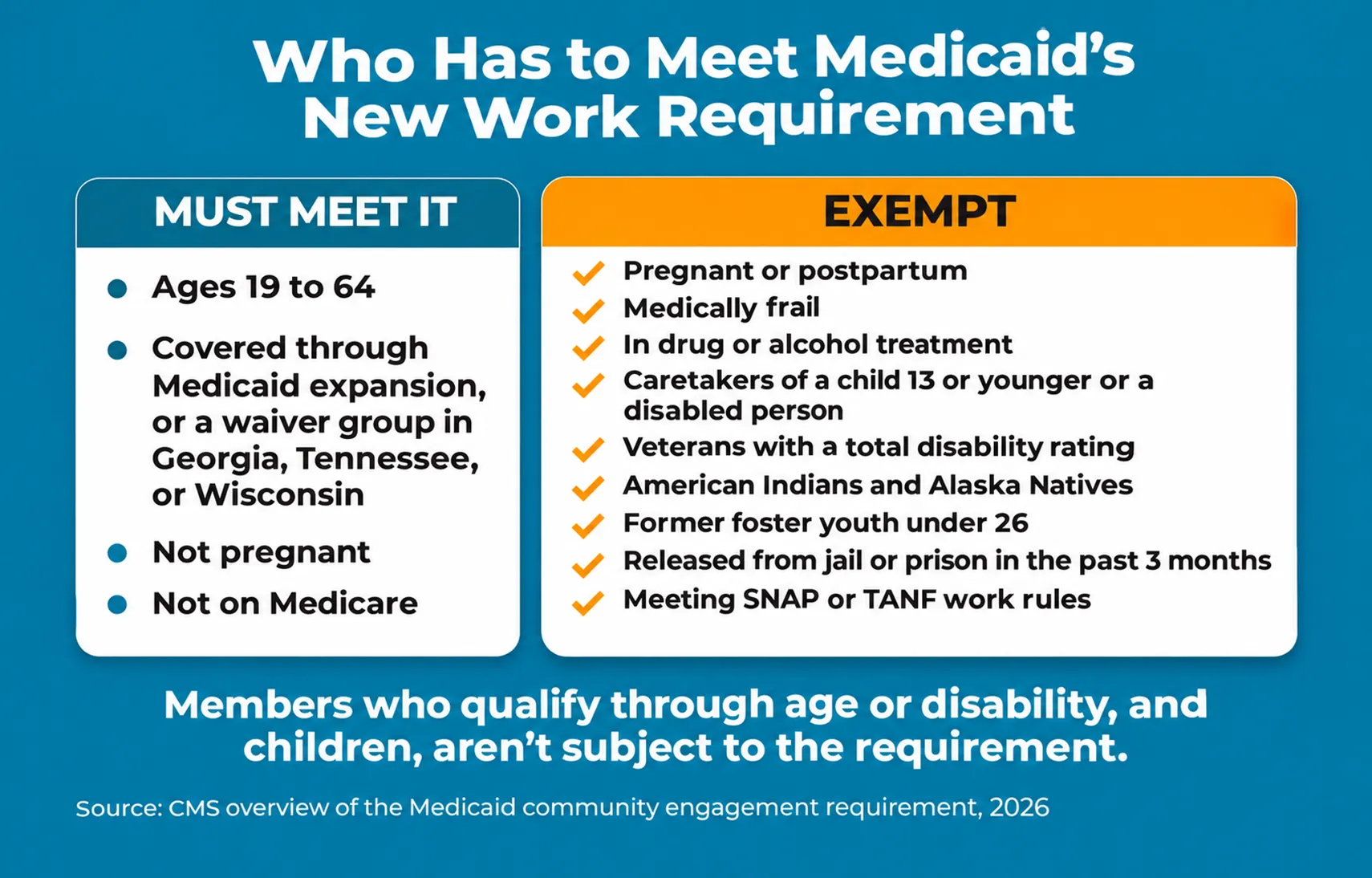
The exemption list is long, and it covers many of the people who ride NEMT most. Members are exempt if they're pregnant or postpartum, medically frail, or in treatment for drug or alcohol use. So are parents and caretakers of a child 13 or younger or of a disabled person, and veterans with a total disability rating. The list also includes American Indians and Alaska Natives, former foster youth under 26, and people released from jail or prison in the past three months, according to CMS's overview. The same goes for people already meeting the work rules for SNAP or TANF. SNAP is the Supplemental Nutrition Assistance Program, formerly food stamps, and TANF is Temporary Assistance for Needy Families, a state-run cash assistance program for low-income families with children.
Note
Under CMS's rule, states can also excuse members for short-term hardships, such as traveling outside their community for an extended period to treat a serious or complex condition. A routine long-distance trip doesn't qualify on its own, but some riders in ongoing out-of-area treatment may.
On October 29, a federal court in Massachusetts struck down an extra test CMS had added to the definition of medically frail. The test, challenged by a group of states, required a condition to significantly limit a person's ability to meet the work rule. KFF says the ruling makes it easier to qualify, and the January 1 start date hasn't changed.
What the Work Requirements Mean for Medicaid Transportation
Medicaid spent $4.65 billion on NEMT in 2024, and expansion adults are among the benefit's lighter users. In 2021, 2% of them used NEMT, compared with 14% of members eligible through age or disability, according to page 30 of the CMS report to Congress on NEMT. We unpacked that report in our post on how many Medicaid beneficiaries use NEMT.
Which NEMT Riders Are Most and Least Affected
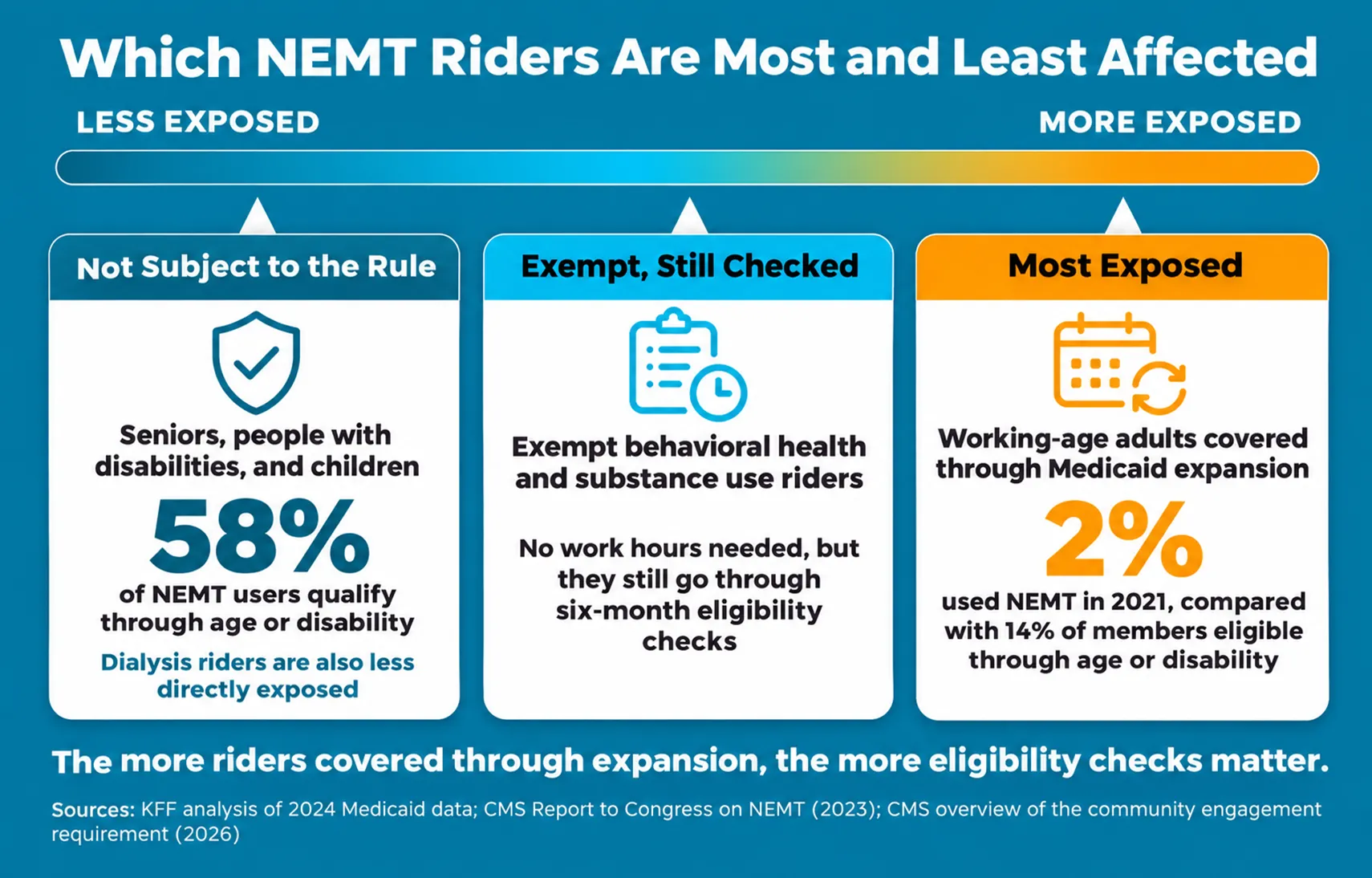
Riders who qualify for Medicaid through age or disability, or who have Medicare, aren't subject to the requirement, and neither are children. Dialysis transportation should be less directly exposed for the same reason, and because riders with serious or complex conditions can count as medically frail. Dialysis accounted for 8% to 13% of NEMT ride days from 2018 to 2021, a segment we covered in our dialysis transportation guide. Exempt substance use and behavioral health riders keep riding too, as long as their exemption is on file and they get through each eligibility check.
That gives NEMT providers a quick way to gauge their exposure. If most riders are seniors, people with disabilities, dialysis patients, or children, the work rule won't reach many of them directly, though recurring trips still need eligibility checks. If a large share are working-age adults covered through expansion, expect more eligibility rechecks and a higher chance of coverage gaps, as the next section explains. And where brokers are paid per member, enrollment shifts can show up in rates and trip volume.
Coverage Gaps Between Booking and Pickup
Starting in 2027, states have to confirm every six months, instead of once a year, that most expansion adults still qualify for Medicaid. For members who aren't exempt, each check now includes proof of work hours. So a rider who had Medicaid when the trip was booked may not have it on the morning of pickup.
Being exempt from the work hours doesn't mean being exempt from the paperwork. Behavioral health made up 16% to 19% of NEMT ride days from 2018 to 2021, and substance use treatment made up 11% to 14%, the same CMS report shows. Most substance use riders are exempt from the work requirement, and so are riders whose mental illness their state counts as disabling. States look for these exemptions in recent claims data first. But those covered through expansion still go through the six-month checks, and many go to therapy or opioid treatment several days a week. A single missed check can pause weeks of behavioral health trips.
Claim Denials and Broker Payments
Coverage changes can cause payment problems, especially when a member's eligibility changes between booking and the ride. Whether the transportation provider carries that risk depends on the broker contract and authorization process. A trip completed under a valid authorization may still be paid. For providers that bill Medicaid directly, there's one more catch: a member who loses coverage and reapplies gets only one month of retroactive coverage. Our guide to preventing common billing denials covers the documentation side.
Brokers feel enrollment changes directly. Many states pay brokers a fixed monthly amount for each eligible member, known as a capitated rate, and Georgia's NEMT program is one example. When enrollment falls, so does that payment. That's worth keeping in mind before contract and rate talks, especially with the broker market already shifting.
When Medicaid Work Requirements Start: Key Dates Through 2028
The federal dates that matter most, based on CMS guidance and the Congressional Research Service summary of the law:
DEC
11
2026
CMS asks states to say whether they'll use a grace period of up to six months, which CMS calls a hold-harmless period. States need CMS approval to use it.
JAN
1
2027
The work requirement starts in most states. Eligibility renewals for most expansion adults move to every six months. Retroactive coverage, which pays for care in the months before a person applies, drops to one month for expansion adults.
JUL
1
2027
The optional grace period ends. States that used it start applying the requirement in full at applications and renewals, unless they've received a separate federal extension.
DEC
31
2028
The latest date a federal extension can delay the work requirement in any state.
Note
Some states are on their own schedule. Nebraska, Montana, and Arkansas started early in 2026, and Iowa plans to start December 1, according to KFF's state tracker. Georgia moves its Pathways program to the federal rules on January 1. California has asked to start on July 1, 2027. Congress could also revisit the requirement, though any change would need to pass both chambers and become law.
How Many Medicaid Members Could Be Affected
The Congressional Budget Office estimates the work requirement will leave 5.3 million more people uninsured in 2034. CMS estimates that about 15% of adults in the expansion group will lose coverage, counting both people who don't meet the requirement and people who lose coverage over paperwork. Both are national projections, not forecasts of NEMT ridership.
What Earlier State Programs Showed
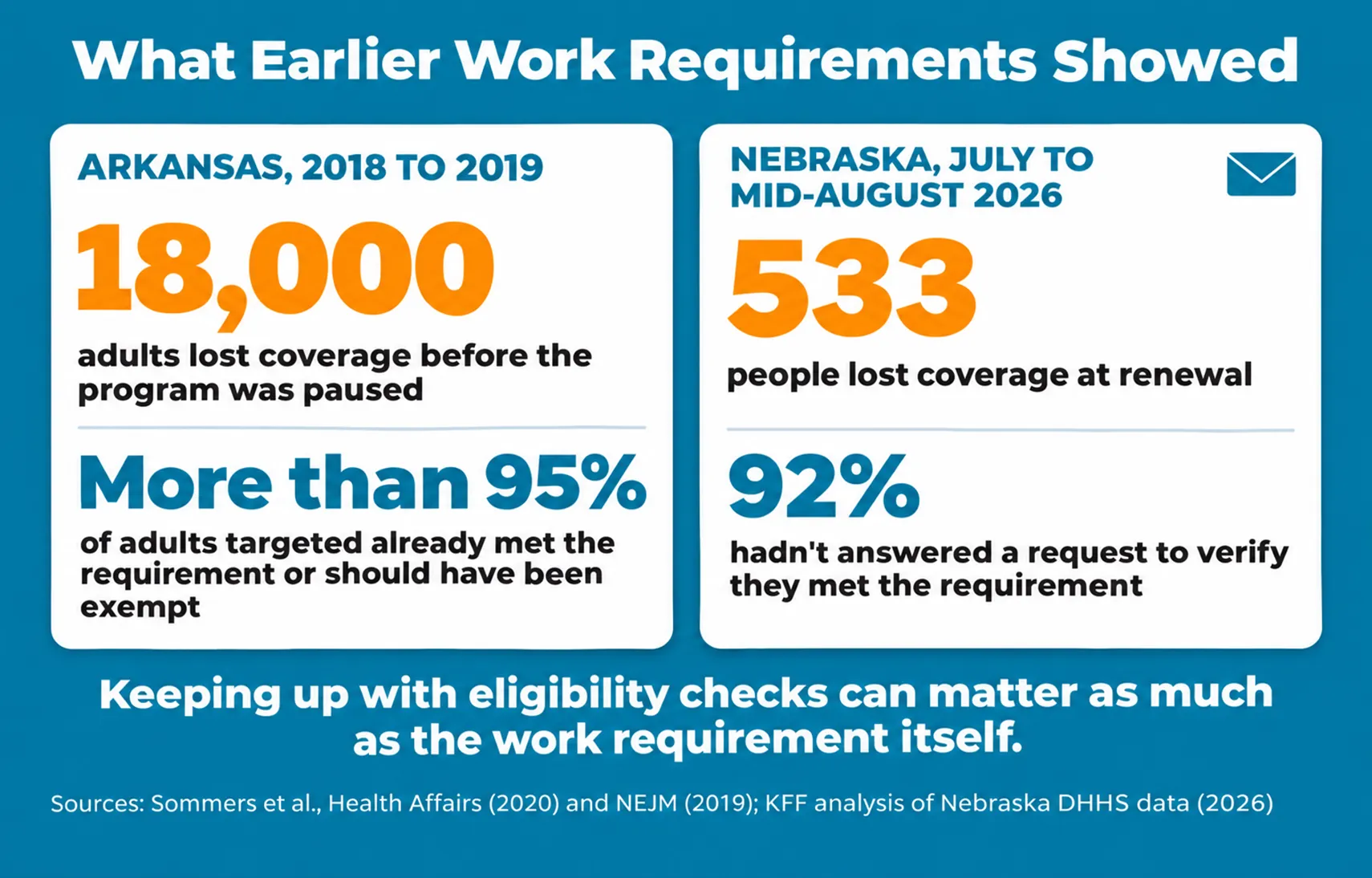
Earlier state programs show that keeping up with eligibility checks can matter as much as the work requirement itself.
Arkansas tried a version of this in 2018. About 18,000 adults lost coverage before a federal judge put the policy on hold in 2019. Employment didn't rise over 18 months of follow-up, according to a study by Sommers and colleagues in Health Affairs. An earlier study by the same researchers found that more than 95% of the adults targeted already met the requirement or should have been exempt.
Nebraska became the first state to enforce the new federal requirement on May 1, 2026. From July to mid-August, 533 people there lost coverage at renewal, and 92% of them hadn't answered a request to verify that they met the requirement. The data don't show how many of them would otherwise have qualified. That's the scenario for transportation providers to plan for: a regular rider who may still qualify but loses coverage over unanswered paperwork.
How NEMT Providers Can Prepare Now
NEMT providers don't control Medicaid eligibility. They do control how quickly they spot a problem and how well their records hold up.
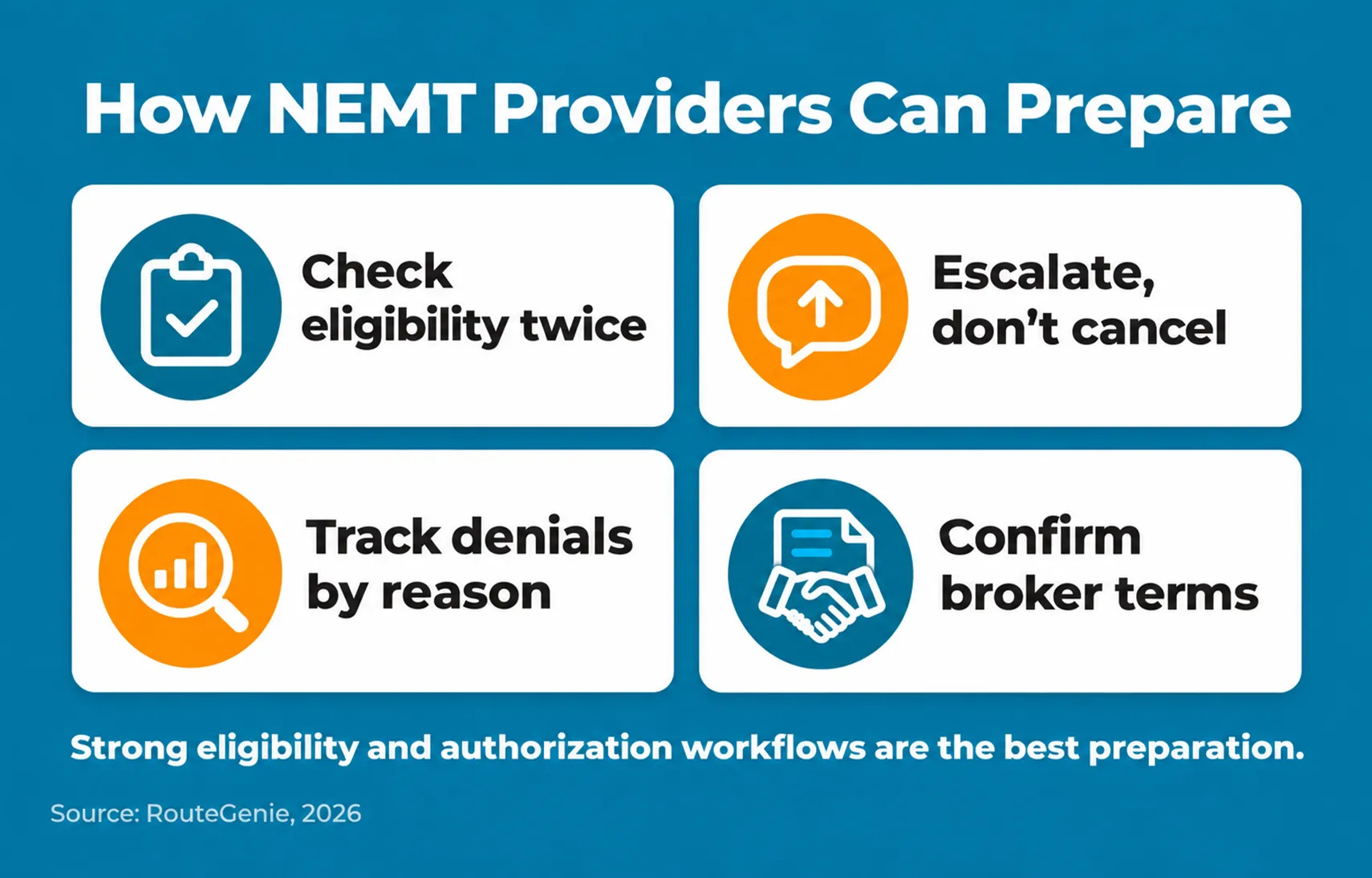 These steps cover both:
- Check eligibility at booking and again before the ride, using whatever the broker or payer contract calls for. That might be a 270/271 transaction, the state Medicaid portal, or the broker's authorization. Our post on NEMT passenger eligibility requirements covers the basics.
- Treat a failed eligibility check as a reason to verify and escalate through the broker's process, not to cancel a medically necessary trip automatically.
- Track denials by reason, keeping eligibility denials separate from missing authorizations, documentation gaps, and other billing issues in NEMT billing metrics.
- Watch the state's start dates and actual changes in recurring trip demand, rather than planning around one national date.
- Ask brokers who's responsible for eligibility checks, whether completed trips are protected if coverage changes, and how volume and rates may shift before contracts renew. Our post on how to get more trips from your NEMT contracts has more on contract talks.
- Keep standing orders, authorization details, service dates, and completed-trip records accurate. They document ongoing care, though the state, not the transportation provider, decides exemptions.
- Review the payer mix, and add new patient groups where local demand, payment rates, and capacity support it.
Medicare Advantage is one place to look, with limits. KFF found that 24% of individual Medicare Advantage plans offer medical transportation in 2026, down from 30% in 2025, and 67% of Special Needs Plans do, down from 81%. A covered benefit doesn't guarantee a contract. Our post on whether Medicare covers medical transportation explains where the benefit applies.
Note
Some lines of business don't depend on Medicaid expansion enrollment at all, including PACE programs, hospital discharge contracts, and private pay clients.
The Bottom Line for NEMT Providers
Medicaid work requirements add new eligibility steps, but they don't remove Medicaid's transportation benefit, and many NEMT riders aren't subject to them. The best preparation is practical: tight eligibility and authorization workflows and accurate records for recurring trips. RouteGenie brings trip scheduling, dispatch, billing, and broker operations into one system. Book a demo to see how it supports day-to-day operations.
About the author


Yurii Martynov is the Marketing Director at RouteGenie, the leading software platform for medical transportation. With years of experience in the NEMT industry, Yurii leads brand strategy, demand generation, and go-to-market efforts that help transportation providers and brokers discover the tools they need to grow. Working closely with NEMT providers, brokers, and healthcare organizations has given him a deep understanding of the challenges facing the industry. He writes about NEMT operations, healthcare transportation trends, and the evolving role of technology in connecting patients to care.