
NEMT Fuel Costs in 2026: What Providers Control When Prices Swing
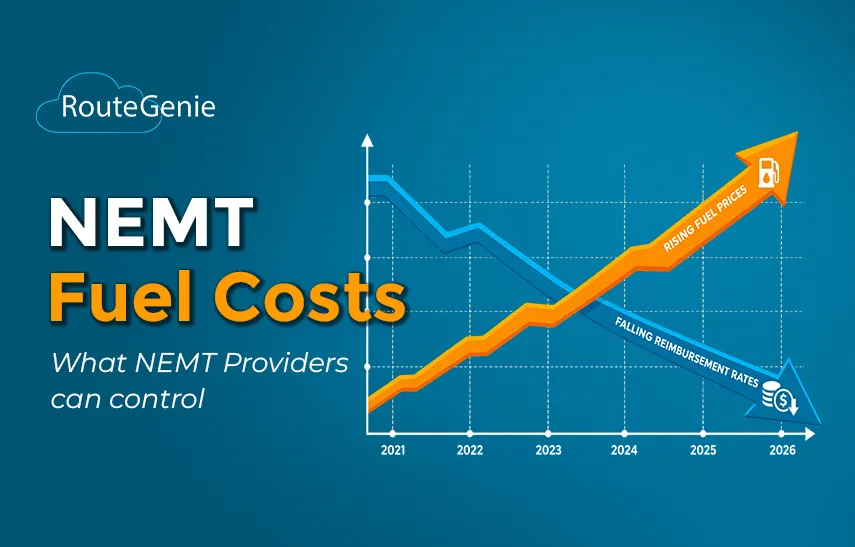
Gasoline did not go one direction this year. It went up, came back down, and went up again. The same gallon cost a dollar and a half more in one quarter than in another, which is a harder problem than an expensive year, because a budget can absorb a high price it planned for and cannot absorb one it did not.
What follows is what actually happened to fuel in 2026, what the swings cost on a single trip, and the three levers still inside provider control: what you buy, how you dispatch it, and who pays you.
Contents:
- What Happened to Gas Prices in 2026
- Why Fuel Volatility Hurts NEMT Providers More Than High Prices
- Medicaid NEMT Rates Can Move the Opposite Direction
- NEMT Fuel Cost Per Trip and Per Vehicle
- Three Ways NEMT Providers Can Cut Fuel Costs
- What This Means for NEMT Providers
What Happened to Gas Prices in 2026
As of early September, the national average for regular gasoline was $4.16 per gallon, per the U.S. Energy Information Administration. Two months earlier, as tensions temporarily eased, it had fallen to $3.78. At the spring peak it reached $4.50.
The most expensive week of 2026 cost 62 percent more than the cheapest, which came in mid-January at about $2.78 a gallon. Averaged across every week so far, 2026 has run at about $3.77 a gallon, which is a number that describes almost none of the weeks anyone actually bought fuel in.
Where you operate changes the number substantially. The Gulf Coast average was $3.685. The Midwest was $3.894. The Rocky Mountain region was $4.314, and the West Coast was $5.362. A provider in Houston and a provider in Seattle are running the same trip on very different cost bases.
The proximate cause is crude oil. Brent crude recently settled above $101, its highest close in more than three months, CNBC reported, after renewed disruption to overseas supply.
If you run diesel, this year has been even worse, and it has not been close. Diesel passed $5.95 a gallon, already above its June 2022 peak of $5.81, and 2026 is on pace to be a record year, up roughly $2.20 over the past year against about 97 cents for gasoline. In percentage terms that is a 58 percent increase against 30 percent, nearly twice the rate, and it landed on the vehicles that were already the most expensive in the fleet to operate. It arrived through no fault of the provider, and nothing could have prevented it. The comparisons later in this article use gasoline prices. If your fleet includes diesel units, the gaps you are living with are wider than the ones shown here.
Why Fuel Volatility Hurts NEMT Providers More Than High Prices
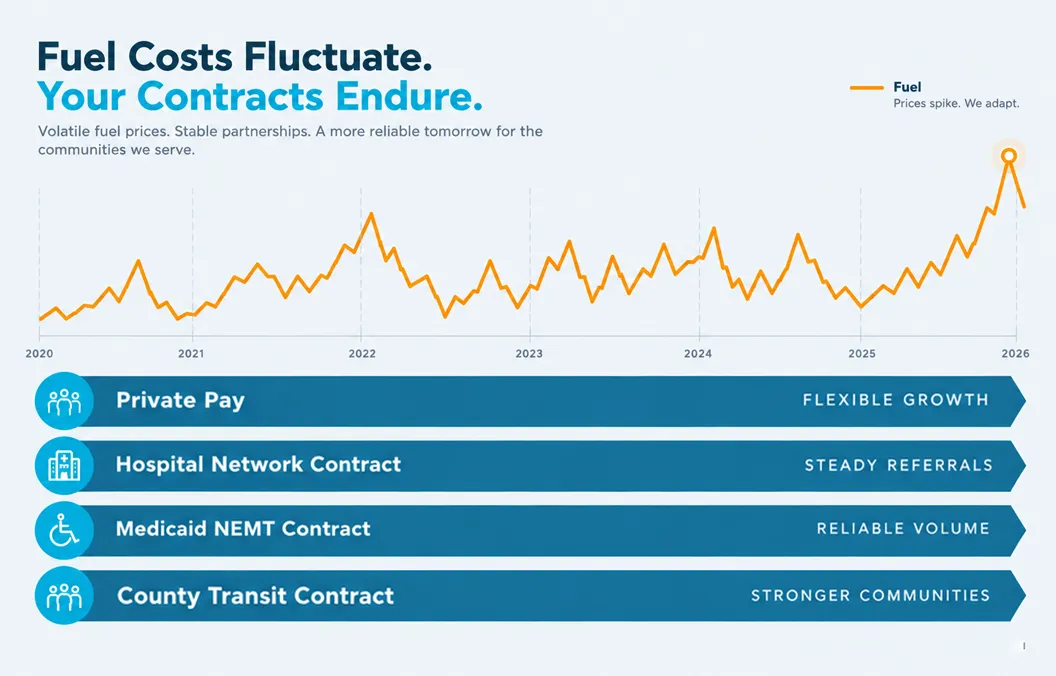
A high price you can plan for. A price that moves a dollar inside a single fiscal year is a forecasting problem, and forecasting problems are harder to solve than cost problems.
The structural issue is timing. Fuel reprices weekly. Almost nothing else does:
- Medicaid fee schedules are set annually or less often
- Broker contracts run for multiple years
- Facility agreements are renegotiated on their own cycle, rarely mid-term
A provider who built a budget on $3.20 gasoline and is now buying at $4.16 has no mechanism to recover the difference until the next contract cycle, and possibly not then.
The federal cushion that historically capped these spikes also has less left in it. Where the Strategic Petroleum Reserve stands:
- 286.6 million barrels as of late August, roughly 40 percent of its 714-million-barrel authorized capacity
- Its lowest level since November 1982
- Following a release of 172 million barrels authorized in March, the U.S. share of a 400-million-barrel collective action by International Energy Agency member countries
- More than a quarter of that inventory unavailable for drawdown as of December 2025 because of construction and cavern outages, per a May Government Accountability Office review reported by CNBC
The Energy Department has said the minimum needed to operate the reserve safely is about 70 million barrels.
None of that is reassuring, and none of it points in a clear direction. With global supply this unsettled, nobody can say where prices go next. What providers can do is plan for the swings rather than wait for an intervention to flatten them.
Medicaid NEMT Rates Can Move the Opposite Direction
The uncomfortable part of 2026 is that reimbursement has not tracked costs, and in some states it has moved in the opposite direction.
The pressure starts at the federal level. The 2025 federal reconciliation law cuts roughly $900 billion from Medicaid over a decade, according to the Center on Budget and Policy Priorities, and states are absorbing that inside their own budgets. KFF's 2026 outlook put the consequence plainly: changes to Medicaid financing make it difficult for states to raise provider payment rates and create pressure to restrict them.
NEMT itself is safe. It is a required Medicaid benefit, not an optional one like dental or vision, so states cannot reach for it first. The rate is a different matter, and in a budget-pressure year it is the lever within reach. The trips will keep coming. Brace for what they pay.
Colorado shows how far a rate decision can go. The state, already mid-transition to a new statewide broker, cut its NEMT rates effective July 1:
- The base pickup fee for an ambulatory or taxicab trip went from $36.40 to $12.40, roughly a third of what it had been. That fee is the only compensation for the drive to reach the passenger, and western Colorado providers describe pickup runs of fifty miles and more that nothing pays for
- The per-mile rate paid on top of that fee went from $3.00 to $2.75, and wheelchair van mileage took the identical cut
Oversight is the other channel, and it moves faster than rate-setting. The Department of Health and Human Services Office of Inspector General opened an audit series on Medicaid NEMT in late May, and integrity reviews interrupt cash flow even for providers doing everything right. Minnesota's revalidation sweep sent disenrollment notices to more than three thousand Medicaid providers, including transportation companies that had already filed their paperwork. Credentialing files are cash-flow protection.
None of this is new, and the providers still standing are the ones who saw it coming and built enough breadth into their payer mix to absorb it without cutting service. Rate decisions are outside provider control. What happens next is not.
NEMT Fuel Cost Per Trip and Per Vehicle
Here is what the swing looks like on one ride. An NEMT vehicle running eight trips a day covers roughly a hundred miles, which works out to about twelve and a half miles per completed trip once deadhead is counted. The table below prices that trip.
|
Vehicle |
Winter low, $2.78 |
Spring peak, $4.50 |
Midsummer low, $3.78 |
Early September, $4.16 |
|
Toyota Sienna hybrid WAV, 36 mpg |
$0.97 |
$1.56 |
$1.31 |
$1.44 |
|
Chrysler Pacifica gas WAV, 22 mpg |
$1.58 |
$2.56 |
$2.15 |
$2.36 |
|
Ford Transit converted WAV, 15 mpg |
$2.32 |
$3.75 |
$3.15 |
$3.47 |
Peak to midsummer low, that same trip moved 60 cents in the Ford Transit and 25 cents in the Sienna hybrid.
Annual fuel at 25,000 miles a vehicle, at the year's low and today:
|
Vehicle |
Winter low, $2.78 |
Today, at $4.16 |
Increase |
|
Toyota Sienna hybrid WAV |
$1,930 |
$2,890 |
+$960 |
|
Chrysler Pacifica gas WAV |
$3,160 |
$4,720 |
+$1,560 |
|
Ford Transit converted WAV |
$4,630 |
$6,930 |
+$2,300 |
That is nearly 50 percent across the board, because fuel cost scales with price no matter what the vehicle is. Across ten vehicles the increase runs $9,600 to $23,000 a year depending on what you run. Across a hundred, $96,000 to $230,000.
Three Ways NEMT Providers Can Cut Fuel Costs
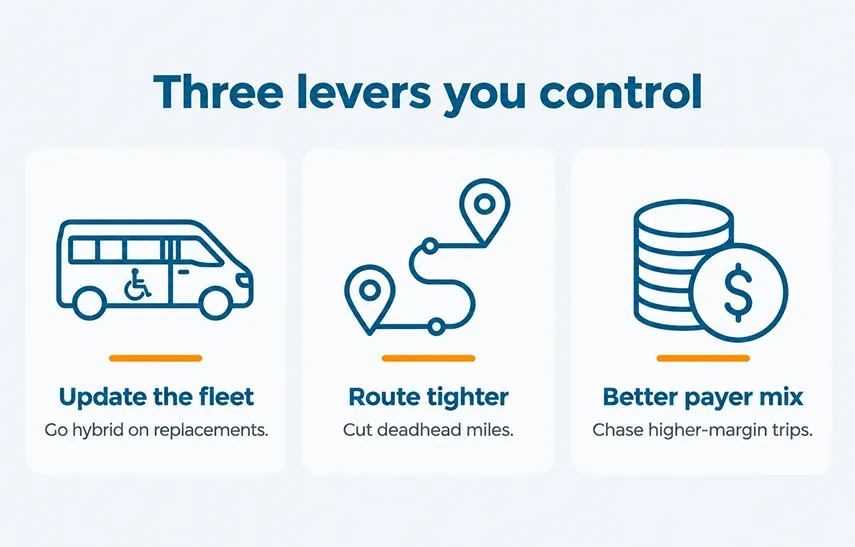
Crude oil prices and fee schedules are both set elsewhere. Gallons burned per completed trip is not. Three moves account for most of the available savings.
Update Your NEMT Fleet
A 30+ vehicle provider in Upstate New York has moved its entire fleet to hybrids, with the goal of keeping fuel costs in check. That is more achievable now than most fleet planners assume.
Optimize the fleet composition. Match the fleet to the modes your area actually demands and keep every vehicle working. A yard full of stretcher vans is dead weight in a market where the trips coming through are wheelchair.
Go hybrid on every replacement. Hybrid vehicles now exist in nearly every category a provider buys, and the Toyota Sienna, the default wheelchair-accessible minivan platform, has been hybrid-only since 2021. BraunAbility states that its Sienna Hybrid conversion holds the factory 36 mpg combined rating. Take two wheelchair-accessible minivans doing identical work, one hybrid and one gasoline: at the year's low the hybrid saved about $1,230 a year, and at today's prices it saves about $1,830, roughly $18,300 across ten vehicles. Rising fuel made that decision nearly 50 percent more valuable without anyone at the company doing anything.
Replace rather than expand. An aging vehicle carries three costs at once, and no maintenance schedule holds all three down forever:
- Fuel economy that drifts down as the engine wears
- A repair bill that climbs every year
- Revenue lost while it sits in a shop
A new hybrid carries a payment and, for the first several years, very little else. Set the monthly payment against the fuel saved and the repairs that stop happening, and the oldest vehicles in the fleet are often the most expensive ones to keep.
Start considering electric. It is the one to watch rather than the one to buy, at least this year. The wheelchair-accessible selection is close to non-existent right now: the Ford E-Transit is effectively the only practical option, and only because upfitters have worked out conversions for it, with no other mainstream wheelchair-accessible electric van yet on the market. But the constraint is supply, not economics. In a fuel crisis, electric is where this is heading. Watch the announcements of new electric models, and consider testing one in your fleet.
Route and Dispatch More Precisely
Every empty mile burns fuel at the same price and returns nothing, and deadhead miles can account for 30 to 40 percent of total miles driven by NEMT vehicles. At current prices that is the single largest recoverable line in the fuel budget. A trained dispatch team working in NEMT software like RouteGenie can take real miles out of the day: matching trip requests to the closest vehicle, rerouting live around traffic and cancellations, dispatching by zone, and combining compatible trips into multi-loaded runs where acuity and schedules allow. Cutting deadhead by even five percent across a fleet compounds into tens of thousands of dollars over a year.
Pursue Higher-Margin NEMT Work
Fuel is an input you cannot negotiate. Revenue per mile is one you can.
Facility contracts, dialysis standing orders, hospital discharge work, and private pay all price differently than baseline Medicaid trips, and providers who carry a mix are less exposed when one payer moves. Breadth is what lets a provider keep serving Medicaid riders at a reduced rate instead of having to choose between the rate and the route.
When one payer cuts, the answer is a better mix. It is rarely a smaller fleet.
What This Means for NEMT Providers
Fuel will move again. It may well be cheaper in November than it is today, and more expensive again after that. Nobody knows when normal arrives, which is why treating this as a shock to absorb until it passes leads nowhere useful.
The more practical view is that volatility is a standing condition of the business now, the same way broker transitions and rate adjustments are. And there is real room to move inside it. The gap between the most and least fuel-efficient way to run the same trip is wide enough that two providers serving identical riders under identical contracts can finish the year with meaningfully different fuel bills.
The providers who come through the next swing in good shape are not the ones who guessed the direction correctly. They are the ones whose cost per completed trip was already low before it happened. Want to see what your own fuel and deadhead numbers look like? Book a RouteGenie demo and we will walk through them with you.
About the author


Serhii Taborovskyi is the founder and author of the Automotive Territory YouTube Channel, with 300,000 subscribers and counting. He is an avid automotive enthusiast and a fan of any and all motorized vehicles. Serhii is a visiting author at RouteGenie, sharing his expertise for the benefit of the NEMT community.