
The Genie Journal, July 2026: Ohio Makes GPS Trip Verification Law

Originally sent to subscribers in July 2026. Issue #07 · July 16, 2026
The Signal
The case for reliable medical transportation keeps getting stronger, and this month it came from several directions at once: new research putting hard numbers on the access gap, and new rules that reward providers who can prove their value. Demand is being documented and quality is being recognized in the same breath. For providers built on reliability, the ground is tilting the right way.
Contents:
- What's Moving This Month
- Deep Read: The Healthcare Access Gap, Measured
- AI for Providers. Prompt of the Month: Build Your Own EVV Audit Simulator
- One Thing Worth Your Time
- What's Going On Inside the Lamp
What's Moving This Month
Ohio Gov. DeWine Signs SB 315, Bringing GPS Trip Verification to Medicaid NEMT
Gov. Mike DeWine signed Senate Bill 315 on July 7. The Ohio Medicaid Program Integrity and Fraud Prevention Act builds a dedicated GPS verification framework for non-emergency medical transportation: providers will submit GPS-confirmed pickup, transport, and drop-off, plus timestamps, route data, and total distance, as a condition of payment. The requirement phases in over eighteen months, with technical standards due within six months and a provider pilot within twelve. A formal exemption process covers equipment failure, rural connectivity gaps, and recipient safety. SB 315 takes effect in early October.
Why this matters: Ohio is building trip verification directly into how providers get paid, and the eighteen-month runway gives everyone room to prepare. Providers who already capture clean GPS data, exception notes, and route detail are well positioned to turn that documentation into faster, more predictable reimbursement as the framework takes shape.
California's $2B Medi-Cal Tax Plan Heads to CMS for Decision
California's plan to backfill Medi-Cal, the state's Medicaid program, is now in the hands of CMS. The gap it addresses traces to HR 1, the July 2025 federal law that limits how states can use provider and managed care taxes to draw down federal matching dollars. The state's proposal, finalized as part of California's 2026 to 2027 budget package, raises the managed care tax on health insurers to recover that match. A nonpartisan state analysis estimates it would add about $100 per year to a single individual's commercial premium. State Republicans have urged CMS to reject the plan; the California Department of Finance says it was crafted to comply with federal rules. California's current tax expires at year-end, leaving a funding gap if CMS denies it.
Why this matters: Medi-Cal covers 14 million Californians and underwrites the state's NEMT benefit, so the outcome matters to every provider billing the program. Whichever way CMS decides, providers who can point to documented reliability and a disciplined cost per trip make a clear case for their value, positioning themselves to hold and grow their role as plans shape their networks for the year ahead.
MTM Health to Replace Modivcare for BCBS Medicaid Transportation in Illinois and Texas
Blue Cross and Blue Shield of Illinois and Blue Cross and Blue Shield of Texas will both transition their Medicaid non-emergency medical transportation programs from Modivcare to MTM Health, effective October 1, 2026. MTM Health becomes the sole transportation vendor for eligible Medicaid members in each state. Both plans are operated by Health Care Service Corporation, which issued parallel provider bulletins in late June.
Why this matters: Illinois and Texas NEMT providers should confirm their MTM network status and identify any credentialing or onboarding requirements well before October. Broker transitions can disrupt existing trip assignments, but they also open capacity for providers that prepare early.
Iowa Launches Medicaid Fraud Elimination Task Force
Governor Kim Reynolds signed an executive order creating the Iowa Medicaid Fraud Elimination Task Force, chaired by Attorney General Brenna Bird. Members include Iowa Medicaid, the Medicaid Fraud Control Unit, and the state's three MCOs (Wellpoint Iowa, Iowa Total Care, Molina Healthcare of Iowa). Directives include supporting MCO provider network management and standing up integrity initiatives focused on high-risk services and electronic visit verification. The task force held its first meeting by July 17, with a statewide strategy due in 120 days.
Why this matters: Iowa is building EVV and program integrity into how its MCOs manage their provider networks. That gives providers with complete trip records a natural way to stand out to the plans they work with, positioning themselves as the dependable partners MCOs want to keep in-network as the strategy rolls out.
FTA Opens $12M ICAM Grant Round for NEMT Coordination
On July 9, the Federal Transit Administration announced approximately $12 million in available funding through its FY 2026 Innovative Coordinated Access and Mobility Pilot Program grant round, with applications due September 9, 2026. ICAM funds capital projects that coordinate health, transportation, and NEMT services for transportation-disadvantaged populations. The federal share is generally capped at 80% with a 20% local match.
Why this matters: ICAM is one of the few federal grant lines that funds NEMT coordination directly. Providers that meet the eligibility rules, or can join an application led by an eligible transit agency, local authority, or nonprofit, may be able to support coordination technology, mobility-management infrastructure, or shared vehicles.
Deep Read: The Healthcare Access Gap, Measured
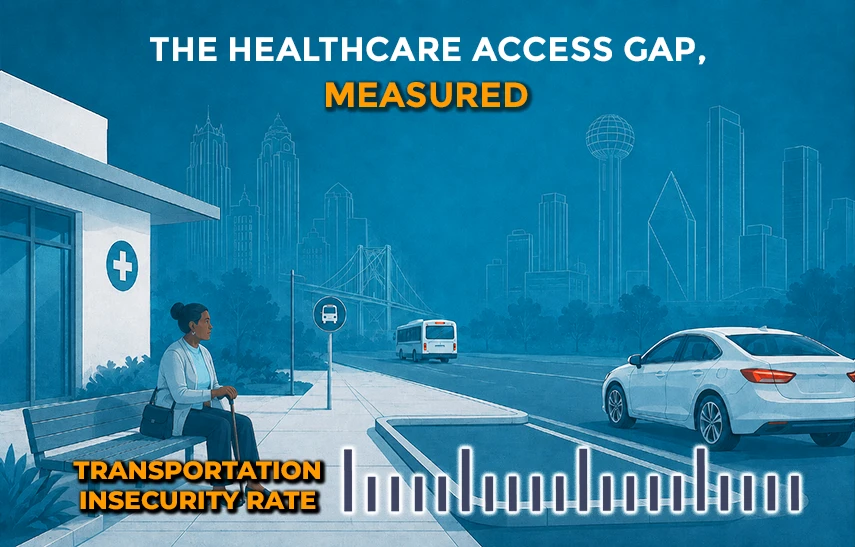
The finding. A new Michigan State University study, published in July in the peer-reviewed journal Sustainability, puts hard numbers on a problem every transportation provider already recognizes. Researchers surveyed 1,600 residents across Dallas and Detroit and found that people managing chronic illness are significantly more likely to face transportation insecurity, and that unreliable transportation is a stronger predictor of missed or delayed care than chronic illness itself.
The numbers. Using the University of Michigan's Transportation Security Index, the study found chronically ill residents concentrated in the "marginal" and "high" insecurity categories, while healthier residents clustered in "no insecurity." In Detroit, respondents with chronic conditions were about 1.75 times more likely to experience marginal or high transportation insecurity. The single strongest protective factor across both cities was not income or employment. It was access to a household vehicle. For context, separate research cited in the study found roughly 36% of Detroit residents experience transportation insecurity, more than double the national rate near 17%.
Why it matters. This is the demand case for medical transportation, written in independent data. The study measures gaps in public transit and personal vehicle access, which is precisely the space NEMT is built to fill. When the authors turn to solutions, they point directly at coordinated non-emergency medical transportation, Medicaid-funded mobility, subsidized rideshare partnerships, and on-demand service designed around medical appointments. That is the core offering for transportation providers, validated by planners and health-equity researchers rather than vendors.
The opportunity. Findings like these can strengthen reimbursement discussions and health-plan proposals by connecting transportation access to measurable healthcare outcomes. Transportation insecurity is now being framed as a structural driver of health outcomes, not a convenience issue. Providers who can document reliability, acuity coverage, and clean trip records are positioned to be the answer payers and health systems are actively looking for.
AI for Providers. Prompt of the Month: Build Your Own EVV Audit Simulator
Context. Ohio just made electronic GPS trip verification law, Iowa is increasing its focus on EVV and Medicaid program integrity, and Colorado already requires auditable electronic NEMT trip records.
Try this. Paste the prompt into Claude with artifacts enabled. Build and test with fake or de-identified data only. Never paste real member information into the chat.
"Build an interactive HTML artifact called 'EVV Audit Simulator' for a Medicaid NEMT provider. It must run entirely in-browser, store nothing, and include a 'Clear all data' button. Let me paste or upload sample trip records using non-identifying values: trip reference, internal rider code (not a Medicaid ID or name), pickup and drop-off timestamps and location values, driver code, vehicle code, and scheduled appointment time. Run each trip through common Medicaid EVV audit failure points: missing location data, timestamp mismatches, identical pickup/drop-off locations, location drift, missing driver or vehicle codes, no verification event. Score each pass, warning, or fail with a plain-language explanation, and show a dashboard with pass rate, top three failure categories, and a downloadable list of highest-risk trips."
What it does. Turns emerging electronic trip-verification and Medicaid program-integrity requirements into a self-service readiness check you can run before a broker or auditor reviews your records. Feed it your brokers, states, and typical trip volume to sharpen it, but keep it to operational details, not rider information. For more ways to put these tools to work, see our guide to AI use cases in medical transportation.
Illustrative starting point, not compliance advice. Follow your own HIPAA policies and use only de-identified data.
One Thing Worth Your Time
Most NEMT contracts start in a hallway between sessions, not a cold email. Our guide to 10 NEMT conferences worth attending in 2026 sorts the year's top events by who you're trying to reach: core NEMT (NEMTAC Transform, TTA Mobilize), PACE and senior care (NPA, NADSA, USAging), Medicaid and health plans (MHPA, NAMD, ADvancing States HCBS), and transit and coordinated mobility (CTAA, APTA, CALACT).
What's Going On Inside the Lamp
Software Updates
Advance trip confirmations, up to 30 days out. Schedule multiple confirmation calls and texts 1 to 30 days ahead, each with its own send time. The system auto-adjusts date language and cancellation keywords in English, Spanish, and Haitian Creole.
Configurable session time-outs. Adjust the default 30-minute inactivity logout up to 24 hours. Email help@routegenie.com to change it.
NTD no-show control by payer. A new per-payer setting decides whether no-show trips count toward Total Sponsored and Total Public Trips.
Reliability fixes. Google Maps outage resilience, smarter nightly auto-unassign, broker dispatch note updates, GRITS 12/24-hour time imports, and an MTM timezone duplicate fix.
Get The Genie Journal in your inbox
Medical transportation intelligence that matters, once a month. Sign up here.