
The Genie Journal, August 2026: Maine Ends Its $750M Broker Fight
Originally sent to subscribers in August 2026. Issue #08 · August 13, 2026
The Signal
This month, the through-line is access, and who is positioned to deliver it. A statewide broker fight in Maine settled, federal dollars opened up for accessible vehicles, and driverless service moved closer, though it still cannot carry a passenger who stays in their wheelchair. Technology and policy keep advancing, but the work still comes down to providers who can prove they showed up.
Contents:
- What's Moving This Month
- Deep Read: The NEMT Broker Landscape Is Changing
- AI for Providers. Prompt of the Month: Build a Stakeholder Brochure for Your Fleet
- One Thing Worth Your Time
- What's Going On Inside the Lamp
What's Moving This Month
Maine's High Court Upholds Statewide MaineCare Transportation Contract
Maine's Supreme Judicial Court on August 4 unanimously upheld the state's award of a 10-year, roughly $750 million MaineCare non-emergency medical transportation contract to Modivcare, rejecting a challenge by Penquis CAP (the Bangor-based nonprofit that had held the regional contract for four central and northern Maine counties). Modivcare won all eight of Maine's transit regions in the 2023 bidding, and the ruling lifts the pause that had held up the statewide rollout. Penquis keeps serving through December 31, 2026, and Modivcare begins covering every county on January 1, 2027.
Why this matters: The ruling marks Modivcare's recovery. A year after a Chapter 11 that erased most of its debt and took it private, the country's largest NEMT broker has defended one of its biggest statewide contracts in court. For providers, it also ends years of uncertainty over who runs MaineCare transportation, and Modivcare says it intends to partner with local providers as it expands into the new regions. That gives Maine providers a clear runway to credential and position for subcontracted volume well before the January handoff.
North Dakota Opens Roughly $2M for Accessible NEMT Vehicles
North Dakota Health and Human Services opened a Non-Emergency Medical Transportation Acquisition funding opportunity on August 11, offering roughly $2 million to help rural healthcare organizations buy accessible transportation vehicles, including wheelchair-equipped vans. The state expects to award about four grants of roughly $500,000 each. Eligible applicants include rural hospitals, clinics, federally qualified health centers, and tribal 638 facilities that are enrolled Medicaid providers in good standing. Applications were due August 19, 2026, through the federally funded Rural Health Transformation Program.
Why this matters: The Rural Health Transformation Program is becoming a real funding channel for accessible vehicles, and this is an early template other states are likely to copy. Providers that partner with an eligible rural hospital, clinic, or health center can help shape applications and expand accessible capacity without carrying the full vehicle cost.
In D.C., No Consensus on Accessible Mobility
Washington, D.C. is trying to write the rules for driverless vehicles, and accessibility is where the agreement falls apart. The District's robotaxi authorization bill, debated in a July council hearing, never mentions wheelchairs. Its only disability provision requires companies to offer an accessible app, not an accessible vehicle. That distinction matters, because there is no factory-made autonomous vehicle on the market today that can carry a passenger who stays in their wheelchair. The result on the table is a two-tier system: full driverless access for ambulatory riders, continued exclusion for people who use mobility devices.
Why this matters: The vehicles are advancing faster than the rules meant to make them accessible, and no local framework has closed that gap. For providers who own accessible, high-acuity service, the riders these fleets cannot serve are exactly the riders NEMT is built around.
The States Can't Agree, So the Federal Government Steps In
States and cities have been left to write their own rules for driverless vehicles, deciding on their own whether the cars can run without a human aboard and what they owe riders with disabilities, producing a patchwork that changes by jurisdiction. Now the federal government is stepping in. On July 30, the National Highway Traffic Safety Administration granted Amazon-owned Zoox the first commercial exemption ever issued for a purpose-built robotaxi, a vehicle with no steering wheel, no pedals, and no driver's seat, unlike the modified production cars behind today's paid services. Alongside it, NHTSA launched a three-year, $5 million consortium with SAE (SAE International, the automotive engineering standards body that defined the familiar Levels 0 through 5 of driving automation), called A2SCEND, to build the first national automated vehicle performance standards.
Why this matters: A single national framework for driverless vehicles is now taking shape, and that framework is where any future accessibility requirement will be written. Even the most advanced vehicle cleared so far cannot secure a wheelchair or provide hands-on assistance, so accessible service stays a provider stronghold. This is the rulemaking to watch, because it will define what autonomous fleets must, and must not, do for the riders NEMT serves.
A 125-Mile Wheelchair Ride to Wisconsin's Capitol Puts a Face on Medicaid Cuts
On August 6, Wisconsin advocate Carl Schulze completed a 125-mile trip in his powered wheelchair to the state Capitol to draw attention to looming Medicaid cuts and their effect on home and community-based care. Schulze, who relies on Medicaid-funded aides, warned that projected reductions tied to the 2025 federal tax and spending law could push states to trim disability services first.
Why this matters: Stories like this keep Medicaid-funded access for people with disabilities in front of the public and state lawmakers, and they make the case that accessible transportation is core infrastructure rather than a convenience. That argument works in providers' favor as budgets get debated, because the services with visible constituencies and documented outcomes are the hardest to cut. Providers who can show reliability and acuity coverage are well placed to make that case locally.
Deep Read: The NEMT Broker Landscape Is Changing
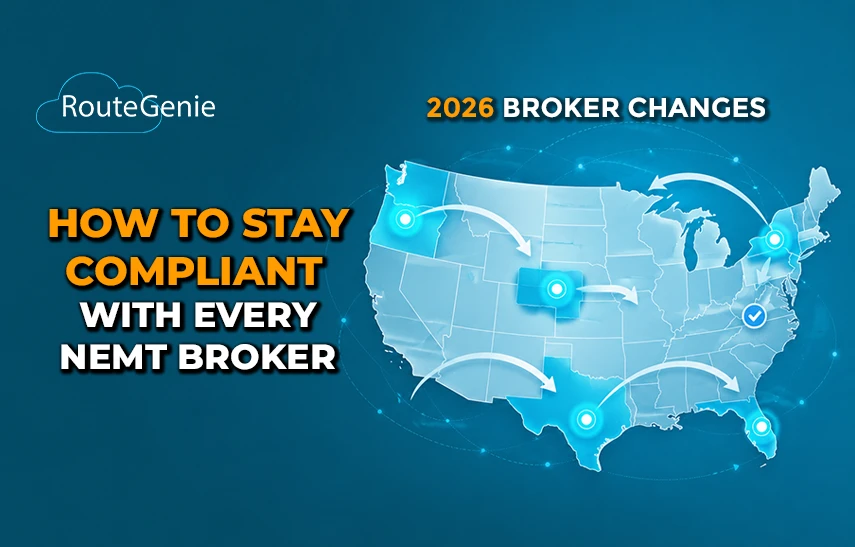
The reshuffle. 2026 has already reshuffled the major broker relationships. Georgia consolidated all five Medicaid regions under Verida, Colorado began its phased move to MediDrive starting with the Denver metro, Wisconsin signaled intent to replace MTM with Verida, and Montana named Modivcare its new statewide broker for October 1. At the same time, managed-care plans kept moving contracts on their own, with MTM Health picking up Blue Cross Blue Shield of Texas and Florida's UnitedHealthcare plan, both from Modivcare. If you drive Medicaid trips for a living, the company that assigns your work and pays your claims may not be the same one a year from now.
What changes. The guide maps the full reshuffle across both levels, statewide broker awards and health-plan vendor switches, then gets practical. It breaks down what actually changes in a transition, covering credentialing and insurance language, driver apps, authorization steps, rates, and the exact trip-documentation fields you need to get paid, and separates the parts that shift with every contract from the compliance core that barely moves. Underneath the churn sits a rising bar that matters more than any single award: states and brokers now expect electronic proof that the trip happened, through GPS data, geofenced arrival, and a complete trip record.
The play. Stop building the operation around any one broker and run a single compliance system that adapts to whoever assigns your trips next. Providers who treat credentialing and trip documentation as their own system rather than any single broker's requirement absorb a transition in weeks instead of quarters, and direct broker integrations keep trip data flowing through a switch without manual re-entry.
AI for Providers. Prompt of the Month: Build a Stakeholder Brochure for Your Fleet
Context. This month's news kept the spotlight on access, and on the fact that the alternatives fall short in different ways. Rideshare can move an ambulatory rider but cannot provide wheelchair securement or hands-on assistance, and emergency medical services can, but at a far higher cost. Your fleet sits in between, accessible and assisted at a fraction of the price, but that advantage only pays off if the hospitals, discharge planners, health plans, and dialysis centers that send you trips can see it clearly.
Try this. Paste the prompt into Claude with artifacts enabled. Fill it in with your own operational and marketing details, not rider information.
"Build a polished, print-ready one-page marketing brochure as an interactive HTML artifact for a non-emergency medical transportation company, professional enough to hand to a hospital discharge planner or health-plan network manager, with no design software or design skills required. Let me fill in my own details through simple input fields: company name, service area, number and types of vehicles (ambulatory, wheelchair-accessible, stretcher, bariatric), driver certifications (CPR and first aid, passenger assistance, wheelchair securement, defensive driving), on-time performance, GPS trip verification, hours and availability, and typical cost per trip by service level. Organize the brochure into three sections: Capabilities, what we move and how we verify every trip; Accessibility, that we safely serve wheelchair, stretcher, and high-acuity riders with hands-on passenger assistance that rideshare does not offer; and Value, our cost per trip next to alternatives, including how it comes in well below emergency medical services, and how reliable transportation reduces missed appointments and avoidable emergency costs. Use a clean, readable layout with a headline, short benefit-driven sections, a simple comparison table, and a clear contact block and call to action. Add a 'Print to PDF' button, let me switch the accent color to match my brand, store nothing, and keep every input in the browser."
What it does. Turns a blank page into a stakeholder-ready brochure without a designer or design software. It frames your accessibility and reliability advantages in the language hospitals and health plans respond to, and it is built to be updated and reprinted whenever your fleet, certifications, or numbers change. Keep it to operational and marketing details, not rider information.
Illustrative starting point, not marketing or pricing advice. Verify every figure and claim before you share the brochure with stakeholders.
One Thing Worth Your Time
A new National Rural Health Association policy paper names transportation as one of the leading barriers to healthcare for rural older adults, tying missed care to higher reliance on emergency services and greater out-of-pocket travel costs, and pointing to coordinated transportation as a core part of the fix. It is useful, independent evidence for the demand case, worth keeping on hand for reimbursement conversations and health-plan proposals.
What's Going On Inside the Lamp
See Us at NEMTAC Transform
RouteGenie is heading to NEMTAC Transform 2026. Find us at booth 228 August 16 to 19 at the JW Marriott Orlando Grande Lakes. Stop by to see the platform in action, talk broker transitions and trip verification with our team, or just say hello.
RouteGenie on the SourceForge Podcast
CEO Cameron Craig joined host Beau Hamilton on episode 130 for a wide-ranging conversation on why getting people to the doctor has become a frontline healthcare issue. They dig into transportation as a social determinant of health, why NEMT stayed on phones and paper for so long, and where GPS verification, route optimization, and AI are actually moving the needle for providers.
Software Updates
New Uber Health integration. RouteGenie now connects directly to Uber Health, so trips you would otherwise turn down can go out the door instead. When your own vehicles are full, assign the trip to your Uber driver group using the same assignment workflow your dispatchers already know, with no second system and no separate login. Uber statuses map to the statuses your team already works from, and the Uber Trip ID appears right in trip details. Reach out to your account manager or Customer Service to get connected.
Expanded passenger language support. Passengers can now choose from 15 languages instead of 3, and that preference follows them through the whole trip, including handoffs to external brokerages. The dropdown is alphabetical with English as the default, and the languages supported by automated calls, English, Spanish, and Haitian Creole, are flagged with a phone icon.
Get The Genie Journal in your inbox
Medical transportation intelligence that matters, once a month. Sign up here.