
NEMT Software Pricing: What It Costs and How Vendors Actually Charge
NEMT software prices typically start at $50 per vehicle per month. The upper limit on the other hand is harder to pinpoint, because cost depends on the vendor's pricing model and what's bundled into the plan. While single-van NEMT providers and smaller medical transportation fleets can start at $50 per vehicle on a transparent, month-to-month basis. Established fleets usually run custom-tailored plans with in-depth reporting, more vehicle licenses, broker integrations, and active modules, which can push the per-vehicle cost to $250 and above at the enterprise level.
This guide walks through the pricing models you'll encounter, the factors that move the monthly bill up or down, and how to match a quote to the way your fleet actually runs.
Contents:
- How Much Does NEMT Software Cost?
- The Main NEMT Software Pricing Models You'll See
- What About Setup Costs?
- Which NEMT Software Pricing Model Should You Choose?
- What This Means for Your Next Software Decision
How Much Does NEMT Software Cost?
The honest answer is that it depends solely on the extent of the software capabilities an NEMT business needs. Moreover, the range is wide because vendors do not price their services equally. One quote will have a bundled set of features with scheduling, dispatch, broker integrations, and billing in a single number. Another quote shows a low per-vehicle rate and bills each item separately. Comparing the two on sticker price alone is comparing different products.
That's why two operators with identical fleets and identical trip volume can end up paying very different monthly totals. Let’s take a look at the major variables that drive the pricing difference.
Factors that determine the cost of NEMT software
Fleet size is the major determinant. The more vehicles you run, the more software licenses you will need monthly. On per-vehicle plans, this means a growing monthly bill every time a transportation provider expands the fleet.
Feature set sets the price ceiling. The core platform handles scheduling, dispatching, and basic reporting. Traditionally, real-time GPS, automatic dispatching, advanced billing, broker integration (EDI), and passenger experience tools cost extra.
Level of customer support can reshape the bill. Standard support is included on most plans. White-glove VIP support, dedicated account management, after-hours coverage, and in-person training typically come with higher-tier plans.
Software customization is the wildcard. It is easier for vendors to offer rigid solutions for all customers. Adapting workflows, building custom reports, or developing integrations specific to a state Medicaid program adds hourly development time. However, some software platforms are willing to aid their clients and develop custom features.
The cleanest way to think about NEMT software pricing is to start with the model, not the price. These are the pricing models that cover most of the market.
The Main NEMT Software Pricing Models You'll See
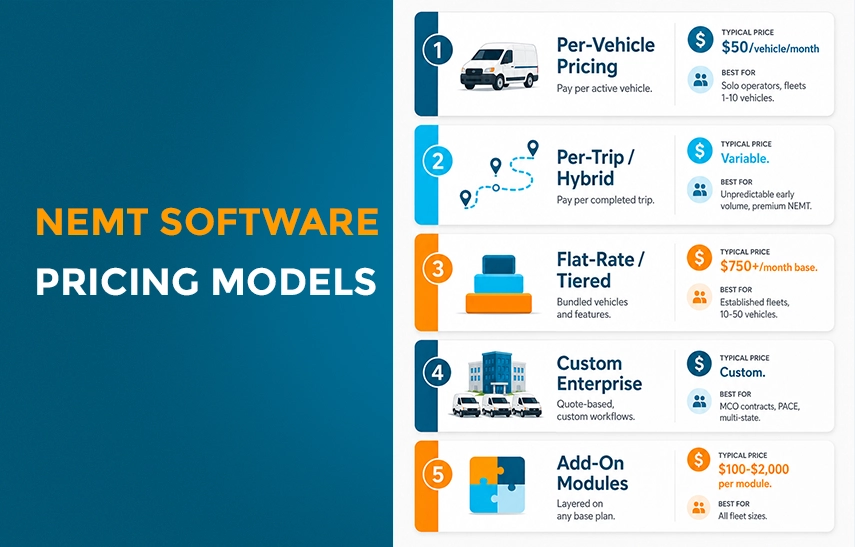
Per-vehicle pricing
The most common transparent model. You pay a fixed amount for every active vehicle, regardless of trip volume. Predictable, easy to forecast, and the cleanest fit for fleets that want a flat monthly number tied directly to fleet size. The base rate covers the core platform: scheduling, dispatching, and basic reporting. Most vendors let users layer optional modules on top, so the bill scales with the operating model rather than ahead of it. RouteGenie's Growth plan works this way: $50 per vehicle per month, month-to-month, with no setup fee on the base software and no vehicle minimum. Broker integrations, auto-dispatching, communication suites, and passenger apps are individually priced add-ons. You get the essentials and pay for extras only if you need them.
Per-trip or hybrid
Some vendors charge per completed trip, either as the primary model or as a per-trip fee stacked on a base subscription. The math looks attractive during a ramp-up. But once the company reaches a greater volume of trips, it compounds quickly. This per-trip rate can effectively become a tax on growth.
Flat-rate / tiered pricing with add-ons
Within this model, a customer pays a base fee that covers a defined set of vehicle licenses, trip volume, and a core feature set. If the client surpasses the limits or requires features that are not included in the plan, they can upgrade the plan or pay separately for additional vehicles, trip allowance, or feature depth. The model fits established medical transportation fleets that want a predictable monthly bill with a larger set of default features. RouteGenie Pro uses this structure: a $750 monthly base fee that includes 15 vehicle licenses. Support is white-glove, while broker integrations, integration setup, and automatic dispatching are included in the base fee. Additional vehicles are priced at $50 per month, and there is an extensive range of feature addons like Facility Concierge Portal or WhatsApp Integration.
Custom enterprise
This is a quote-based pricing aimed at larger operators, MCO contracts, and PACE programs. Larger contracts can require special pricing terms and additional software features. NEMT software developer like RouteGenie serves this segment too. Customers can request a quote for special software tweaks to accommodate their in-house workflow or unique state rules. This software configuration and flexibility are essential to meet the enterprise-level requirements.
What About Setup Costs?
The monthly subscription is rarely the whole picture. Most NEMT software vendors charge one-time setup fees on top of the recurring bill:
- Broker integrations: around $100 per integration
- Add-on modules (auto-dispatching, private pay, portals, communication suites): roughly $250 each
- Clearinghouse connections for billing: about $100 per payer
- White-label passenger apps: in the $2,000 range
- On-site training and launch support: from $1,000 for virtual onboarding
- Custom development: hourly, typically $150 to $250
These costs aren't hidden; they live in every vendor's contract. But they explain why the total first-year cost can look very different from the monthly sticker price. A useful budgeting rule: assume setup runs one to three months of subscription for a small fleet, three to six months for an established fleet rolling out the full feature set.
Which NEMT Software Pricing Model Should You Choose?
We have established that medical transportation fleet management software usually starts as low as $50/month per vehicle and can go significantly higher depending on the complexity of the operation. Choosing the correct pricing model is vital to keep the software expenses at bay while also getting access to the advanced software features that can significantly increase the efficiency of your business. It might sound counterintuitive, but when it comes to NEMT software, sometimes spending more means earning more. So here is the clear breakdown, which pricing models fit which NEMT fleet:
- Solo and small fleets (1–10 vehicles). Per-vehicle plan with optional add-ons. Low base rate, short contract, features turn on when the business needs them.
- Established fleets (10–50 vehicles). Flat-rate or tiered plan with add-ons. Bundled features and a predictable monthly number, with caps to watch on trip allowance and feature gating.
- Providers with lower trip volume. Per-trip pricing works well as a temporary entry point while trip volume is still unpredictable. It can also suit lower-volume, higher-margin premium NEMT services. This value-based NEMT model requires more vehicles on the road completing fewer trips per vehicle, so paying a license fee for each one can cost more than a per-trip scheme.
- Large operations (MCO, PACE, brokers, multi-state). Either a quote-only enterprise platform or a flat-rate plan extended with custom development. The second path keeps pricing transparent while still delivering the integrations and workflows these contracts require.
What This Means for Your Next Software Decision
NEMT software doesn't usually break a fleet's budget on its own — fuel and driver wages cost more. The risk is in picking the wrong model and paying for things you don't use, or skipping the things you actually need. The right plan, matched to how the business runs today, tends to pay for itself inside a year through saved dispatcher time, recovered claims, and trips completed without buying another van.
The fastest way to know which model fits is to put the numbers against your fleet, your broker mix, and your trip volume. Book a RouteGenie demo and the team will walk through the plans, show how the add-ons work, and quote a configuration that matches what you actually do.
About the author


Yurii Martynov is the Marketing Director at RouteGenie, the leading software platform for medical transportation. With years of experience in the NEMT industry, Yurii leads brand strategy, demand generation, and go-to-market efforts that help transportation providers and brokers discover the tools they need to grow. Working closely with NEMT providers, brokers, and healthcare organizations has given him a deep understanding of the challenges facing the industry. He writes about NEMT operations, healthcare transportation trends, and the evolving role of technology in connecting patients to care.